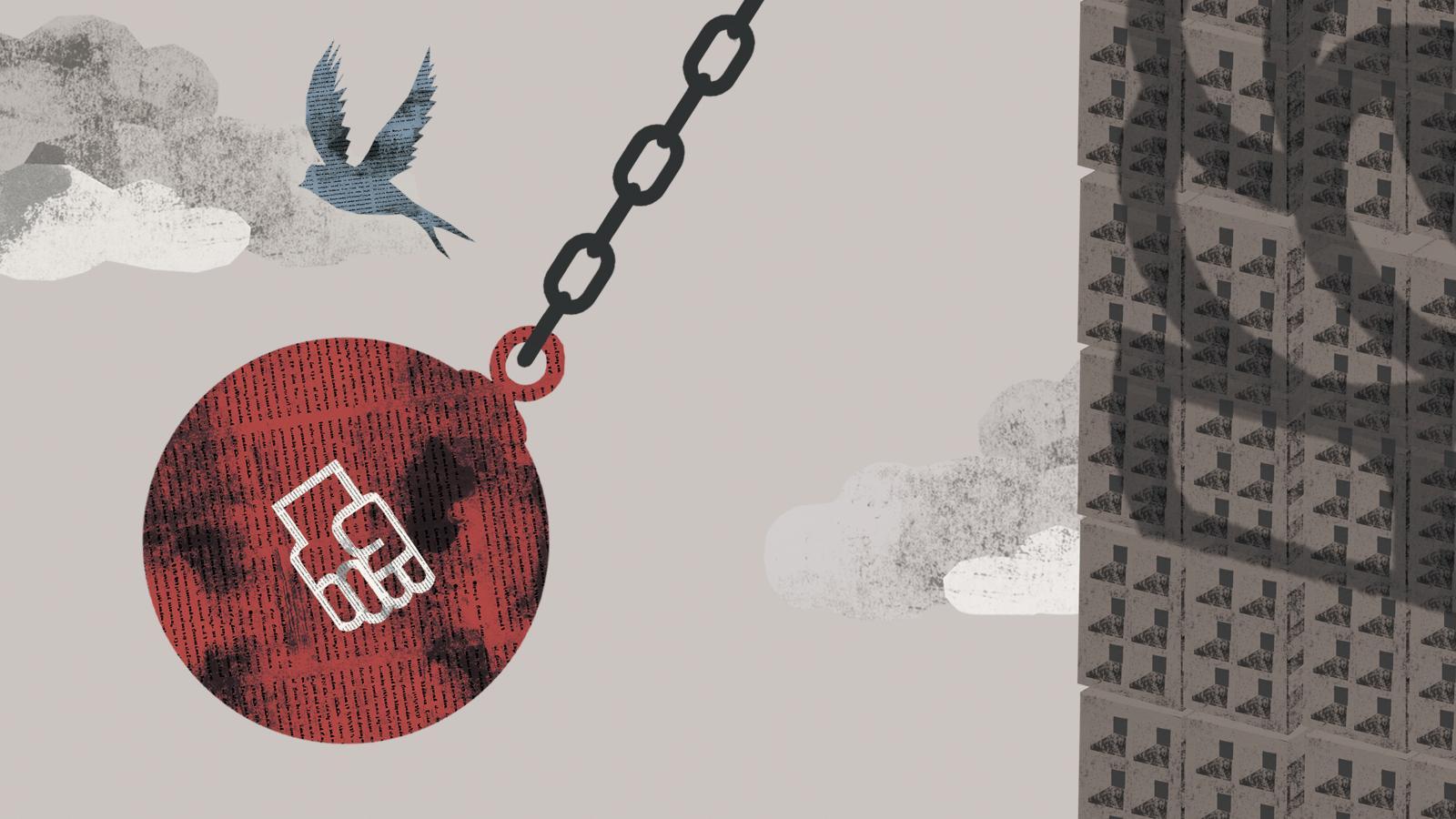

Government changes in Spain go through processes of demolition. They seem like regime changes, and sometimes they even are. I'm not talking about the virulence of political confrontation. Internal struggles within and outside parties do not make Spain unique. No, what makes Spain unique is an unfinished territorial architecture that always threatens to be demolished or reconfigured. It is this unresolved issue and the bloody expression of ideological difference that turns politics into a battlefield.
The fury that is being experienced in Madrid these days is difficult to temper and emotionality further complicates sifting the wheat from the chaff of judicial proceedings. The cases against the PSOE and the entourage of the head of government are described by one side or the other as a sign of generalized corruption or a kind of coup d'état. The fact is that Pedro Sánchez's resistance is numantina, judicial credibility is faltering, the socialists will go through the courts, the Kitchen case demonstrates the modus operandi of the PP, the digital outlets of the rebellion cash in with every leak, and the ranks of unconditional supporters of one side and the other are consolidating against the adversary, who is, of course, treated as an enemy.
The big question for analysts is whether Sánchez will resist in Moncloa in the coming months without calling elections, and the answer is yes. Sánchez knows that everything is susceptible to worsening and is convinced that the undisguised objective of some politicians and part of the judiciary is to put him in prison. The socialist has gone too far for what the deep state of the establishment (from Aznar to Felipe González) can tolerate. He not only signed an amnesty (vetoed by the courts), but he was also elected with the votes of Catalan and Basque nationalists and independentists.
The socialist environment tries to hide the difficult situation of responding to the Zapatero case with the hope that the case will have some explanation and that summer and the World Cup will arrive to dilute the harsh news. Meanwhile, they are trying to recover from the shock left by the writing against "bambi Zapatero". The ruling is not conclusive about the criminal activity of the former government president, but it has left many unanswered questions open (the jewelry or the role of the daughters and the friend as fronts), and allows, at a minimum and in good faith, to glimpse an indefinite action between lobbying, commissionism, and influence peddling. At least, in the absence of other criminal conclusions, Zapatero the Virtuous thought he could act as a diplomat with complex countries like Venezuela and China and at the same time do business thanks to his knowledge of the fine print of the administration. Just as independentism was naive in underestimating the power of the State, it is hard to believe that a former Spanish government president was also naive to the extent that many who know him attribute to him today. Many socialists prefer to think that ZP is naive but not corrupt, but neither Judge Pedraz is just anyone nor will twelve hours of police "requesting" information at the PSOE headquarters for the Leire case be harmless. It remains to be seen what will emerge from the socialists' finances and whether it can be proven that the party worked and paid to demonstrate the PP's dirty war.
Sánchez has been on the countdown for a while now, but now the time to decide whether to go for a super Sunday of municipal and general elections or to maintain the difference between the calls has accelerated. What does not seem to be an option is a motion of no confidence. The PP knows it would not win it because it does not have the necessary support from Catalan and Basque nationalists, but it also lacks the courage to present a motion to gain political benefit and project an alternative image without Vox. The order among the Populars is rather to play dead politically, not to confront beyond the media and wait for victory to fall in the elections like ripe fruit.
The partners hope that, after the Andalusian elections, the PSOE will manage to close some of the pending issues (Catalan, amnesty, immigration powers, financing model). The investiture partners were so by forming an alliance against the PP and Vox, and they remain here. They do not want to identify too much with the socialists, but they also do not want to be responsible for their fall, which could mean an electoral victory for the right, which would come to power conditioned by the far-right.
In this way, the possibility of a change of government, of a simple change of government, fades away, and the demolition of the system, of the institutions, deepens. The change is made with all the forces of the deep state trying to demolish socialism and is read as a change of regime that threatens a non-homogeneous and unitarian Spain. The result, for the moment, is the erosion of democratic institutions.
