Barça makes Rodri's signing official: "He will not need adaptation"
The Barça club announces the incorporation until 2030 of the pivot who comes closest to Sergio Busquets
-
CAT -
CAST
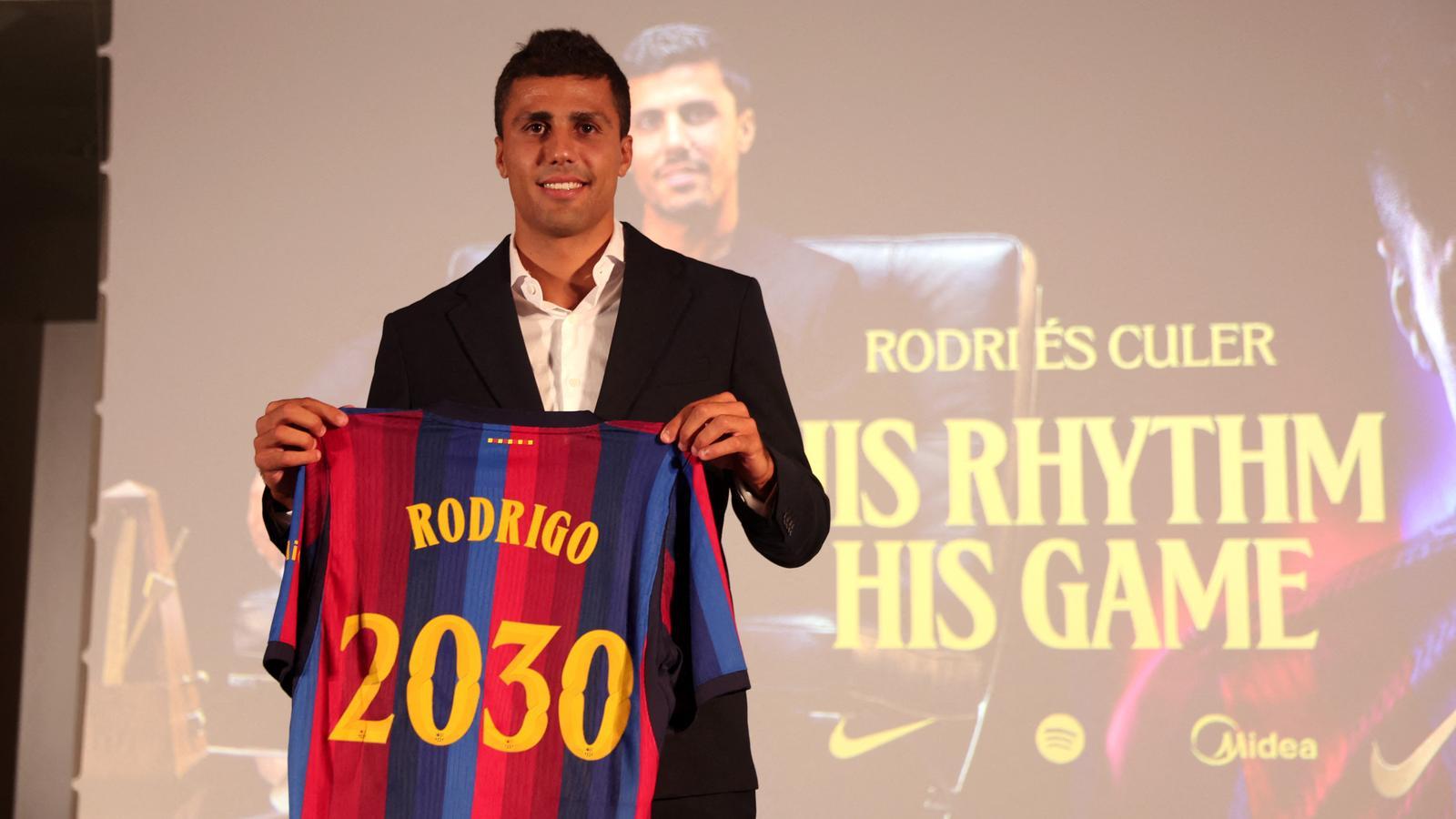
BarcelonaIf in the most glorious eras of contemporary Barça, the leader of the midfield was Sergio Busquets, now the Catalan club has not only strengthened itself with a Ballon d'Or winner and the best player of the World Cup, but also with the figure who most closely resembles Sergio Busquets: Rodrigo Hernández is now officially a Culer. Barça will pay Manchester City a transfer fee of 60 million euros fixed, 11.5 million in easily achievable variables (such as, for example, depending on the games played in the League) and another 5 million euros in case of winning the Champions League. The Madrid-born defensive midfielder has signed until 2030.
Rodri had decided he wanted to leave City this summer, so he was willing to listen to offers. He asked for an unattainable figure (20 million euros net annually) to renew, aware that it was impossible for the sky-blue team to accept it. He let Real Madrid court him, but Florentino Pérez was not willing to make a great economic effort to buy him. That was when Barça entered the scene. The player was clear: he prefers to play for Hansi Flick and with the bulk of his teammates from the world champion Spanish national team.
"It's a very special day for me. It has been a difficult decision. First, to leave City, where I have been very happy and to which I will be eternally grateful. Also to make my departure possible," Rodri began at his presentation. "I have chosen Barça, for its football and its values. I had other options [Real Madrid], but Barça was my first option." He also referred to Hansi Flick: "I have spoken more with Deco and Jan [Laporta], but I consider him a transparent person, who tells you things straight." Rodri, in a brief appearance, concluded that "Barça is getting closer and closer to winning the Champions League".
Rodri's fit at Barça
The fit of the Madrid native at Barça seems destined to work. Carles Planchart, who has spent a good part of his professional career as an analyst at City, knows him well. The Catalan coach, in conversation with ARA, has no doubt that "he is the profile that Barça needed to give it balance between offensive and defensive transitions". "Barça has a midfield with very offensive, not very physical and not very defensive players. That's why Eric, when they put him as a defensive midfielder, balanced the team more defensively. Especially in the Champions League, when you compete with teams with great physical power or man-to-man defenses, Barça has suffered and Rodri will help a lot here".
For his part, the former Olympic athlete Martí Perarnau and author, among others, of books analyzing Pep Guardiola's football work, believes that Rodri will fit into Barça from the first minute: "He is the type of player who hardly needs to adapt to Barça's game because he understands it perfectly. He has practiced it for years at City, which is an identical concept, played with its own nuances because the players are different, but that's all. He has played it for the Spanish national team, full of Barça players." Perarnau warns, however, that he is a footballer – and even more so after the last intervention on his back after the World Cup – "diesel": "He needs matches, minutes, mileage and little by little." Rodri has said that he "is already ready to play".
Sergio Busquets' successor
The comparison with Busquets is recurrent. "Busquets, for Barça's game, at that moment of Pep's, was the key piece –Planchart assures–. There were few people who had a 360-degree vision and such clear control of the game and the tempo of the match. But football has changed and we are talking about a very high physical demand. Before it was a lot about finding spaces, about reading where they were and now, the physical demand implies almost athlete's conditions", expresses the analyst. "It is a privilege that they compare me to Busquets. We have characteristics in common and also differences. I have always admired him. He is a friend, a teammate and, above all, a great reference", Rodri said at his presentation.
Perarnau adds: "By role, they are two very similar players, who structure the game. However, by characteristics, they are different. Busquets was a player who understood that by staying still and away from his teammates he best organized the game. On the other hand, Rodri has a tendency to move a bit too much and, in any case, to move more than Busquets. Surely if we looked at the kilometers run by Busquets, they were a normal average. With Rodri, the accumulation of kilometers throughout the match is much higher." The writer concludes that this is a difference in "essence" of the two pivots, but qualifies that the Premier has had an influence: "Because more kilometers are run in general".
Pep Guardiola had to work a lot with Rodri
Planchart explains how Rodri became one of the best players on the planet. "Pep has made him better because he plays in the position where he was a specialist. He has helped him to improve a lot in aspects such as game interpretation and positioning and in reading football: knowing whether to receive the ball or if it is better to move away to create space. Fundamental concepts for a pivot in teams like City, Barça or the Spanish national team".
Guardiola evolved Rodri and Rodri evolved City. "He arrived very young, at 23 years old. He arrived as Fernandinho's replacement and Rodri's first two years were weak. He struggled to adapt after Villarreal and Atlético de Madrid. He tended to resolve football situations through physicality – Perarnau explains – and they had to work hard, Pep and the entire technical staff, to make him understand the positional midfield concepts that Pep wanted. And he has ended up being a crucial, decisive player. In fact, when he injured his cruciate ligaments, City's decline began. It was structural".

Mourinho reveals the reason why Madrid discarded Rodri
José Mourinho has revealed that Real Madrid made an offer to Rodri before the midfielder ended up choosing Barça, but that the footballer's indecision caused the white club to lose interest. "The doubts Rodri has had have generated doubts in me", explained the Portuguese coach in an interview on El Chiringuito. The Portuguese assured that he spoke "a couple of times" with the player and that Madrid presented him with "an important offer", although he did not end up negotiating with Manchester City.
The coach considers that the player's mentality is decisive for wearing the white shirt. "Madrid is of a dimension that cannot have players who think twice. If you contact them, the player must ask you when he should come", he affirmed. At the same time, he defined Rodri as "an extraordinary and very correct player" and wished him luck at Barça, although he qualified with a laugh that he hopes he doesn't do "too well". Furthermore, he also ruled out that Madrid needs to make more signings this summer. "I don't miss Rodri. We have solutions, we have quality and a finished squad", he sentenced.
