Case Noelia: euthanasia, on trial

-
CAT -
CAST
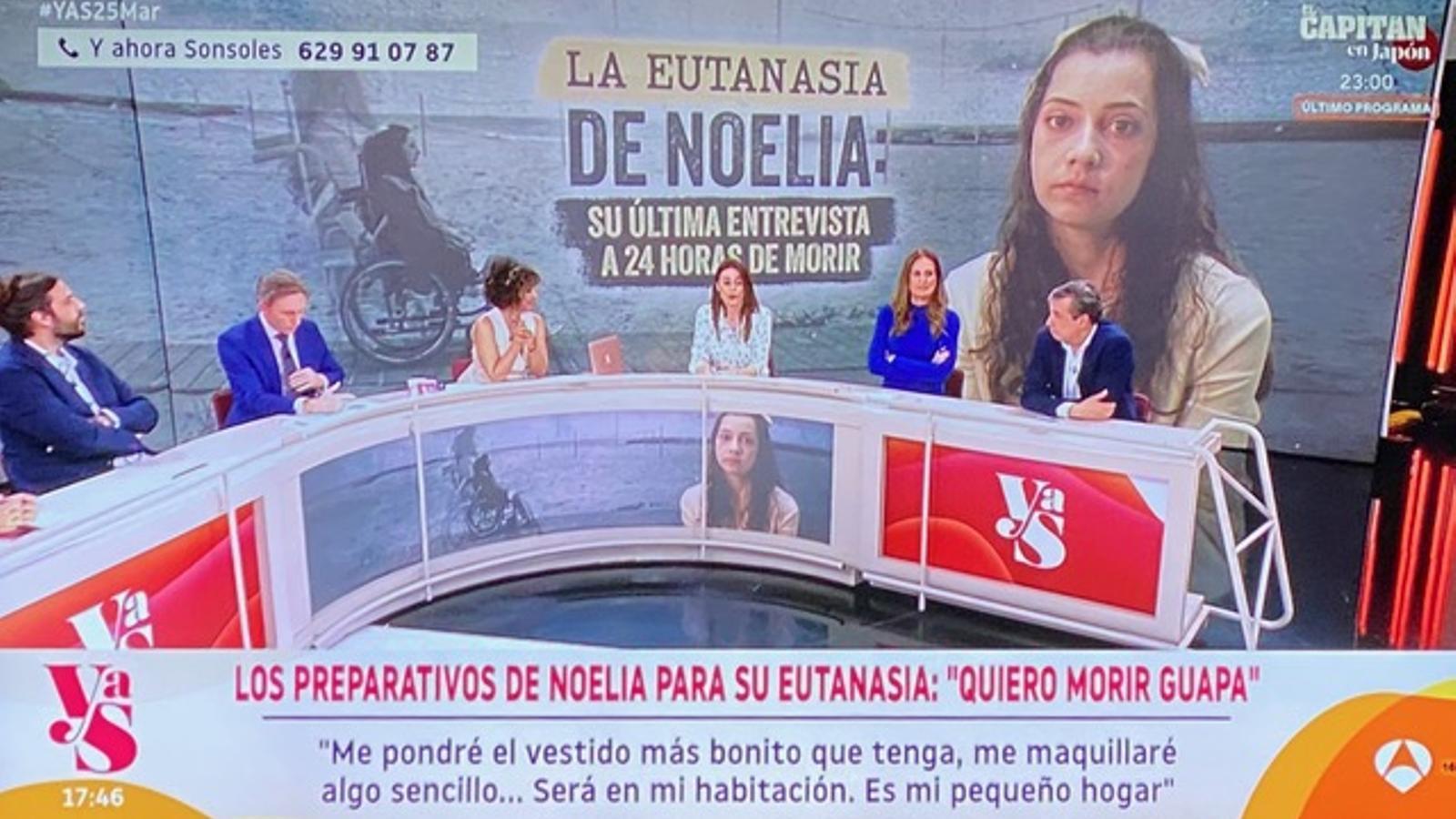
The verbs to live and to die are conjugated differently in people's lives. There are those who have an easy life and a difficult death; those who drag out a hard life but find a peaceful death. The lucky ones, for whom both life and death smile, and the unlucky ones, for whom living is very difficult, and dying too. In this last combination lies the experience of Noelia Castillo, the 25-year-old young woman who finally, on Thursday, was able to access euthanasia after almost two years of judicial ordeal, fueled by her father's opposition and the offensive of Abogados Cristianos (Christian Lawyers), a group much closer to doctrinal militancy and ultra-conservative activism than to Christian compassion.This case obliges us, first of all, to reflect on what happens when a legitimate moral belief, such as the sanctity or inviolability of human life, ceases to be an intimate conviction and becomes an ideology of combat in the public sphere. Every democratic society must respect people who, for religious or philosophical reasons, reject euthanasia for themselves. What it cannot accept, however, is that religious beliefs —or the groups that instrumentalize them— seek to impose their creed on everyone. Beliefs can be proposed, but not imposed. The judicial crusade against Noelia is nothing more than an attempt to forcibly prevail a certain moral vision, blessed by sectors of the extreme right and channeled through the courts to generate media noise, intimidate, and attack the government of Pedro Sánchez.The second issue that this case highlights is the application of euthanasia in the psychiatric field. Noelia had a mental health disorder, and the spinal cord injury she suffered was a consequence of a suicide attempt. It should be noted, however, that euthanasia was not granted to her solely for psychiatric reasons, but also for the irreversible physical injuries she presented, which caused her intolerable physical and psychological suffering. Even so, her mental pathology has been used to try to discredit her decision. The controversy in this area is intense. Opponents of euthanasia maintain that it is very difficult to know when psychological suffering is truly irremediable, to establish whether the desire to die is an autonomous decision or a symptom of the illness, and to ensure that euthanasia does not become, in practice, a form of medically facilitated suicide. Proponents, on the other hand, recall that severe and continuous mental suffering can also become devastating, refractory to treatments, and incompatible with a minimum threshold of quality of life. They argue, therefore, that excluding these patients from the outset is not an act of prudence, but a form of paternalism that discriminates against them, as if their pain were less important. And they argue that, with rigorous evaluations and an exhaustive exploration of decision-making capacity, the answer cannot be an automatic prohibition. In any case, to avoid concern, it should be kept in mind that not excluding these patients from the outset does not mean they should necessarily be admitted.

There is still a third particularly relevant element. The irruption of third parties in a radically personal decision. What this long legal battle has established is that neither family members nor groups external to the affected person could alter her sovereignty nor delegitimize the work of professionals and the final decision of the Guarantee and Evaluation Commission. And this is important not only for Noelia, but for society as a whole, because it is now being decided whether the family members of an adult patient with full capacity can intervene to prevent the application of a medically approved euthanasia. All judicial bodies that have ruled on the appeals filed against Noelia's decision reinforce the idea that the euthanasia law is not, in any case, an improvised or permissive mechanism, but a rights-guaranteeing, demanding framework subject to strict controls.Those who on Thursday brazenly gathered in front of the health center where Noelia's euthanasia took place, positioning themselves as self-proclaimed guardians of life, and the media that have served as their loudspeaker for these two years, did not want to save the life of a 25-year-old girl. What they wanted, and what they have wanted for a long time, is to condemn us all to the degradation of democratic and humanist values, and to reimpose an authoritarian morality on the lives of others.