'We have a pope'

-
CAT -
CAST
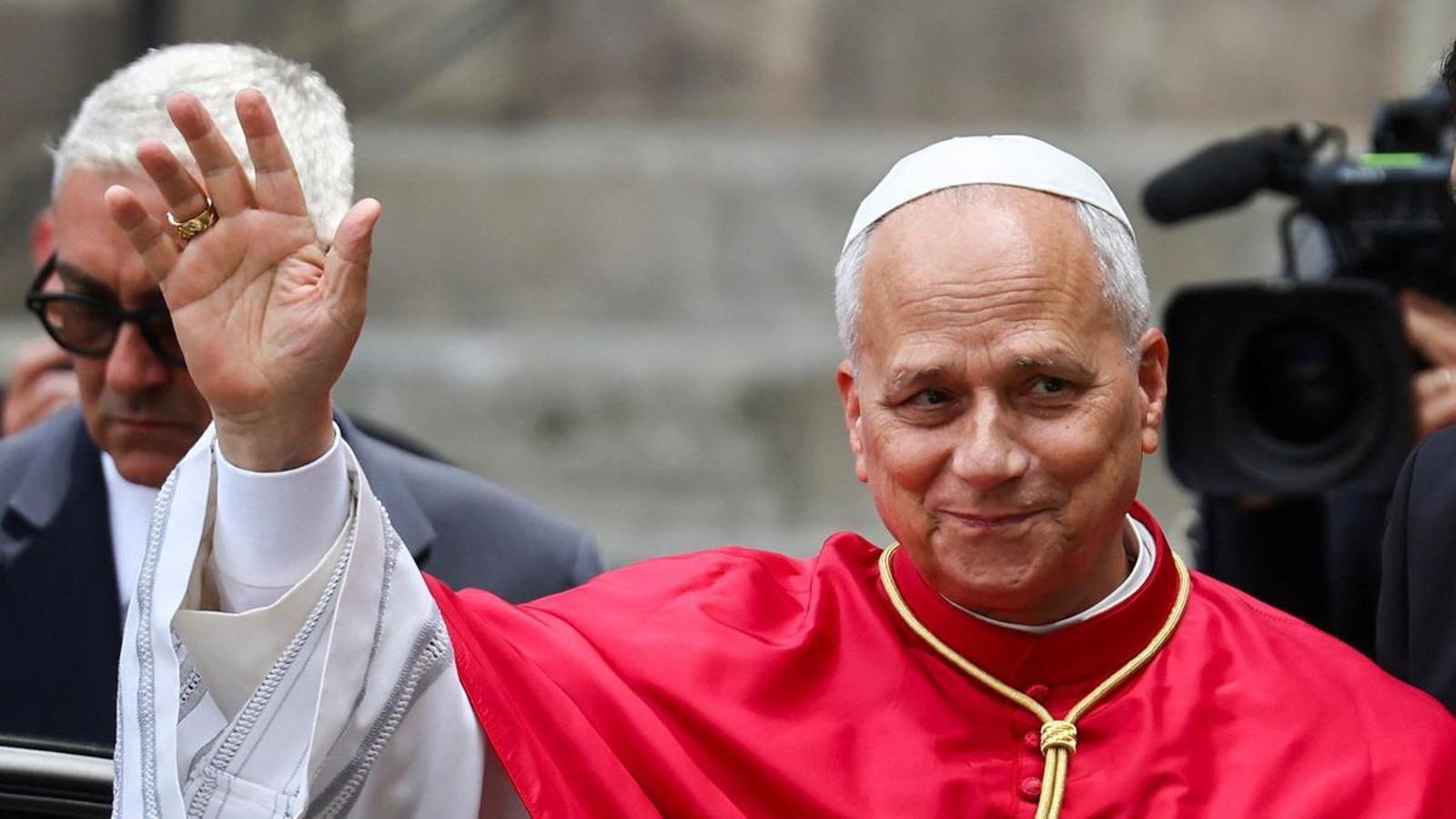
Besides the religious and political factors, the Pope's trip has had a spectacular media impact, to be studied academically; this is the space of the Reader's Advocate. I have received two complaints on the matter. The subscriber Teresa Maria Castanyer, who identifies herself as a linguist and interested in liturgy, begins with this phrase: “I am sorry to observe that there are often errors in information about topics of the Catholic Church”. And she gives very clear examples. Writing “cupons” (coupons), placed in quotation marks, instead of “copons”, that is, confusing lottery tickets or shares with the “valuable metal vessel in the shape of a cup for keeping the consecrated hosts” (IEC). The sender states that the error was corrected in the digital version. She also expresses that, in a photo caption, we say that Leo XIV was at a mass when in reality he was at the Vatican window praying the angelus. Finally, in another photo, we make cardinals of prelates who were not, based on a misinterpretation of the solidi. “These kinds of things –concludes the subscriber– denote a certain carelessness, little interest in providing accurate information. And I am sorry, because if I notice more errors than I would like in topics that I know... How many errors must I not detect in other topics?”Teresa Maria Castanyer is right. Journalism must be able to translate technical languages and transmit them correctly to readers, it is an ancestral divulgatory function of the profession. Liturgy is a non-verbal language loaded with meanings –Romano Guardini explains it in The Spirit of the Liturgy (Pòrtic, 2011) – and, faced with a media challenge of such magnitude as the papal visit, the media could have been more careful with ritual vocabulary and its hermeneutics.Xavier Albertí draws my attention to an Aena advertisement “with language that I don’t find appropriate enough”; he quotes and comments: "«Spain, meeting point. Four stops, one single destination (Madrid, Barcelona, Gran Canaria, Tenerife)». The text, intentionally or not, refers us to the well-known slogan of the unity of destination in the universal» and, at the very least, has an evident integrating and integrationist tone. Could the newspaper have saved itself from publishing it?"The CEO, Pablo Casals, responds to the reader: “At L’ARA, we clearly distinguish between editorial content and advertising spaces, which are the responsibility of the advertisers, but these spaces always go through a prior filter on the type of advertiser, product, or service advertised. This means we do not accept any advertisement: we have red lines linked to legality, non-discrimination, the absence of hate speech, respect for fundamental rights, and coherence with basic coexistence values. In fact, on other occasions, we have rejected advertisements or asked for them to be modified when we have considered them inappropriate for our medium, for example in areas such as gambling, dating, or certain services linked to addictions or practices not well aligned with L’ARA’s values. In this specific case, we understand that the reader may view it critically or feel uncomfortable with it, but we did not consider that the advertisement crossed any of these red lines in a clear manner”.The Pope as a media phenomenon is so evident that from the outset he has achieved hegemony – with non-ecclesiastical license from Antonio Gramsci – in most of the media. A mass leader who mobilizes crowds, with different scripts, dramaturgy, sets, scenography, costumes, actors... Without two thousand years of history, this ceremonial superproduction would be unthinkable, which culminated in the masterful audiovisual demonstration of the Sagrada Família, due, among others, to the director Paulí Subirà, the artistic director Igor Cortadellas, the composer Daniel López Pradas and the maestro Josep Pons, one of our great orchestra conductors, first-class artistic contributions. That ARA has managed the topic appropriately is evidenced by the mere two reported complaints and very few critical comments in the direct coverage of the digital articles. I emphasize, therefore, that our journalistic treatment of the papal visit has been factually correct, without falling into either the hooliganism that Mònica Planas properly points out regarding television, or into contempt, and that the opinion articles have offered a diverse range of visions of a topic that has always given rise to much controversy, between the opposite poles of our most ingrained anti-clericalism and the no less ingrained fundamentalist moralism. João Borges, editor of the opinion section, has counted about thirty articles, starting with José María Brunet's first one, "The Pope's visit and the virus ship" (May 9th). An exact figure is not necessary because there are pieces of interpretative journalism that border on information and opinion, and three editorials have been included in the tally, and not the three articles on the encyclical Magnifica humanitas signed by Ferran Sáez Mateu, Sebastià Alzamora, and Peter Singer.I have missed, however, enough journalistic echo from the civil part, which would have been a countermeasure for those who may have become imbued with the truce to the non-confessionality of the State proclaimed by their own representatives according to their political interests, based on who knows what constitutional interpretation that can absolve – let's say it ad sensum– their actions. I mention civil arguments:– its performance. I mention civil arguments:Le Monde, 1963, or the closure of intellectuals and artists in 1970, against the death penalty. The Pope enters Barcelona through the cathedral, from where the demonstration of priests against torture in 1966, harshly repressed, emerges. The Pope goes to Sant Agustí, where in 1970 the Assembly of Catalonia is constituted, the main unitary body for the fight against the dictatorship and for political and national freedoms. And the Sagrada Família is called Gaudí, but a very important interpreter of it was the architect Jordi Bonet Armengol, who directed the works for almost thirty years and was also a builder of Catalanism of great substance.All this has fallen out of focus, although the Catalan issue, unfortunately, has resurfaced “the Catalan problemAll this has gone out of focus, although the Catalan issue, unfortunately, has resurfaced “Monsignor Antoni Maria Oriol, who was a professor at the Faculty of Theology of Catalonia, collected and commented on more than nine hundred texts from contemporary pontifical magisterium on the national issue (Albert Bonet Foundation, 2014). The volume emphasizes the cultural factor that is based on language and that the Church has taken into account at least since the Second Vatican Council, which allowed religious celebrations in vernacular languages, and that John Paul II, the most traveled pope, developed and defended over a million kilometers and the twelve languages he spoke: the theological concept of "inculturation", which is the interpretation of Christianity according to each culture. The Reader's Advocate takes note of doubts, suggestions, criticisms, and complaints about the newspaper's content in its digital and paper editions, and ensures that the treatment of information is in accordance with deontological codes.To contact the Reader's Advocate you can send an email to eldefensor@ara.cat or record a message of no more than one minute to the WhatsApp number 653784787. In all cases, identification with name, surnames and DNI number is required.
