Why did the ship's boatswain climb to the top of La Rambla?
The Royal Academy of Sciences and Arts of Barcelona: clocks and much more
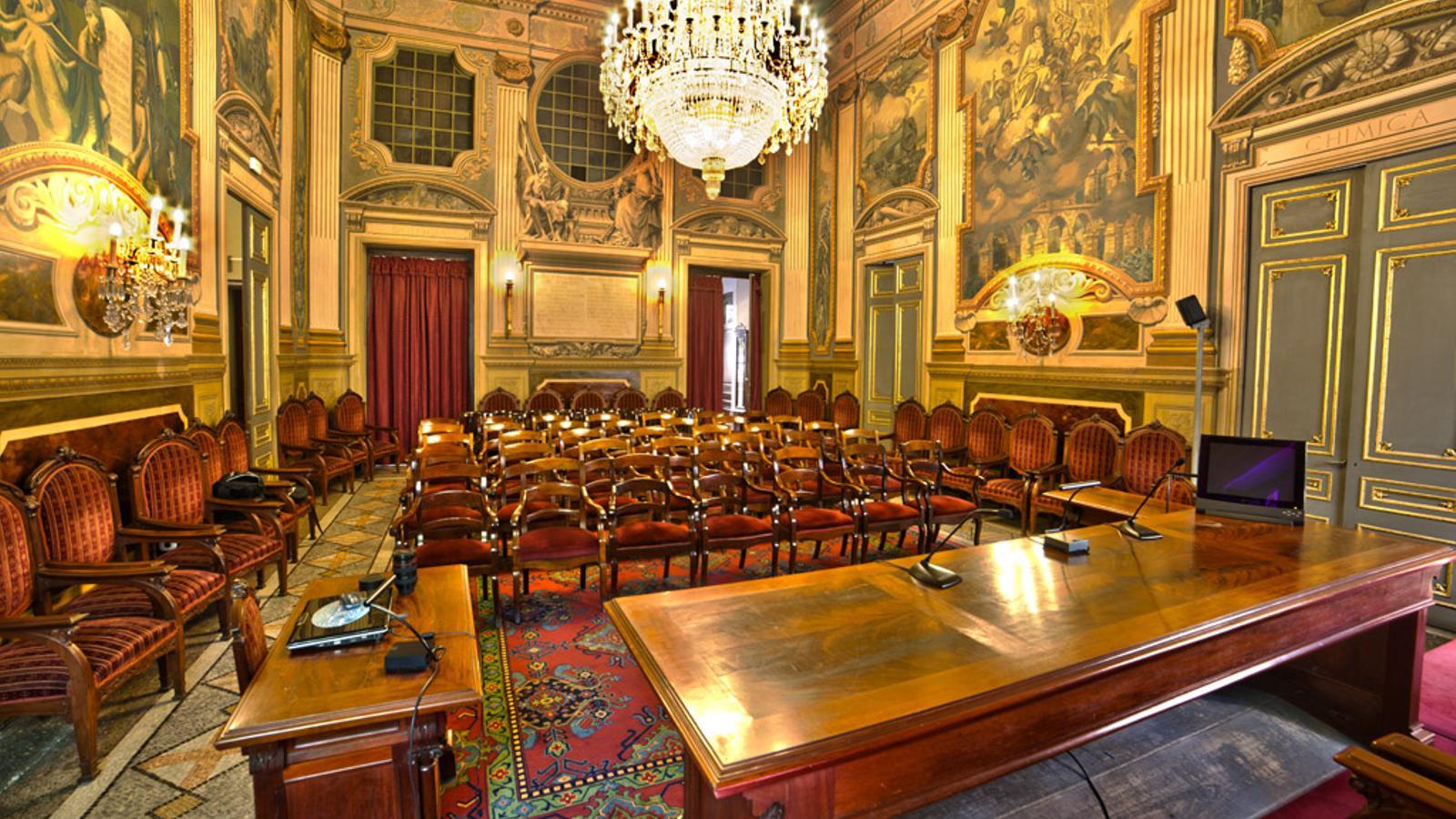

For a long time, watches have been in decline, on wrists, in public buildings, and in so many other places. Mobile phones tell the time and, of course, they have sentenced them to death. But not entirely. There are survivors. One of the oldest that continues to tell the time is found on Barcelona's Rambla dels Estudis, on the facade of the headquarters of the Royal Academy of Sciences and Arts. This is an entity that deals with the research and dissemination of sciences and their application to technology and the arts. It is located in a building renovated by Josep Domènech i Estapà, who, in addition to being an architect, had scientific interests: he presided over the Astronomical Society of Barcelona.At the beginning of the industrial era, in full preparation for the Universal Exhibition of 1888, the Academy felt obliged to give the official time to all Barcelonians: there were quite a few public clocks, but they went their own way. When the radio began to "tell" the time signals, the Academy's clock – which obtained the time through astronomical observations – began to lose followers. Now, with updated instrumentation, it gives the time with an accuracy of a tenth of a second.Today we jump to the era when the watch began to become widespread. There were few of them. Trams still ran in Barcelona. Some said that Barcelonians only put their hand in their pocket for two reasons: one, to pay for the tram, and the other, to adjust the time on their watch in front of the Academy of Sciences and Arts.And it wasn't just Barcelonans who came to the Academy to set clocks. Some visitors did too. When a ship arrived, the boatswain would walk the entire Rambla carrying the ship's clock or clocks, to set them to the exact time. It was important not only for knowing the time but also for calculating longitude and following the course. If you go to La Rambla, in front of the Academy of Sciences and Arts, you will see that the clock on the facade says: "Official Time". It is flanked by two sculptures: on the left, one of the scientific genius, with a compass in hand; and on the right, one of the artistic genius, holding a small sculpture. These two winged geniuses were commissioned from the sculptor Rafael Atché, author of the Columbus statue, located at the other end of La Rambla. The Academia building, which also houses the Poliorama theatre, is crowned by two domes. One was dedicated to astronomy and the other to meteorology. But when lighting arrived in the city, a darker place was sought for observation and the Fabra Observatory was built, on Tibidabo. I visit the headquarters of this center accompanied by Jordi Isern, who is its president. Jordi is an astrophysicist and works on the final stages of the life of stars. He is an gentleman from Empordà, with exquisite manners. When he was young, he left his native Llançà to come to Barcelona to study physics. "If you study, you can stay here," his father told him. He was diligent... and he stayed. La Rambla, now gutted by construction work, was the landscape of his youth. He remembers mythical characters who used to stroll, like a woman who had a stuffed rat on her back."The Academy has 75 full members, elected by co-optation: among them. At 80 years old they become emeritus." Jordi will be emeritus in four years. "The Academy was born in 1764, during the Enlightenment. It was first called Conferencia Physycomatemática Experimental". Jordi explains it to me as we climb up to the upper floor, where there is a wooden spiral staircase that leads to the top of the building. George Orwell narrates in his book Homage to Catalonia the difficulty of climbing this staircase loaded with a rifle, during the May Events. The one on the facade is not the only unique clock in the center. The one by the Swiss watchmaker Albert Billeter, from 1869, also stands out, marking the position of the Earth, the Moon, the Sun, and some planets. It is enormous. He made it for the Senate, but the Senate did not want it because it was too expensive. The clock is located next to the assembly hall, which is double-height. In this assembly hall, I need to talk about another Albert (who is also a foreigner): Albert Einstein gave a lecture here in 1923 on his topic: the theory of relativity. "How is it that you have King Charles III in a prominent place?", I ask. "The current building is the result of the renovation of the building constructed in 1761 to house the public chair of mathematics. Charles III ceded the building to the Academy shortly after, once this chair disappeared", explains Jordi. When, during the Civil War, some uncontrolled people wanted to take it away, the meteorologist Eduard Fontserè, who was a member of the Academy, exclaimed: "Don't take it away! He is one of us. He is the one who expelled the Jesuits!"."The first photograph of CataloniaThere are a lot of treasures at the Academy of Sciences and Arts. Books stand out, of course. One of the most prized objects is the camera with which the first photograph in Catalonia was taken, in 1839. It took them 20 minutes to take it. There was a music band to celebrate it! "The photograph was lost...", explains Jordi Isern. And he makes an enigmatic pause: "Because they auctioned it off to pay for the camera". Anyway, a reproduction of the photograph is preserved.

