The universe grows
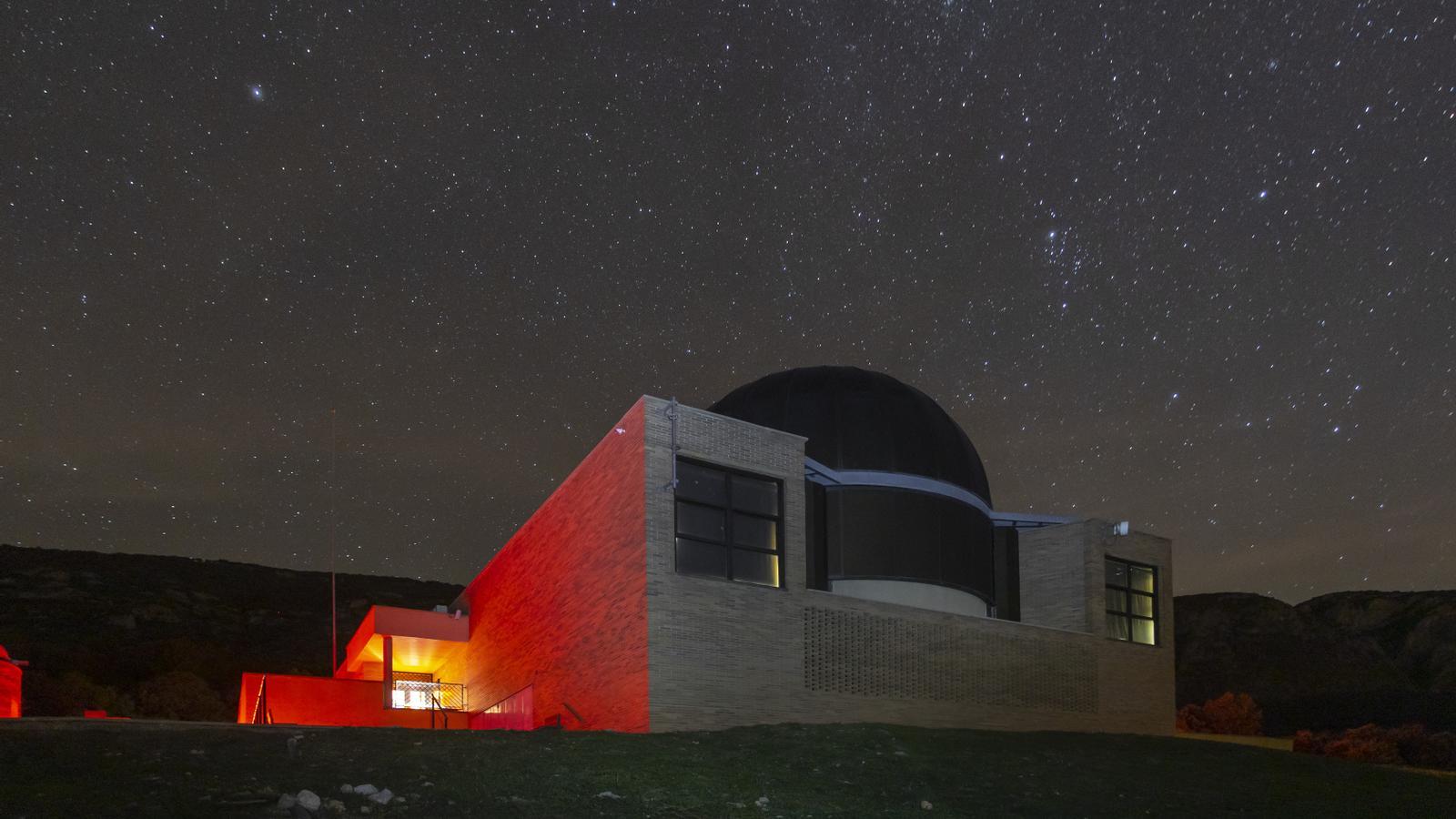
The advantage of the very dark sky of the Montsec Astronomical Park

-
CAT -
CAST
Although we put numbers to the universe, it is very difficult to get an idea of its dimensions. It contains more than 100,000 million galaxies like ours. And in our galaxy, the Milky Way, there are more than 100,000 million stars. The Earth is 4,500 million years old. If the first hominids are from a million years ago, it is clear that humans arrive at the last instant. These are some of the numerous megadata disseminated by the Montsec Astronomical Park that confirm what we already knew: we are insignificant. And to top it all off, the universe, which began almost 14,000 million years ago with the Big Bang, is expanding. Yes, it is being observed that the most distant galaxies are getting further and further away. I'm traveling to one of the places in the country with the darkest sky ––although, it must be said, a little light from Balaguer, Lleida, Zaragoza, the metropolitan area, etc. arrives at night–: Montsec. I'm going to the Montsec Astronomical Park, not to the Montsec Observatory, located a few kilometers away, but much higher up, where the largest telescope in Catalonia is located, named after Joan Oró, considered one of the founders of organic cosmochemistry, a discipline that studies the origin and evolution of organic molecules in space. Oró was very popular in Catalonia in the 80s and 90s of the 20th century. I'm saying this especially because if you go there it's easy to put the wrong location: Montsec Observatory. You have to put Montsec Astronomical Park. The Montsec Astronomical Park –by the way, driven, among others, by Joan Oró– is the main attraction of Àger, along with paragliding (people come from all over the world to do it). Previously, it was the Collegiate Church of Sant Pere d'Àger, located at the top of the municipality, half in ruins –it was bombed during the Reapers' War and during the First Carlist War, in 1835–, although it has been extensively restored. Don't miss going there, though. This astronomical park is very, very educational. It wanted to pay tribute to Maria Assumpció Català, an astronomer, athe first doctor in mathematics from the University of Barcelona, who decisively pushed for Spain to join the European Space Agency, naming one of the main telescopes after him. In addition, permanent exhibitions have been set up there. I will visit them later, I think. As soon as I arrive, a documentary screening is about to begin, in a large dome 12 meters in diameter. I put on a pair of 3D glasses they offer me. I am surprised –positively– there is only one empty seat left. Someone has had an unforeseen event, be it a fever, the death of a relative... Or perhaps tiredness? It is more likely the latter than that all tickets except one have been sold. I am really enjoying the documentary Voyager, about the automatic probes Voyager I and II that explored in the 70s and 80s the gas giants: Jupiter, Saturn, Uranus, and Neptune. An especially fascinating episode is an electrical storm on Jupiter. When the projection ends, surprise!: the dome opens and we see the real sky. One of the stellar moments of the visit is the observation of the firmament. We can see it every day, if there are no clouds. But doing it accompanied by a crowd of people who are interested in it, and having the explanations of the guide, David Rabanal Nogués, is infinitely better. David has a laser in his hand, which makes a beam of light that reaches up to 200 meters (to give us an idea, a distance slightly greater than the height of the Sagrada Família), and he points out planets, stars, and some of the 88 constellations.stellar "You already know that the stars barely move. What moves is the earth. Throughout the year, the stars change places because we are moving. This is one of the facts that show that the earth is round", says David. And then he pretends to threaten the group with the laser. "I hope that among all of you there are no flat-earthers!", he says with a smile. There are deniers of scientific certainties, like a temple, infiltrated where you would never expect.
David gives us a final comment that says a lot about the importance that observing the night sky has had throughout history. Sailors in North America were afraid to go further south than Mexico and enter the southern hemisphere because, since the North Star can no longer be seen, they lost their way. Joan Oró, the scientist of life Joan Oró began to wonder about the origin of life as a child and adolescent, at night, when he helped make bread. At NASA, he led groundbreaking research on complex organic compounds in carbonaceous chondrites, and he interpreted the results of the Apollo and Viking missions to the Moon and Mars, respectively. In another, political field, he was a deputy in the Parliament of Catalonia, for the defunct CiU. The Lleida Water Museum dedicates a room to Joan Oró. It displays the desk that the scientist had in his homes in Lleida, Houston, and Barcelona.

