Medicine, territory of women
The Royal Academy of Medicine preserves 'The Vesalius', the mythical modern anatomy treatise

-
CAT -
CAST
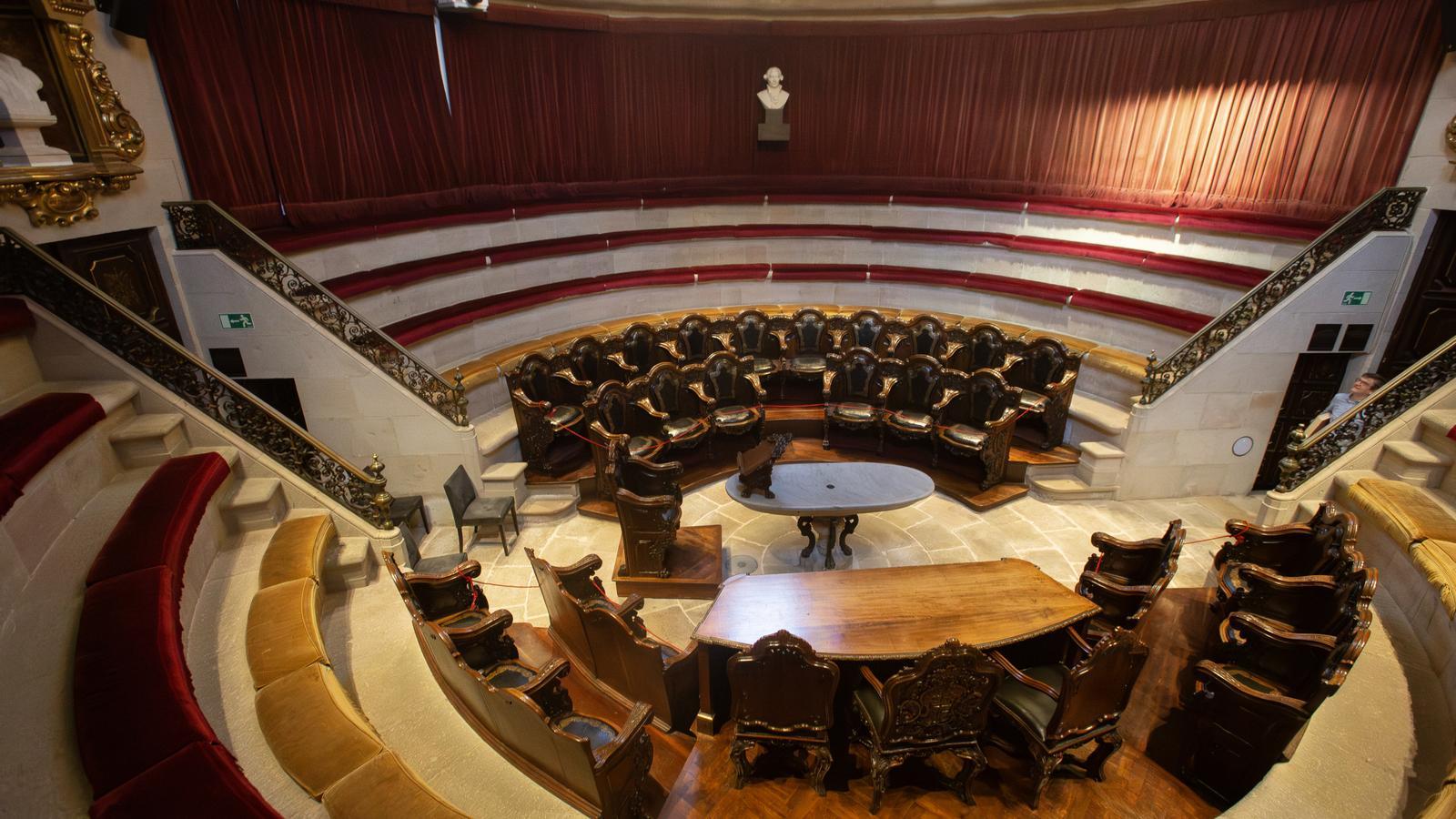
The anatomical amphitheater is the jewel of the building of the Royal Academy of Medicine of Catalonia, located in the heart of Ciutat Vella, in Barcelona, in front of the Institute of Catalan Studies. In the very center of this amphitheater there is an original rotating marble table where students performed dissections of corpses. The corpses arrived, still warm, from the Hospital de la Santa Creu, located side by side. They were of people who died completely alone and whose bodies no one claimed.
In the amphitheater today there is no corpse. None has been dissected for years. On the table there is a computer, through which the Greek Ourania Varsou, professor of anatomy at the University of Glasgow, projects images on a large screen. She is accompanied by another professor: Theodora Tseligka. Yes, two women. Currently, this variable is not news; it was unthinkable before. About twenty students, all girls, listen to them. Things have changed. Fortunately.
The activity is part of the optional subject humanism in medicine, of the Faculty of Medicine of the Pompeu Fabra University, co-directed by Manuel Pera, a member of the Academy. A good part of the classes are held outside the classroom. Ourania Varsou aloud explores the benefits of so-called narrative medicine, and then Tseligka shows the students a copy of De humani corporis fabrica libri septem [On the structure of the human body in seven books]. This book was published in the 16th century, in the midst of the Renaissance, by the Flemish doctor Andreas Vesalius – in Spain he is known as Andrés Vesalio. It is known as El Vesalio. "He made many more books, but this one was, by far, the most successful," comments Ana Pérez, curator and documentary manager of the Academy.
"Vesalio had an ambitious goal: to offer a complete and accurate description of the human body. He performed human dissections properly. And he was lucky that the printing press had been invented relatively recently and was in full expansion. This was decisive for the diffusion of the work, much reissued, a bestseller –stresses Ana–. It is one of the most important works of Western medicine and science. It revolutionized the anatomical knowledge of the human body".
"This is a copy, right?", I ask him. "Yes, we have the original stored," he replies. It has about 700 pages and is written in Latin (Ciceronian Latin – from Cicero –, the most used variant in science). It contains a stack of very precise illustrations of bones, cartilage, muscles, ligaments, veins, arteries, nerves, organs of nutrition and reproduction, the heart, lungs, brain, and sense organs. These drawings were probably made by artists from Titian's workshop.
The bodies in the drawings are not stretched out, as would be expected of a cadaver. Almost all are in dynamic poses, some accompanied by beautiful background landscapes. "They are all men," I say. "No, almost all," Ana clarifies. And she shows me a drawing on the cover of a girl.
"In medicine, there is a before and after Vesalius. Before, medicine was based on what Galen and Aristotle had said. Health and illness were explained by the balance or imbalance of four basic bodily fluids (blood, phlegm, yellow bile, and black bile). Dissection of the human body was forbidden, although some did it behind closed doors. Furthermore, it was very difficult to preserve cadavers: there was no formaldehyde, and ice was highly sought after and much of it was needed...", comments Luis Grande, a member of the Academy, as we visit the other rooms of the Academy. Halfway up the stairs, I notice a hand with an eye in the center, made of white marble. It is the symbol of surgeons. This academy was initially for surgeons.
We are now in the presidents' hall of the Academy, located on the first floor, full of portraits of the highest institutions over the years. They are all men. «Before Vesalius, many of the anatomical descriptions came from animal dissections. In contrast, Vesalius, at the University of Padua, carefully examined every part of the human body», says Luis as we enter the 19th-century library. And he shows me another treasure, a book that has been brought up especially from the basement, where the temperature and humidity are ideal and well controlled (where El Vesalio” also “rests”). It is also known by the surname of its author, Olavide. His name is also very long: Dermatología general y clínica iconográfica de enfermedades de la piel o dermatosis, by Doctor José Eugenio Olavide, considered the father of dermatology in Spain. This book – large format, consisting of two volumes – was brought to the Academy by the widow of a prestigious dermatologist, who had found it in a lamentable state at the Rastro market in Madrid. Thus it was saved.

Dolors Aleu, the first Catalan female doctorThe building that houses the Royal Academy of Medicine of Catalonia was built to be the Royal College of Surgery of Barcelona (it was between the years 1760 and 1843). It was then the seat of the Faculty of Medicine (1843-1906), before it moved to the current building on Casanova street. Since 1929, the Royal Academy of Medicine has been housed there, an entity that remains active: it organizes academic sessions on scientific work, the congress of Catalan medicine history... Currently there are twelve women out of a total of sixty academics. It is where Dolors Aleu (1857-1913) studied, considered the first Catalan female doctor. Having everything against her, Aleu managed to become a doctor for women and children.

