Is the eroticism of 'Josafat' more liberating than that of 'The Bridgertons'?
The book by Prudenci Bertrana celebrates 120 years with a reissue and a rereading with more than 150 people in the crypts of the cathedral of Girona

-
CAT -
CAST
GironaA hidden door behind one of the benches in the chapel of the baptistery of Girona Cathedral leads to a dimension suspended in time. It is the entrance to the bell tower of the largest medieval nave in the world. On the Gothic walls, the names of the bells can still be read, and the ropes hang from the ceiling to ring them. Climbing a beautiful and humble spiral staircase leads to one of the rooms that the Girona writer Prudenci Bertrana surely trod in the early 20th century. It is where the bell ringer lived until before the Civil War. Behind a large window overlooking the Plaça dels Apòstols hides a two-story dwelling with three cells, as if it were a stage. The same one where we can imagine the protagonist of Josafat living, the hunched bell ringer, with a pointed skull, eagle's nose and rough hair, who lives isolated, constrained between lust and the weight of sin to fall into the seduction of a prostitute.
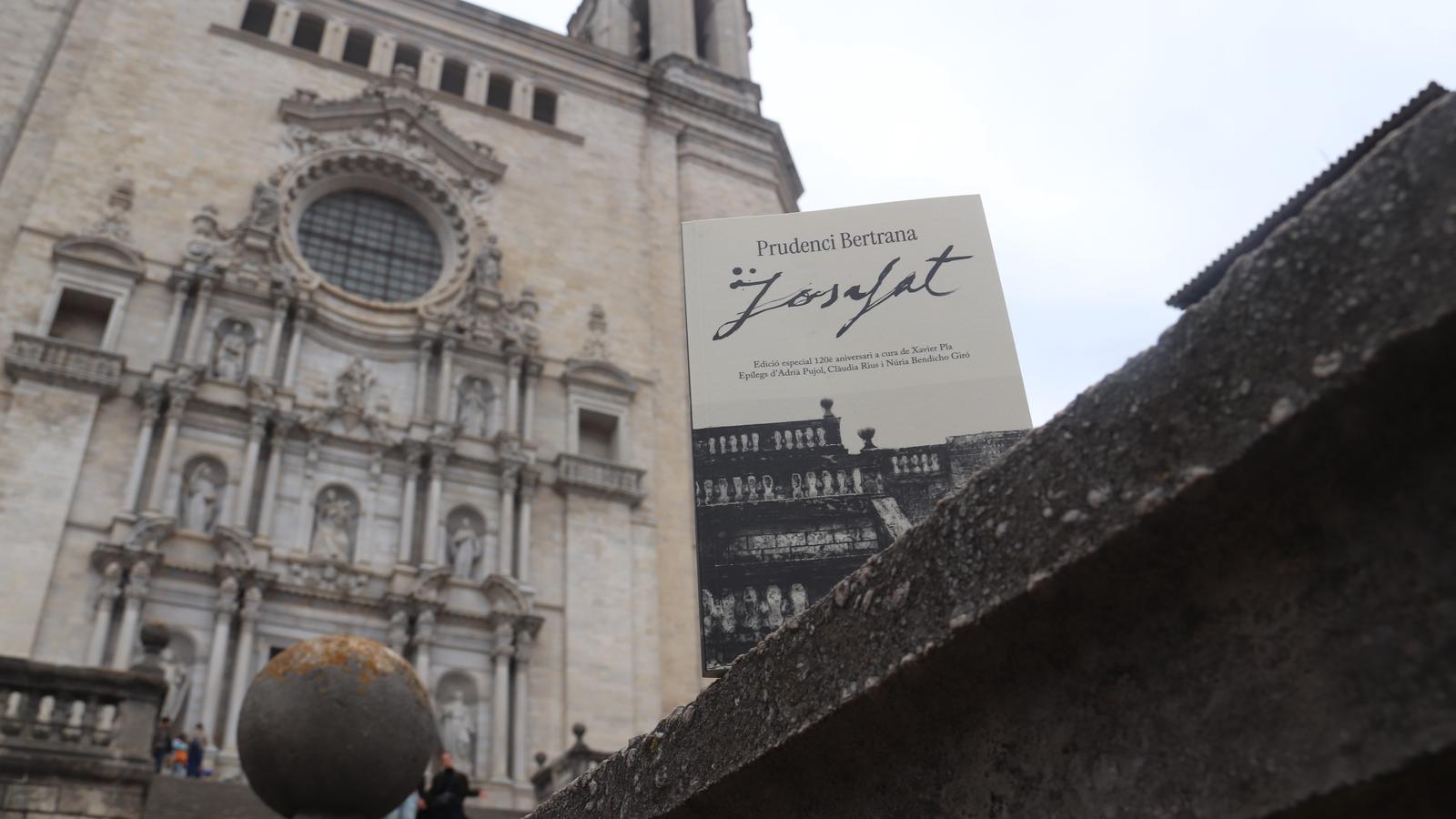
The story of twisted desire and lust between this Girona-style Quasimodo and Fineta, with the temple as a third character of discord and a phallus-shaped bell tower, scandalized the society of the time just 120 years ago. It was 1906 and the Ribas printing press of Palafrugell took on the challenge of bringing to market a novel described as "sacrilegious" at the time and which became a classic of Catalan literature. This Thursday evening, more than 150 people will gather in the crypts of the cathedral to reread it, in the first Bertranada organized by the publishing house Ela Geminada with the support of the Chapter of the Cathedral, the Prudenci Bertrana Foundation and the Girona City Council. On the occasion of the 120th anniversary, the classic has been reissued again by Xavier Pla, with the text of the 2017 reissue that recovers the original writing of the Girona writer prior to Pompeu Fabra.
But the special edition goes further, with the incorporation of three epilogues by young writers who reread the work in the key of the 21st century. A way to update the classic and build a bridge between a society with a great weight of religion and a moment, the current one, in which the weight of the individual marks everything. "We already had two very different editions in our catalog and we saw in the excuse of the anniversary a way to bring a book that is published a lot to bookstores and at the same time incorporate an epilogue, something we had not done until now," explains Laia Regincós, editor of Ela Geminada. The result is an Adrià Pujol who compares Bertrana's Josafat with "our incel, withdrawn and addicted to digital pornography." Or "the far-right boy, scandalized by progressive ideologies." People at the limit in an atmosphere of a society in a "dead end".
Desire and restraint
While Pujol recalls how the first reading of Josafat "shook his head" when he was made to read it in COU at the Institut de Palafrugell and imagined Fineta as the singer Samantha Fox, cultural journalist and content creator Clàudia Rius signs an epilogue in which she confronts a work she has read for the first time in her thirties. She assures that she has already recommended it to a couple of men who write about masculinity. "We feel that we are the freest society, but rarely have I read about sexuality as I have with Prudenci Bertrana –reflects the host of the podcast La contracoberta, which deals with classic authors–. It is perhaps more liberating Josafat than The Bridgertons". An analogy with series and content from audiovisual platforms, controlled to the millimeter to be for all audiences, which for Rius have created a current society "especially devout". "Rereading Josafat returns us to a strangely puritanical image of ourselves", she adds.
The 21st century has become a society where the perspective of the self and overthinking reigns, while for Rius the writer from Girona puts us in front of passionate beings who, if they fear anything, fear God. But in this context, if a character has stolen Rius's heart, it is Fineta, whom she can only classify as "free": "We have the vision that women of the past had to be puritanical, and what is most striking is that Fineta wants to exploit her desire, despite everything". The myth of Beauty and the Beast takes on a dimension here that Bertrana, throughout the novel, already anticipates will end badly.
In the last epilogue, the Generation Z writer Núria Bendicho puts herself in the shoes of "La Josafat", a girl from a dysfunctional family who suffers bullying at school and who turns her rooftop into the space where she isolates herself from the world. A contemporary protagonist of Bertrana's work who from her particular viewpoint turns the darkness of Barcelona into an "inclement downpour" that washes away "the filth of men, the sadness of spirits" and her "disappointment".
Meeting space in the cathedral
This Thursday the bell tower will be moved to the crypts of the cathedral, under the colossal baroque staircase. The first Bertranada aims to be a city event that was initially planned for a maximum of 80 people. However, as the free tickets sold out in less than two hours, it was decided to double the capacity. It aims to be a meeting for re-reading a classic also from a multidisciplinary perspective. Glòria Granell and Judit Pujol will kick it off with an approach to the author's figure as a whole, followed by Pla and the signatories of the epilogues who will hold a round table, and the evening will be completed with a reading of fragments of the work by Jordi Garcia, a live artistic intervention by Joan Mateu – author of the pieces accompanying the commemorative edition – and the screening of the trailer for the film Josafat, directed by Xavi Puebla.
