"Always be wary of Javier Cercas' novels"
The writer draws a devoted audience on the first day of the Guadalajara International Book Fair

-
CAT -
CAST
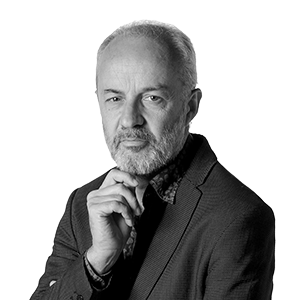
Guadalajara (Mexico)With the Guadalajara International Book Fair inauguratedThe writer Javier Cercas kicked off the literary season yesterday in a packed auditorium at the Barcelona pavilion, the city where he has lived for twenty-five years, although most people still think he lives in Girona. He divides his time between the Alt Empordà region and the Catalan capital. In the capital of Jalisco, he gathered a devoted and enthusiastic audience.It's coming, it's coming, how exciting!"Announced an admirer sitting in the second row. Most had attended the previous session to secure a place at the talk by the author who rose to worldwide fame with Soldiers of Salamis when he was 39 years old, and now, at 63, coinciding with the death of Pope Francis, he has brought out God's madman at the end of the world.
"I'm very happy to be here," Cercas began. "And we're even happier," came the reply from the audience. In conversation with journalist Elena Hevia, the writer gave a thorough and passionate overview of his life and work, so intertwined: "Unlike journalism and history, in literature, fiction and reality are always mixed, always. Pure fiction doesn't exist. Always be wary of Javier Cercas's novels; there are no two of them. In Soldiers of SalamisFor example, the narrator shared his name and claimed it was a true story, "and some people believed it." This is where it all began, although he had been writing for some time without ever imagining he would become a professional.
"The truths in novels are ambiguous. Don Quixote is mad, a lunatic in an asylum, but he's a lucid and noble man. Thomas Mann said that novels say yes and no at the same time. Writers have two religions: irony and truth, one truth." Yesterday, Cercas was eager to chat, to share his thoughts. He felt comfortable. The session seemed too short for the audience.
"I think I'm a writer because I'm uprooted. This is fundamental," he explained. An uprooting that, in his case, he says is "doubly so": as the son of immigrants from Extremadura who arrived in Girona at the age of four, something quite common in Catalonia and Spain in the 1960s. "As Dalí said, I'm supernormal." The other uprooting, which again makes him "supernormal," is spiritual. How many people of his generation lost faith in their parents? Christian culture, which according to Cercas permeates us all, is another matter. At 14, after a heartbreak in his hometown, upon returning alone and desperate to Girona, he began reading Unamuno and never stopped. If until then he had been an obedient son and a good student, he suddenly stopped going to Mass and started smoking and drinking beer. "I still haven't gotten out of that confusion," he confesses.
The book related to the Pope, whom he accompanied to Mongolia and which allowed him to enter the Vatican freely, is about an atheist who wonders about life after death, and more specifically, about the possibility of his mother being reunited in heaven with her husband and Javier's father. “It’s the million-dollar question, of course, the one about life and death,” he said. “The questions children ask are the ones that interest me.” According to Cercas, all books seek the answer to a great question. “And the answer is that there’s never a clear answer; in real literature, there are no certainties. And when you realize it, it’s too late, you’re already hooked. In this, too, I’m perfectly normal.”
Since we’re in the Barcelona pavilion, we have to ask him a rhetorical question. Barcelona is also present in his work, isn’t it? And of course, he’s going to study at the university. "It was a very different Barcelona; La Rambla was a dangerous place, and I lived nearby. It was an incredible city, with many libraries and bookstores. I used to study at the Library of Catalonia. I studied and read a lot of Catalan literature. In fact, it took me a long time to discover writers in Spanish. I'm a strange example of extreme communication between Spanish and Catalan, which were somewhat worlds apart. My initial introduction was to Catalan authors. I was a repulsive student. Basically, I studied and had girlfriends.
In Guadalajara, most of the authors brought by the Barcelona delegation write in Catalan, but the best known to the Mexican public are, for obvious reasons, those who write in Spanish, starting with Cercas himself, as we saw yesterday.
"
