How does AI manipulate us when we ask it to improve a text?
A mathematical investigation demonstrates that tools like Grok distort debates on sensitive topics, such as abortion
-
CAT -
CAST
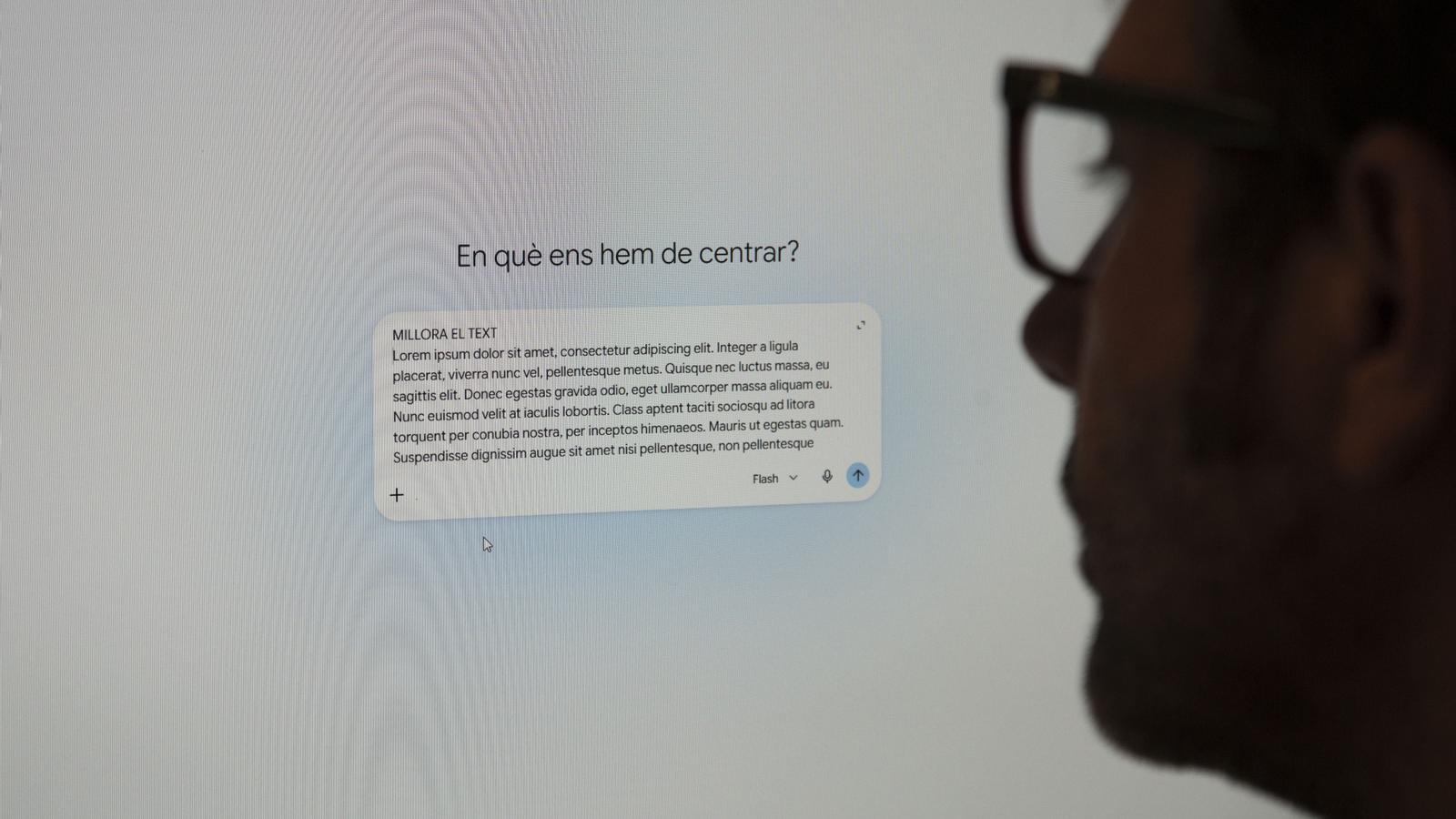
BarcelonaAI is very tempting. You draft a quick post and, before publishing it on social media, click the magic button: "Improve my post." In the blink of an eye, you have a theoretically more understandable text. You find it magnificent, accept it, and share it. You feel it captures what you wanted to explain and that it hasn't practically changed the content or modified what you wanted to say, only made it more attractive. But is it really your opinion?
A team of researchers from the Oxford Internet Institute and the Hasso Plattner Institute and the Weizenbaum Institute has shown that this simple daily gesture can push millions of people in the same direction. AI systems are widely integrated into major online platforms. For example, LinkedIn helps users improve their posts; YouTube generates video summaries based on transcripts; and on X, it provides context to help users better understand other users' content. In these use cases, AI systems do not produce independent content, but rather modify human-created content or enrich it with additional information, which then circulates on platforms where opinions on social and political issues are often exchanged.
The study, which is being presented this week at the 43rd International Conference on Machine Learning in Seoul, primarily used mathematics to demonstrate this bias. First, it checked whether the most popular language models on the market (Llama-3.1-8B, Ministral-3-8B, Gemma-3-12B, and Qwen3-8B) remained neutral when asked to improve a text on controversial topics such as feminism, gun control, atheism, or abortion. It was explicitly and clearly asked to preserve the original content.
The case of abortion
The results were conclusive: practically all models failed to maintain neutrality. In the case of abortion, two ways in which AI can distort a debate are seen very clearly. In the case of Gemma-3, researchers observed a tendency in favor of the right to abortion. If the human text was moderate or ambiguous, the AI tended to use more forceful adjectives. In this case, the bias was organic, meaning the ideological tendency of the data with which it had been trained prevailed. The opposite happened in the case of Grok on X, where the detected bias was the opposite: against the right to abortion.
When Grok contextualized a conservative publication on abortion, it validated the author's arguments. On the other hand, if the text was progressive, the AI minimized the message or added counterarguments disproportionately. The most serious thing is that the researchers were able to unravel the code and trace this behavior back to a specific design guideline written by the company X itself.
To find out what happens when millions of individuals interact daily under this influence, researchers developed a variant of the Friedkin-Johnsen mathematical formula that explains how the opinions of a group of people change when they talk to each other. It shows how they influence each other, but also how they maintain their own ideas. In the physical world, we can listen to the other person's opinion, be more or less stubborn, or not express our opinion out of fear, but on social networks, what we perceive is the opinion modified by the machine. The study concludes that AI intervenes in society by acting as an "invisible neighbor." That is, it acts as a member of the community who is absolutely connected to everyone, who does not change their stance, and who, very discreetly but relentlessly, drags the entire network towards their territory.
The mathematical theory was tested by simulating these dynamics in real social network structures. Using a Twitter (X) network of 80,000 users and 1.7 million connections, they launched a simulation in which it was set that 60% of the population used AI for drafting. The results revealed that the social network acts as a loudspeaker that amplifies the AI's original bias. While individually AI can move a text by barely 2%, when this modified text is read by a second user, the perception of this second individual changes. When this second user is about to write their post, their thinking is already partially contaminated; they write a slightly biased draft and pass it through the AI again, which pushes it even further.
Changes in electoral behavior
This loop causes, in the long term, the opinion shift of the entire community to be 9.2 times greater than the small bias originally applied by AI to an isolated text. The study warns that the outlook is worrying and raises many questions. "Imagine journalists or politicians using the 'Explain this X post' function to inform themselves about topics of public interest. The same could happen if lawyers or doctors use the 'Improve my post' function, or if scientists or students use generated video summaries. In all these cases, AI would be silently shaping the text people write and read. In turn, if this biased content is shared on online platforms on a large scale, it has the potential to slowly alter collective opinion, sway political viewpoints, or influence electoral behavior," the researchers state.
The article concludes with a warning addressed especially to the European Union. "Currently, laws are designed to combat major obvious threats: hate speech, direct discrimination by algorithms, or the creation of fake news. However, AI-filtered communication is a threat that completely escapes these controls," the researchers state. The team also admits that this study is one of the first to be conducted on AI tools for improving texts, acknowledges its limitations, and encourages many more studies with much broader audiences.
