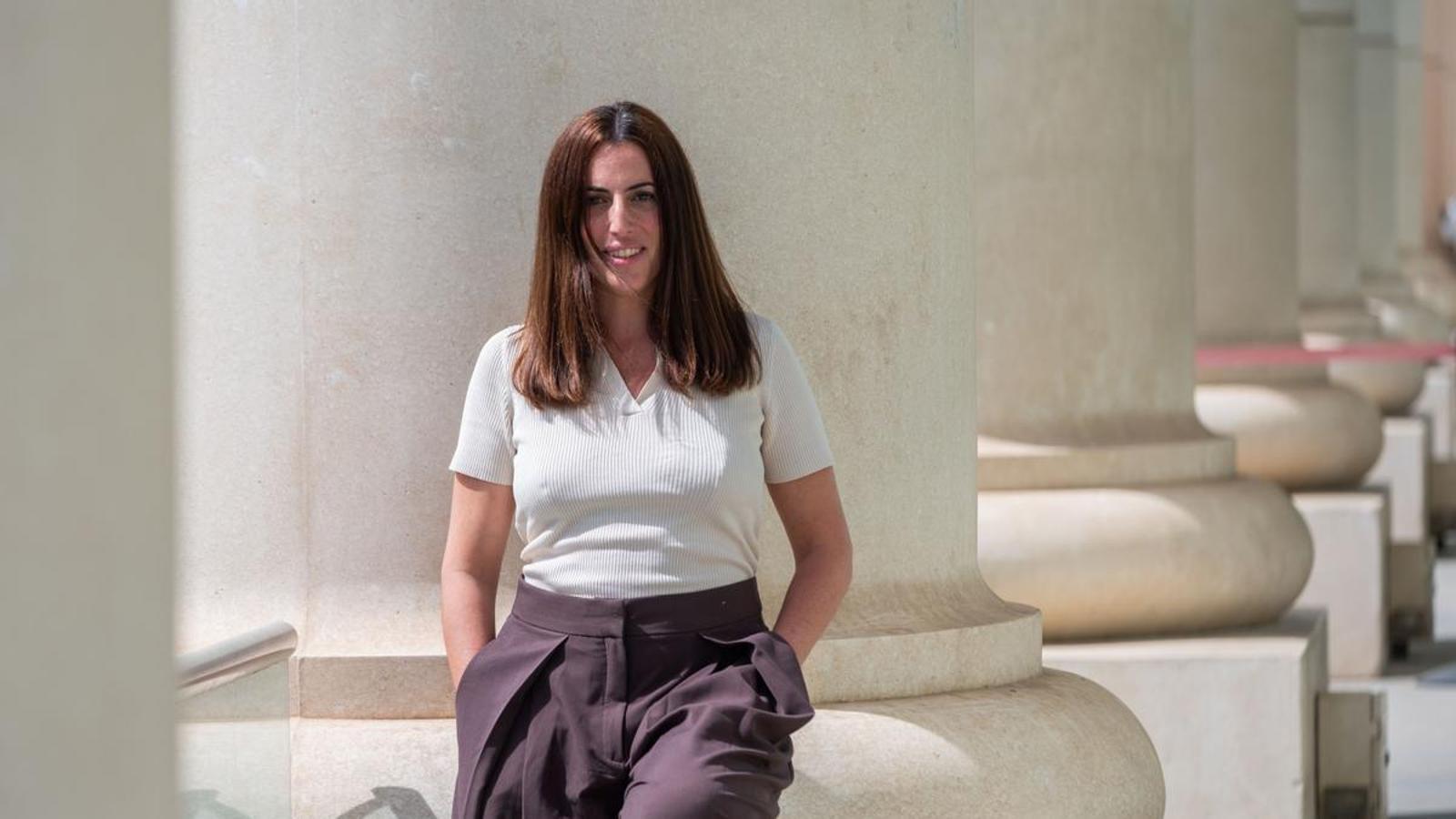
Alba Florejachs: Being a mother is exhausting, you don't always enjoy everything, and that doesn't make you a worse mother
Television and theater actress and mother of two daughters, aged 10 and 6. She regularly appears on 3Cat's 'Polònia'. She participated in the SX3 series 'Fuet' and the program 'El got d'aigua'. She performs in 'Batecs' at the Sala Tallers of the TNC. She is co-author with Ariana Ruglio, Lara Díez Quintanilla and Nídia Tusal. The play stages the story of three women who go through the experience of losing a child and also the grief of non-motherhood.

-
CAT -
CAST
You are often asked questions that throw you off balance. I remember we were at a country house that we shared with friends and the little one was talking to some slightly older creatures who were listening to her with their mouths agape. When we asked her what they were talking about, she said: “Mom, isn’t it true that from the vagina comes discharge, blood, life, and death?”. It was a very powerful moment, and at the same time a precious opportunity to talk about it naturally. Being a mother is a very lively job, constantly transforming. It is beautiful, but also demanding, because it involves accompanying without controlling, listening, and knowing when to give space.What do you find burdensome?
— The day-to-day management, the rush, the schedules, having to be aware of many things at once and the mental toll of sustaining it all. Sometimes it's not so much what you do, but having to do it constantly.
What makes you feel proud?
— For example, of how we have been distributing responsibilities. The older one already does laundry, prepares breakfast, and we have even started cleaning the house together. The younger one picks up, sets the table, and takes care of the plants. They are small things, but they help generate autonomy and a sense of community.
As an actress, you do comedy. Do you also do it as a mother?
— I use a lot of humor at home. It helps to distance myself from things that might seem very serious. It's a way to defuse drama and put things into perspective. And it's a habit that, over time, I've also been incorporating towards myself. In fact, there's something that always makes me a little embarrassed to explain, but at the same time seems revealing to me.
Explain it to me.
— I lived in Cuba for a year and I have many friends there who have a way of communicating through humor. That perspective stayed with me. Now, when something affects me especially, I activate this character. It's as if I connect with this more Cuban part of myself and sometimes I even speak out loud with a Cuban accent.
Have your daughters seen Batecs?
— I explained to them what it was about, but without going into detail, and their imagination did the rest. The day they came to see her, the little one insisted on sitting further back, away from the stage, because she thought there would be a real birth on stage. Afterwards, we were able to talk calmly at home, and it was nice to see that this also opened up questions about the future, about whether they will want to have children someday, about what the desire for motherhood means.

Has your way of understanding motherhood evolved much?
— Yes. I think it's quite inevitable. When you talk to other families, you realize that there are parts of motherhood that are harder to say out loud because they don't fit with the idealized image we have. The romanticization of motherhood has done us a lot of harm. It has placed us in a position where it seems like we have to be able to do everything and sustain everything at once. Over time, I've come to understand that we must recognize that mothering is exhausting and that you don't always enjoy everything. This doesn't make you a worse mother, it makes you more honest. I try to live motherhood from a less normative place, more open to conversation, to listening, and to constant review. I'm very interested in making space for emotions, sharing doubts, and not always having all the answers.
Listen, understand...
— It is important to be able to embrace all emotions. The more space we give them to express themselves, the lighter everything becomes. Feelings work like waves: they arrive, they grow, and if we let them be, they eventually pass.
What phrases do you say most often?
— My usual phrases are quite universal: “Brush your teeth”, “Pick this up, please”, “Come on, we’re late”, or “Are you listening to me?”.
Amazing phrases.
— “Don’t lick the floor, don’t lick the railing”. They are the kind of phrases that make you realize that reality surpasses any prediction.
Which phrases are the most effective?
— I've discovered that when I slow down and speak from a calmer place, making eye contact, it works very well. The more convoluted sentences come out in moments of tiredness. A few years ago when I was overwhelmed and the little one dropped a plate on the floor and it broke. I let out a scream and, automatically, apologized. Then the older one told me: "Don't worry, Mom, we have a psychologist tomorrow."
