A woman secretary general of the UN?
The hearings begin to determine the new leader of the United Nations, who will have the challenge of restoring legitimacy to the organization

BarcelonaAt the end of this year, the mandate of António Guterres, current Secretary-General of the United Nations (UN), expires. And the race to succeed him has begun with a very present question: will the organization be led by a woman for the first time in its 80-year history?
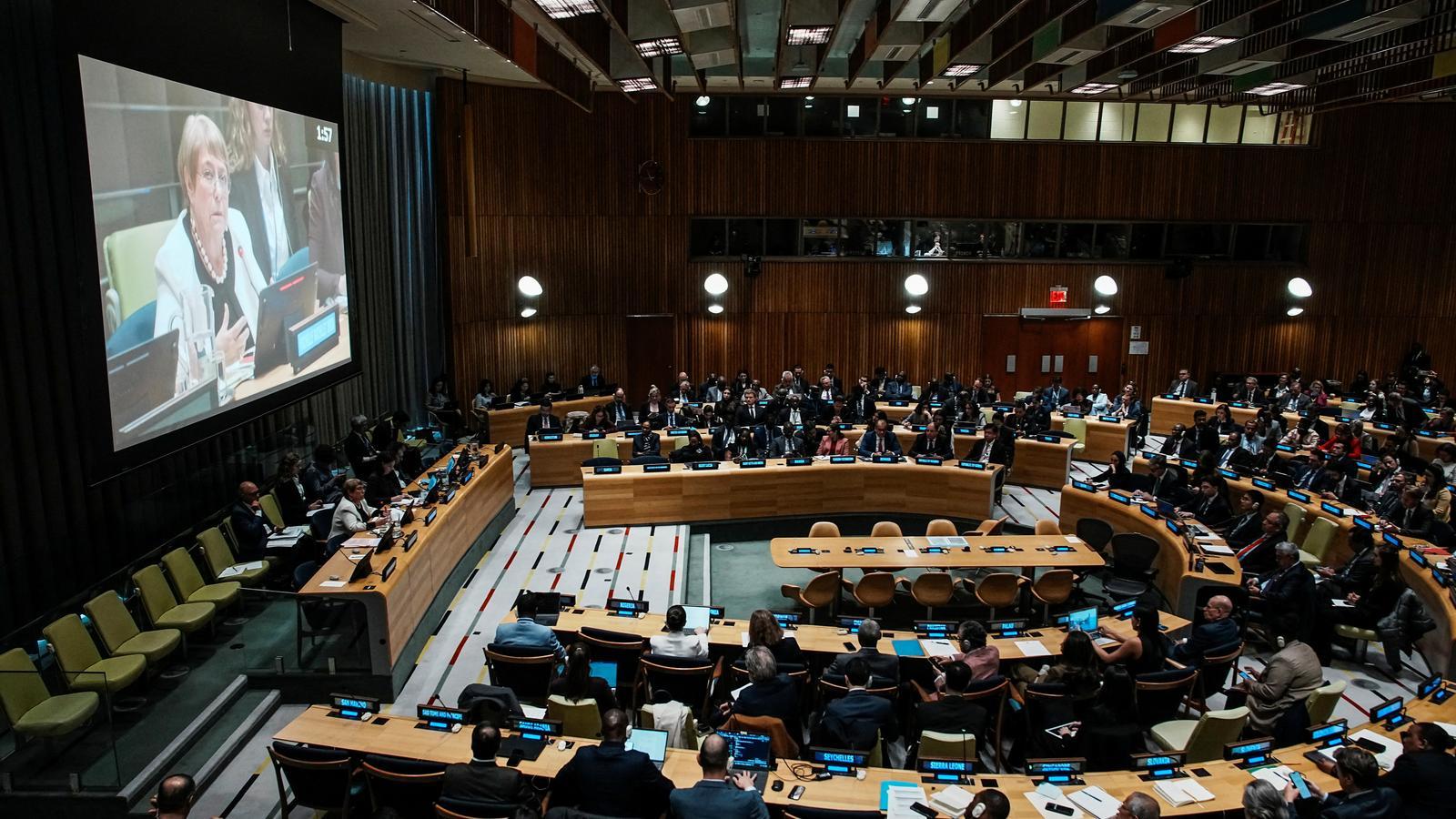
This Tuesday, public hearings begin in New York, a mechanism established in 2016 in which candidates present their roadmap. This year, there is broad consensus among several countries for a woman to assume leadership of the UN. A decision that would correct "an anomalous situation" in the organization that "arbitrates and frames actions for progress, equality, and the defense of human rights," states Cristina Gallach, former UN Deputy Secretary-General, to ARA. The current Executive Director of Global Women Leaders argues that "those who establish equality structures should be affected".
However, the leadership is also claimed by the Latin America region by virtue of an unwritten tradition of geographic rotation. However, those who carry the most weight in deciding who will take the reins of the organization are the member states of the Security Council, and more specifically, the five permanent members with veto power: the United States, China, Russia, the United Kingdom, and France.
Whoever ends up leading the organization faces the major challenge of restoring legitimacy to the international organization, so eroded by Donald Trump's setbacks and the crisis of international law evidenced by the Gaza war. "The most important challenge is to put the UN back at the center of international action. We now see how it is bypassed in negotiation processes and in post-conflict governance structures," assures Gallach. The President of the General Assembly, the German Annalena Baerbock, expressed a similar sentiment at the beginning of the plenary session, where she argued that the election of the secretary-general "is not simply an administrative decision, but a declaration of intent".
Michelle Bachelet
Among the four candidates, there are two men and two women; three from Latin America and one from Africa. The first to present her arguments was Michelle Bachelet, who advocated for "the urgent need for hope" in a world where international law is "under unprecedented pressure." Twice president of Chile, Bachelet was UN High Commissioner for Human Rights, and also served from 2010 to 2013 as Executive Director of UN Women, the organization's agency that promotes women's rights. Although she put herself forward with the support of her country, the new Chilean president, José Antonio Kast, withdrew it, alleging a lack of national political consensus. However, her candidacy has been maintained with the support of Brazil and Mexico.
Bachelet attended the progressive summit organized in Barcelona this weekend, where both former Chilean President Gabriel Boric and Pedro Sánchez advocated for the UN to be led for the first time by a woman. Her progressive stances – she is in favor of abortion, for example – have earned her criticism from Washington's envoy to the UN, Mike Waltz, who seemed to dismiss her candidacy by saying he shared a US senator's concerns about her suitability.
Rafael Grossi
The candidate with the most visibility is Rafael Grossi, Director General and omnipresent figure of the UN nuclear watchdog for the last six years. A career diplomat of Argentine nationality, Grossi has received the support of his president, Javier Milei, who has formalized his candidacy and with whom he "maintains a good relationship", as he stated in an interview with El País late last year.
From the helm of the International Atomic Energy Agency (IAEA), he has overseen Iran's nuclear program for a long time and led the negotiations between Tehran and Washington in 2018, when Donald Trump decided to withdraw from the nuclear deal. Among his most notable achievements is getting an IAEA team stationed at the Zaporizhzhia nuclear power plant, in Ukrainian territory occupied by Russia, after several trips to the front. His greater chances of ending up in the position are because, during the years he has headed the IAEA, he has stayed on the side of the five permanent members of the Security Council, whose support is essential to lead the UN.
Rebeca Grynspan
The other woman running for the position is Rebeca Grynspan, former Vice President of Costa Rica and, until now, UN Trade chief. Grynspan left her position at the United Nations Conference on Trade and Development at the end of September to avoid a conflict of interest during the campaign. A move that her opponent Rafael Grossi has declined.
Born to parents who fled Europe after World War II, she directly links her worldview to the origins of the UN and its role in international cooperation and conflict prevention. She describes herself as a reform-minded multilateralist who has fought against gender barriers and has always believed in the UN and its commitment to peace, development, and human rights.
Macky Sall
The last of the candidates and the only one not from the American continent is Macky Sall, who was president of Senegal for twelve years until 2024. Son of a peanut seller from a rural area of Senegal, the infrastructure development he carried out under his mandate weighs as an asset for the role he may play.
He was nominated by Burundi and his candidacy receives a lot of support on the African continent, but not from his country of origin or from Nigeria, according to Reuters. If elected, he would be the third African secretary-general after the Egyptian Boutros-Ghali and the Ghanaian Kofi Annan.
