War, high prices and censorship: the Taliban won't even let us talk about our suffering

-
CAT -
CAST
Kabulmarks the fifteenth day since tensions and clashes between Afghanistan and Pakistan began. For the past three nights there have been no Pakistani drones in Kabul’s sky, but earlier in this Ramadan, when people usually wake for suhoor to the sound of alarm clocks, we were waking instead to the roar of Pakistani jets and the crack of gunfire.
Several times I woke while the sky was still dark and the sound of shooting echoed across the city. Later, the Taliban would announce that Pakistani drones had entered Kabul’s airspace and that their forces had fired at them. For me, and for many others, hearing gunfire again carries a familiar but heavy feeling. We are a generation that grew up with war. Sometimes I feel we are people who were born amid the sounds of explosions and suicide attacks, and perhaps those same sounds will one day accompany us out of this world.
At the same time, on our western border, Iran is also at war. These conflicts may be happening hundreds of kilometers from our homes, but their effects reach our daily lives very quickly. Afghanistan has long been a country dependent on imports. Many of the goods people use every day come from neighboring countries. For years Pakistan was one of Afghanistan’s most important trade routes. Rice, cooking oil, chickpeas, spices, medicine, clothing and many other goods came from there.
The Taliban’s Ministry of Commerce announced that trade between Afghanistan and Pakistan reached more than 1.108 billion dollars in the first six months of 2025 alone. But since October many border crossings have been closed and trade between the two countries has effectively stopped.
The Taliban said they would find alternative routes, and one of the most important was Iran. But now that conflict is continuing there as well, that route no longer works as it once did.
I see the results of this situation every day in the market. Prices have risen quickly. Rice that used to cost about 3,200 afghanis now sells for around 4,300. The price of flour has increased from 1,500 afghanis to 2,200, and cooking oil that once cost around 1,500 afghanis is now more than 2,150.

My family has always considered itself a middle-class family. In our house only my mother and I work. My mother is a primary school teacher and I am a journalist. My brothers are still students, and my father, who served as a military officer during the former republic, no longer has a job.
I am twenty-five years old, and until recently I cannot remember anyone in our home ever saying that because first-grade rice was too expensive we should buy a cheaper kind.
But five days ago I heard that for the first time. My mother told my father that the flour and rice in our house had run out. My father went to the market to buy them, but when he returned his hands were empty. He had asked about the prices and then come home without buying anything so he could discuss it with my mother.
When I walked into the room, I heard my mother saying that rice had become too expensive and maybe we should buy third-grade rice instead of the best quality. My father said the shopkeeper had told him the grains were not very large, but that it was “good to eat.”
At that moment I felt something shift inside me. For the first time, I felt that our family, which had always thought of itself as middle class was slowly moving toward a lower place. I wondered how many other families were feeling the same thing.
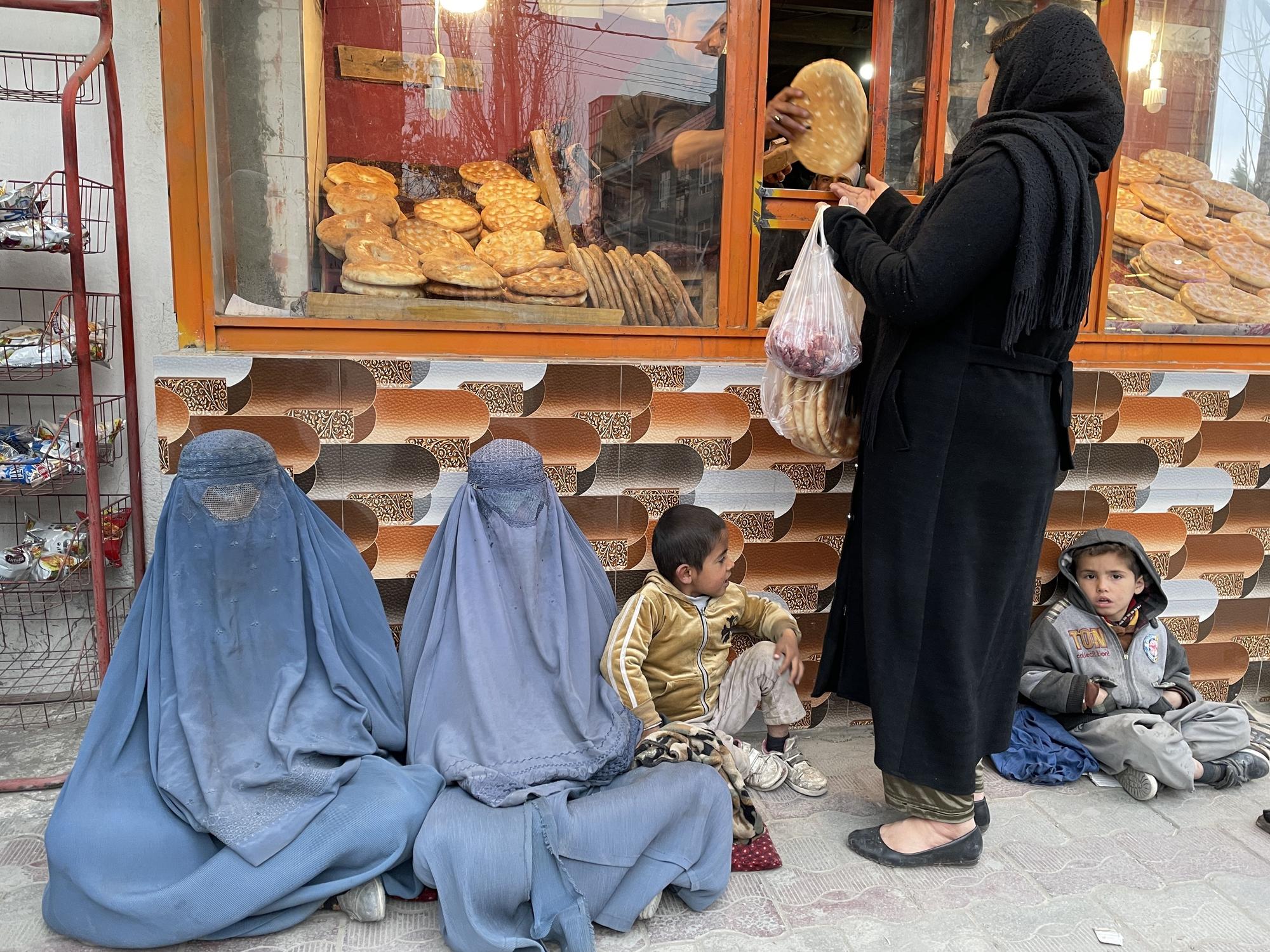
During Ramadan, around the time of iftar, I see scenes in some Kabul streets that seem to be repeating more often now. Some traders and wealthier people distribute food for charity. Each person receives a disposable container with a little rice, a small portion of meat, one date and half a piece of bread.
But hundreds of women, men, elderly people and children gather to receive even this small portion of food. When the distribution begins, the crowd surges forward. The fear of being left without anything pushes people to press against each other.
I had seen similar scenes in Kabul before, but this time there is an important difference. Women are now part of the crowd as well, and the number of people in need has grown from dozens to hundreds.
Just today, while passing through one of these streets, I was stuck in traffic for a long time. So many people had gathered in the road that cars could barely move. Amid the noise of the crowd I heard the voice of a child telling his friend: “Hurry, if we don’t get anything we will stay hungry.”

Winter has not ended yet. Rain still falls and the air in Kabul remains cold enough that it is difficult to get through the night without turning on a gas heater or adding fresh charcoal to the traditional sandali heater.
But the price of gas has risen too. It used to cost about 45 afghanis per kilogram. Now it is around 70. In the past few nights we have often wrapped ourselves in wool blankets instead of turning on the heater just to get through the night.
And yet the hardest part of this situation may not be the rising prices. I am a journalist, and I know many people are complaining about the cost of living. But censorship in Afghanistan has become so strict that media outlets are not even allowed to publish some reports about these problems. The Taliban have warned journalists not to report on the impact that the closure of crossings with Pakistan has had on people’s lives. Still, whenever I go to the market or speak with people, I hear everyone talking about the same thing.
In these same days, the Taliban’s foreign minister said in the media that the closure of these trade routes has had no effect on the lives of ordinary Afghans. When I heard that statement, I thought about the conversation between my parents about buying rice.
Sometimes it feels as if we are not only facing war or rising prices; we are also facing the denial of our own suffering..
