Von der Leyen backtracks and defends international law after criticism from Costa and Sánchez
The Spanish Prime Minister calls for a rules-based world order following the controversial speech by the head of the European Commission

-
CAT -
CAST
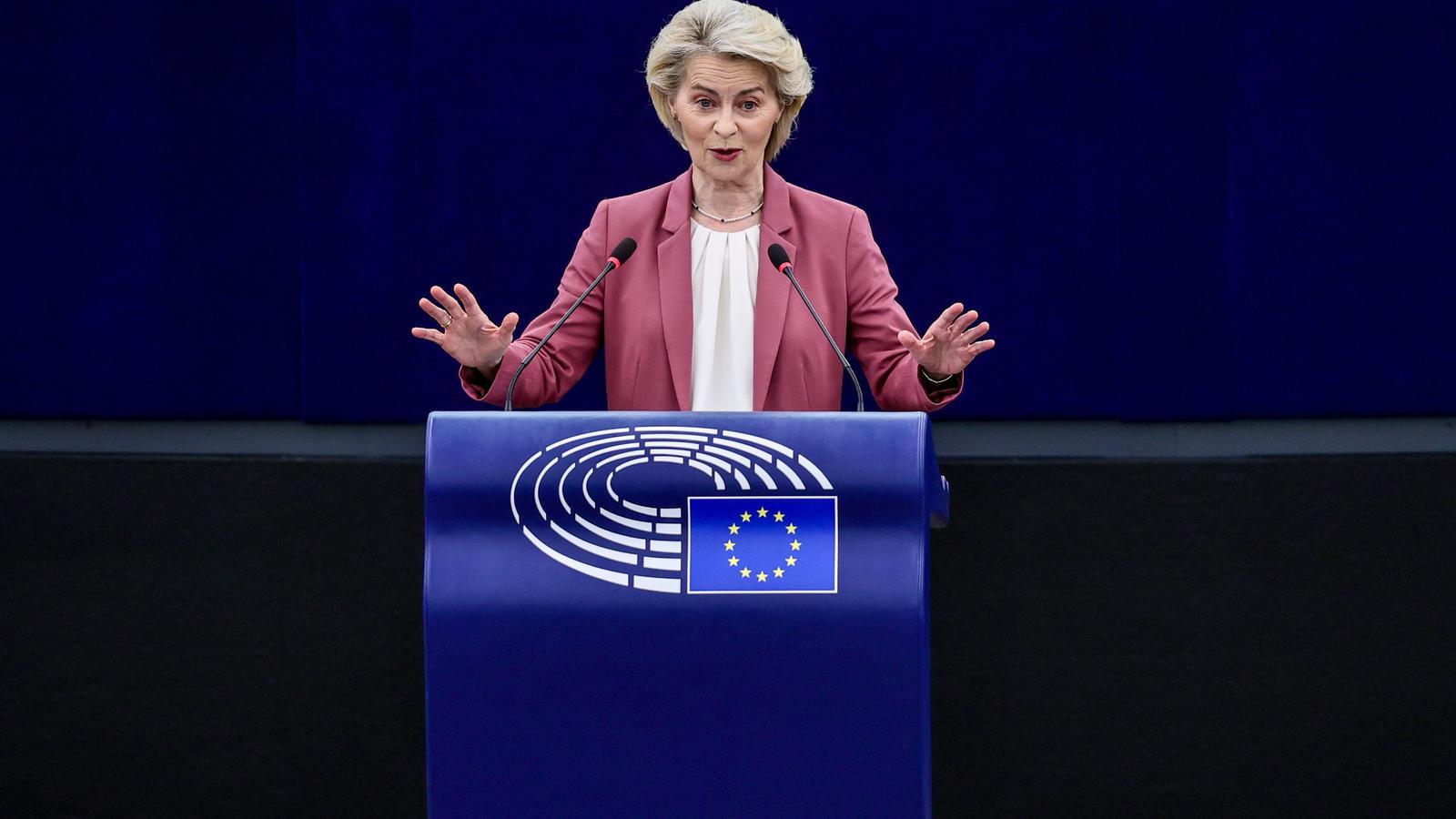
BrusselsThe President of the European Commission, Ursula von der Leyen, has sought to calm tensions and to prevent the European Union from fracturing because of the war in Iran. After her controversial speech on Monday in which she practically declared the rules-based world order dead, she came to the defense of international law this Wednesday in an appearance before the plenary session of the European Parliament. "Our commitment to the principles of the UN Charter and to international law is as fundamental today as it was at the time of our creation. And we will always defend these principles," she stressed.
The conservative leader has defended—albeit half-heartedly—international law in the Iran war on several occasions, although only to denounce the Ayatollahs' regime for violating it, and has omitted any responsibility on the part of the United States and Israel. However, this Wednesday, after the forceful response she received from the President of the European Council, António Costa, and the President of the Spanish Government, Pedro Sánchez, the head of the EU executive made her strongest defense since the US and Israeli militaries launched the offensive against Iran.
Sánchez, the only social democratic leader among the EU's major economies, was the head of government in the bloc who responded most critically to Von der Leyen on Tuesday. In an interview on Eldiario.esThe Spanish Prime Minister pointed out that, despite the fact that "the world is changing," the "values and principles of the European Union should not change." "The world of yesterday was a world without rules. The dilemma is not an old order versus a new order, it is international order versus international disorder, which led us to two world wars," the Spanish Prime Minister emphasized, who has become one of the most dissenting voices within the European Commission and the more polarized EU.

In this way, the Spanish Prime Minister closed ranks with Costa, who is also from the social democratic family. Although the President of the European Council and the President of the European Commission maintain a good relationship, the former Portuguese Prime Minister responded forcefully on Tuesday to the German conservative's speech. "We must defend the principles enshrined in the Charter of the United Nations, as set out in our treaties. Violations of international law must not be accepted," Costa said. Furthermore, the President of the European Council directly pointed out, for the first time since the US and Israeli attack against the Iranian regime, the violation of international law by Washington and Tel Aviv. Costa stated that the illegal aggression of Russia against Ukraine, the offensives against Gaza and Iran, and, among others, Donald Trump's threats to invade Greenland, which is sovereign territory of an EU member state, Denmark, must be condemned equally.
Von der Leyen, however, has not gone so far as to suggest that Trump or Israeli Prime Minister Benjamin Netanyahu have violated international law. In fact, the President of the European Commission has used the same wording found in all the joint statements issued and agreed upon by the European Union as a whole regarding the war in the Middle East.
Von der Leyen takes a more neutral stance
The attack launched by Trump and Netanyahu against the ayatollahs' regime has once again divided the European Union. On one side are leaders who, like German Chancellor Friedrich Merz, have openly and unequivocally supported the US and Israeli offensive; and, echoing Ursula von der Leyen, have downplayed the importance of international law and multilateralism. On the other, French President Emmanuel Macron, Prime Minister Sánchez, and even Italian Prime Minister Giorgia Meloni have criticized the White House for violating the rules that have governed the international order since the end of World War II.
Thus, with her speech on Wednesday, the President of the European Commission adopted a more conciliatory tone within the European Union and its member states, which, represented by the European Council, are the ones that truly hold power in foreign policy. In fact, Von der Leyen has also received considerable criticism in recent days, once again, for overstepping her bounds and attempting to play an international role that is not officially hers to assume.
