Trump asks for more time to end the war against Iran: "We will hit harder in the coming weeks"
The president insists that the end is near, despite not being able to give any date, while concern grows over the price of oil

-
CAT -
CAST
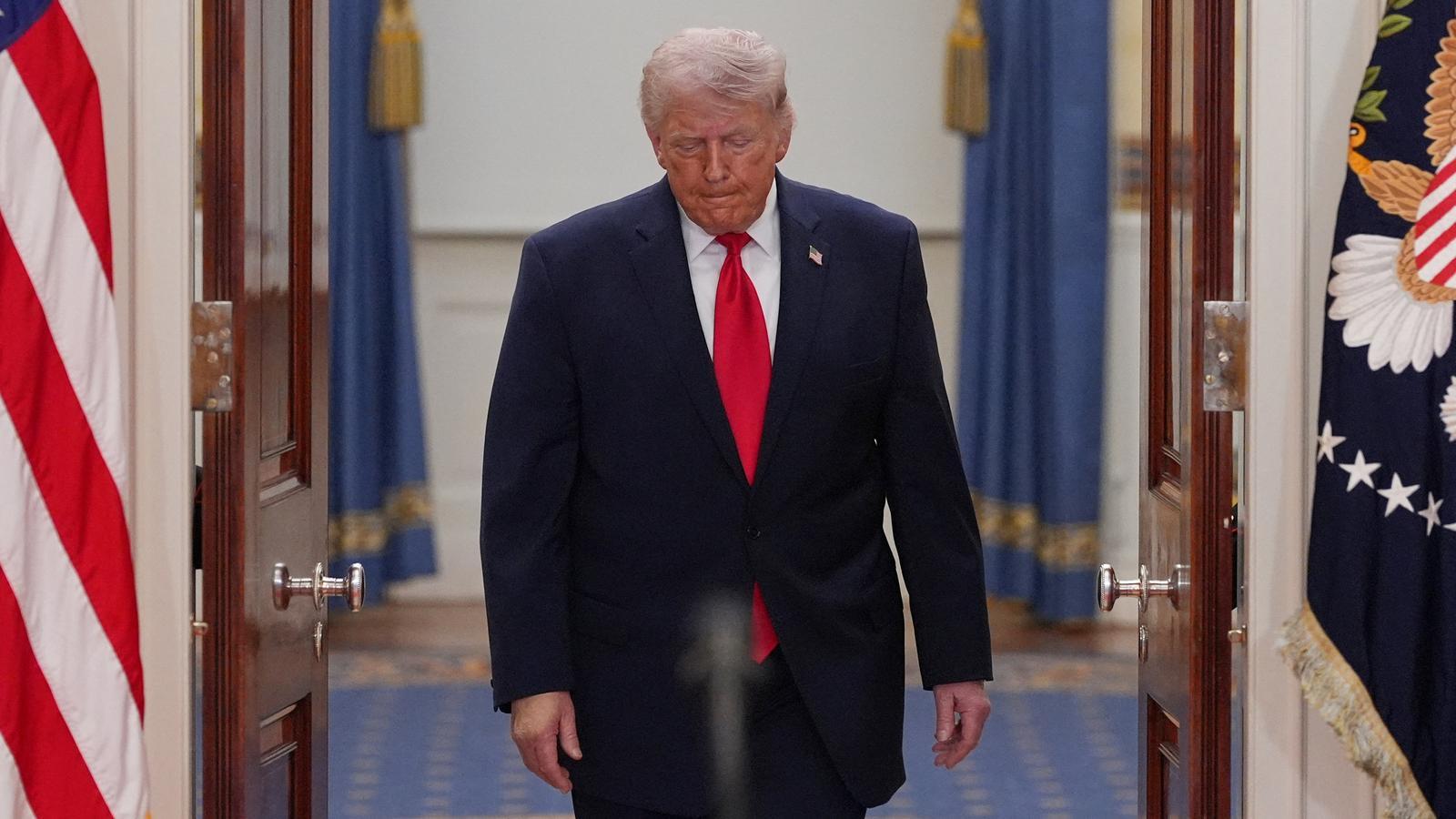
WashingtonA speech that could have been one of his messages on Truth Social. All the expectation generated around Wednesday night's appearance has been reduced to a 20-minute intervention that seemed like a compilation of statements from previous days. Donald Trump has once again said that he expects to end the war in the next two or three weeks; that he is negotiating with the supposed new Iranian regime whose identity he has not even revealed and that the United States is very close to achieving its objectives. The US president seeks to buy time for a war that, according to his own forecasts, should have already ended. "It is very important that we maintain the perspective of this conflict," defended the Republican, who cited the four weeks of inconclusive war as a supposed triumph compared to other longer conflicts such as Vietnam or World War II.
"Thanks to the progress we have made, I can say tonight that we are on track to achieve all our military objectives very soon," Trump said. And he added: "Over the next two or three weeks we will hit them very hard. In the coming weeks we will return them to the Stone Age, where they belong." Far from offering any kind of update or clarification, the appearance raises even more questions about the future of the war. Especially with regard to the forecast of an escalation of attacks in the coming days, considering that the Pentagon has already mobilized 7,000 additional soldiers to the region. All of them specialized in ground operations. Trump has made no mention of these new troops destined for the Middle East.
It has taken a month of conflict and the price of gasoline in the US to exceed 4 dollars per gallon (3.78 liters) for Trump to finally address the nation. The day after jointly attacking Tehran with Israel, he limited himself to making several announcements through Truth Social. Nor did he hold any press conference or similar when there were the first US soldier casualties, which now amount to 13. The only thing that has brought the magnate to the forefront has been the widespread concern about the price of gasoline.
Trump has tried to send a message of calm to Americans about the rising price of oil. "The United States has never been better prepared economically to face this threat. You all know that we built the strongest economy in history. We are living it right now," he said. War is an abstract concept for a good part of citizens, but seeing how the price at the gas pump rises every day is a tangible fact that generates more discomfort every day.
It is not known if the president's words will have served as solace for the citizens, but for the markets it has become clear that they have not. At the end of the speech, the price of a barrel of crude oil shot up 5% to stand again at 106 dollars. The price of oil had fallen shortly before the speech. Investors had hoped that Trump would announce the end of the war or some similar scenario.
No details of the new regime
"Regime change was never the objective. We never talked about regime change, but it has happened because all of its original leaders are dead," Trump stated. This statement, at the outset, is false: only bombing Iran on February 28 called on Iranians to take to the streets and bring about regime change. Even when they were still negotiating with the ayatollahs, Trump made a Truth Social post talking about the need to provoke regime change if an agreement was not reached. Despite reiterating that there is a new regime in Iran "less radical and much more reasonable," Trump has not provided any further details about who this new group leading the nation is supposed to be. For now, the only interlocutor whose existence is known are the members of the Revolutionary Guard and the rest of the regime's officials who are still alive, who have repeatedly denied the supposed negotiations that Washington defends.
Trump again referred to the supposed diplomatic contacts with this new regime and recalled the ultimatum to attack Iranian power plants if an agreement was not reached by April 6: "If during this period of time there is no agreement, we have key targets in sight. If there is no agreement, we will bomb every one of your power plants [...] And there is nothing you can do to prevent it because you do not have anti-aircraft defense systems, your radar is 100% annihilated. We are an unstoppable military force." The president took the opportunity to repeat the phrase he said to Volodymyr Zelensky during the row in the Oval Office: "We have all the cards and they have none."
Despite discussing supposed negotiations with Iran, Trump made no reference to the letter published by President Masoud Pezeshkian shortly before his speech. In the letter, Pezeshkian asked Americans to truly consider what the objective of this war is and how it serves American interests. "Is America First part of the US government's priorities today? I invite you to look beyond the disinformation machinery," states the text, published in English and Persian. Pezeshkian hit a nerve with the most critical sector of Trumpism regarding the war and described Washington as a "proxy" of Israel that has allowed itself to be drawn into a conflict that only serves Tel Aviv's interests.
Pezeshkian emphasized how the regime has shown itself prepared to continue in a war of attrition. Nevertheless, he also seemed to extend a hand to Trump for a possible dialogue: "Today the world is at a crossroads: continuing on the path of confrontation is more futile and costly than ever. The choice between confrontation and negotiation is real and has consequences." It is not clear, however, what value Pezeshkian's offer holds, given that within the ayatollahs' regime, the Supreme Leader is the highest authority.
Currently, the position is held by Ali Khamenei's son, Mojtaba Khamenei, and there is no indication that the letter has his approval or was commissioned by him. In fact, the letter once again added confusion to the crossed statements from both sides. On Wednesday morning, Trump had stated that the Iranians had offered him a ceasefire, a fact that has been quickly denied by the regime.
The Iranians lost their reasons to see Washington as a reliable interlocutor a long time ago. On Wednesday afternoon, they proved it again: according to Iranian media reports, former Foreign Minister Kamal Kharazi had been injured in an attack on residential buildings in Tehran. Kharazi is considered a moderate politician and, according to Iranian officials, had been one of the supervisors of diplomatic contacts with Pakistan for a possible meeting between regime officials and Vice President JD Vance.
Ormuz and NATO, marginal issues
Trump's references to the blockade of the Strait of Hormuz have been scarce, and all to imply that it is not a US problem. Even though it has indeed been provoked by Washington. "We are doing incredibly well in the production and sale of large quantities of oil and gas, with the second largest reserves on the planet after the United States of America. We are now totally independent of the Middle East and, even so, we are there to help. We don't have to be there. We don't need their oil. We don't need anything they have, but we are there to help our allies," Trump said. According to the leader, the maritime passage will open "naturally" once the war is over.
Reopening the Strait of Hormuz seems to have gone from being one of Trump's main priorities to practically being collateral damage that he disregards. The shift makes sense: the United States is looking for a decisive action in the war that will allow them to quickly claim victory. The White House has been hitting a wall for weeks regarding Hormuz, and getting it unblocked does not seem like an achievable goal right now; neither through diplomatic nor military means. So, little by little, the administration is backing down from the goal it had initially set.
Criticizing European allies for not having helped him in his military endeavor, moreover, has another subtext: it means loading them with the responsibility of unleashing the mess he has caused in the region. Meanwhile, by rebound, it gives him more ammunition to attack NATO. However, despite Trump having spent all Wednesday sounding the possibility of withdrawing the US from the Alliance, he has not made a single mention of the fact during his speech.
