Thus advances in the Vatican the beatification process of Gaudí
Francesc made a first step by proclaiming him "venerable servant of God" before dying

-
CAT -
CAST
RomeOn April 14, 2025, just one week before his death, Pope Francis proclaimed Catalan architect Antoni Gaudí (1852-1926) a "venerable servant of God," a title with which the Catholic Church recognizes the heroic virtues of men and women, and which constitutes the first step towards sainthood within the long process of beatification and canonization. A historic decision that came after an initiative launched in the 90s by José Manuel Almuzara dedicated to disseminating the figure of the one known as the "architect of God.
Although it wasn't until the early 2000s that the Vatican took the request into consideration, Gaudí's devotees have been requesting his canonization for over three decades, emphasizing how the imposing spires of the Sagrada Família convinced many people to convert to Catholicism. "Gaudí used his architecture as a tool to pray," recently explained Almuzara, an architect and president of the Society for the Beatification of Gaudí, an association of faithful and lay people responsible for promoting the canonization process before the Vatican.
The decision of the late Argentine pontiff finally accelerated the process to elevate the Catalan genius to the altars, who died prematurely after being hit by a tram in 1926 and left his great masterpiece unfinished.
For Gaudí to be beatified, the Congregation for the Causes of Saints, the Vatican "department" also known as the "factory of saints," which decides which person possesses the necessary virtues to be inscribed in the book of saints, must recognize a miracle for him. To achieve sainthood, it is necessary for this influential body of the Vatican curia to certify at least two.
The promoters of the cause submitted a report of over 1,000 pages with testimonies from people who knew the architect, as well as several possible miracles attributed to the Catalan genius, which occurred in Europe and Latin America. But for the Vatican experts, Antoni Gaudí's works are already authentic architectural miracles, expressions of a deep dialogue between architecture, nature, and the divine.
"He is a great saint, but also a great builder. The two elements go hand in hand, and we must not forget it," defended the Italian historian Maria Antonietta Crippa, an expert on the work of the Catalan genius, during the Art, Faith and Beauty in Gaudí's Work congress, organized by the Delegation of the Generalitat in Italy to commemorate the centenary of his death.
Accompanied by the priest and philosopher Lluís Clavell, Crippa recalled the importance of light inside the basilica, which "evokes a welcoming and luminous forest, a construction that alludes to nature," as well as the relevance of liturgy in Gaudí's work. "A deeply moving masterpiece," she said.
The Catalan religious figure, for his part, said that Gaudí "transmits great unity through shared beauty." "It is the same desire of Pope Leo XIV for unity and peace, which is materialized in the contemplation and prayer offered by the Sagrada Família," he added.
Experts agree that the figure of Antoni Gaudí cannot be understood without his intense spiritual life. In his adulthood, the architect lived a profound faith marked by prayer and complete immersion in the tradition of the Church. Especially significant was his devotion to Saint Philip Neri – he often frequented his oratory in Barcelona–. But who best explained the close relationship between the Catholic Church and "God's architect" was Benedict XVI himself, who defined Gaudí as "a brilliant and coherent Christian architect, whose spark of faith burned until the end of his life, lived with dignity and absolute austerity".
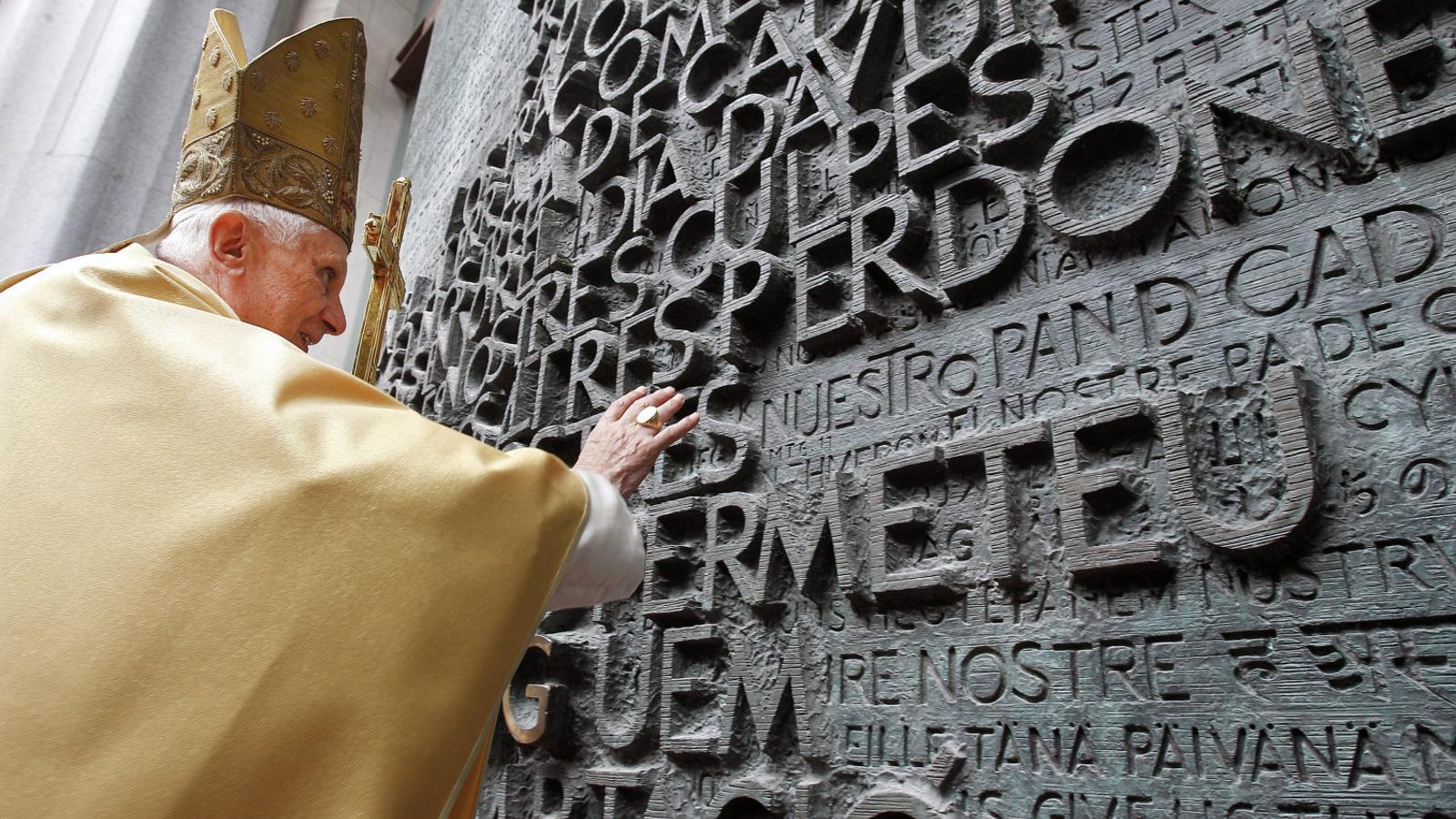
On November 7, 2010, the German pontiff visited Barcelona to consecrate the Sagrada Família during a solemn mass, attended by more than 8,000 people, which elevated the considered cathedral of the 21st century to the category of basilica, in imitation of the thirteen churches of Rome –seven major and six minor–, which are considered the first in Christendom. "In this context, Gaudí wanted to unite the inspiration that came to him from the three great books that nourished him as a man, as a believer, and as an architect: the book of nature, the book of Holy Scripture, and the book of liturgy," he recalled in his homily.
Before him, Pope John Paul II praised the Catalan architect for the first time during his visit to the Condal City in 1982. His work – said the Polish pontiff at the time – recalls "another construction made of living stones: that of the Christian family".
But if Benedict XVI demonstrated his deep connection with the Catalan genius by being the first pope to honor the "holiness" of Antoni Gaudí and years later Francis opened the doors to his beatification process, Leo XIV could be the one to sign the decree allowing "God's architect" to ascend to the altars.
On June 10, on the occasion of the centenary of his death, Barcelona will receive the Pope, who will inaugurate and bless the Tower of Jesus. Completed last April, it means that the basilica has reached its maximum height, 172.5 meters. The American pontiff will celebrate the Eucharist inside the temple and subsequently the blessing of the tower outside, in a ceremony that is expected to be massive.
