The grid road: en route to a Ukrainian drone control center
The Donbas faces key battles on the Kramatorsk and Kharkiv fronts of a war fought from underground
-
CAT -
CAST
Kharkiv Front (Ukraine)A giant net surrounds the entire road in the direction of the front of Kramatorsk that stretches for hundreds of kilometers. The system is simple: a succession of metal poles placed on both sides of the pavement is repeated continuously along the route. This structure supports large meshes that cover the sides and the top of the road, forming a kind of protective tunnel. Some of these nets are white and others have green hues. In various places, it is common to see dead birds, which have become entangled and trapped. The scene, added to the usual appearance of the road – where very few vehicles circulate – gives the whole a hellish air.
In some places, holes can be seen in the nets, broken or damaged, but for the most part they remain intact. This system is intended to protect vehicles circulating within its bubble from attacks by small Russian suicide drones, which would not be able to penetrate these meshes or hit their targets.
These types of drones are the ones that now sow terror on various fronts in Ukraine. In contrast to the more inaccurate Iranian Shaheds, these can be guided by operators who control them from several kilometers away. The procedure is straightforward: the operator has real-time vision of what the drone's camera captures, identifies a target – often a vehicle or a soldier – and detonates the explosive charge.
For this reason, soldiers in uniform are no longer seen in Kramatorsk: they know they are priority targets in this type of war, which pits machines against humans. On the streets, vehicles always move very quickly, as if this could protect them from an attack by a suicide drone. But the reality is that these devices reach top speeds higher than those of cars and operate in three dimensions, which gives them an advantage, while ground transports are limited to following established routes.
The appearance of the city is very reminiscent of the beginning of the war, when explosions and destruction were common. Now it is no longer due to artillery but to drones of different sizes. Some restaurants have already suffered their impact and the city's best-known hotel, too: it has been split in two by the attack of a large drone. In addition, some supermarkets have been destroyed.
The main entrance to Kramatorsk, where car dealerships used to be, is now largely destroyed, as are some buildings near the town hall. No one goes out at night, and when the sun sets, the city is plunged into complete darkness. Despite this, the few restaurants that remain open are usually full, as are the supermarkets, which still maintain their supplies, even though the prices of many products have doubled.
You can find fresh milk, fruit of the day, or freshly prepared food. But this is not indicative of anything. There is a pattern that repeats in the sieges of other cities. First, terror spreads among the small civilian population that remains, and then the progressive destruction of resources begins, until the city is left without water or electricity. From here, the war of attrition begins, which either ends in total destruction –as happened in the sadly known Bakhmut– or in a slow and gradual takeover of the territory.

Kramatorsk is, without a doubt, a strategic point, and the Ukrainian authorities are aware that its loss would be a turning point in the war in Donbas. A few hours away – now many more than before, as part of the journey has its pavement broken, with large potholes that prevent driving at a very high speed – is the Kharkiv front. The city presents a completely different appearance from Kramatorsk: on the main streets there are people walking, cars parked on both sides and restaurants and shops open. Everything seems normal.
The help of artificial intelligence
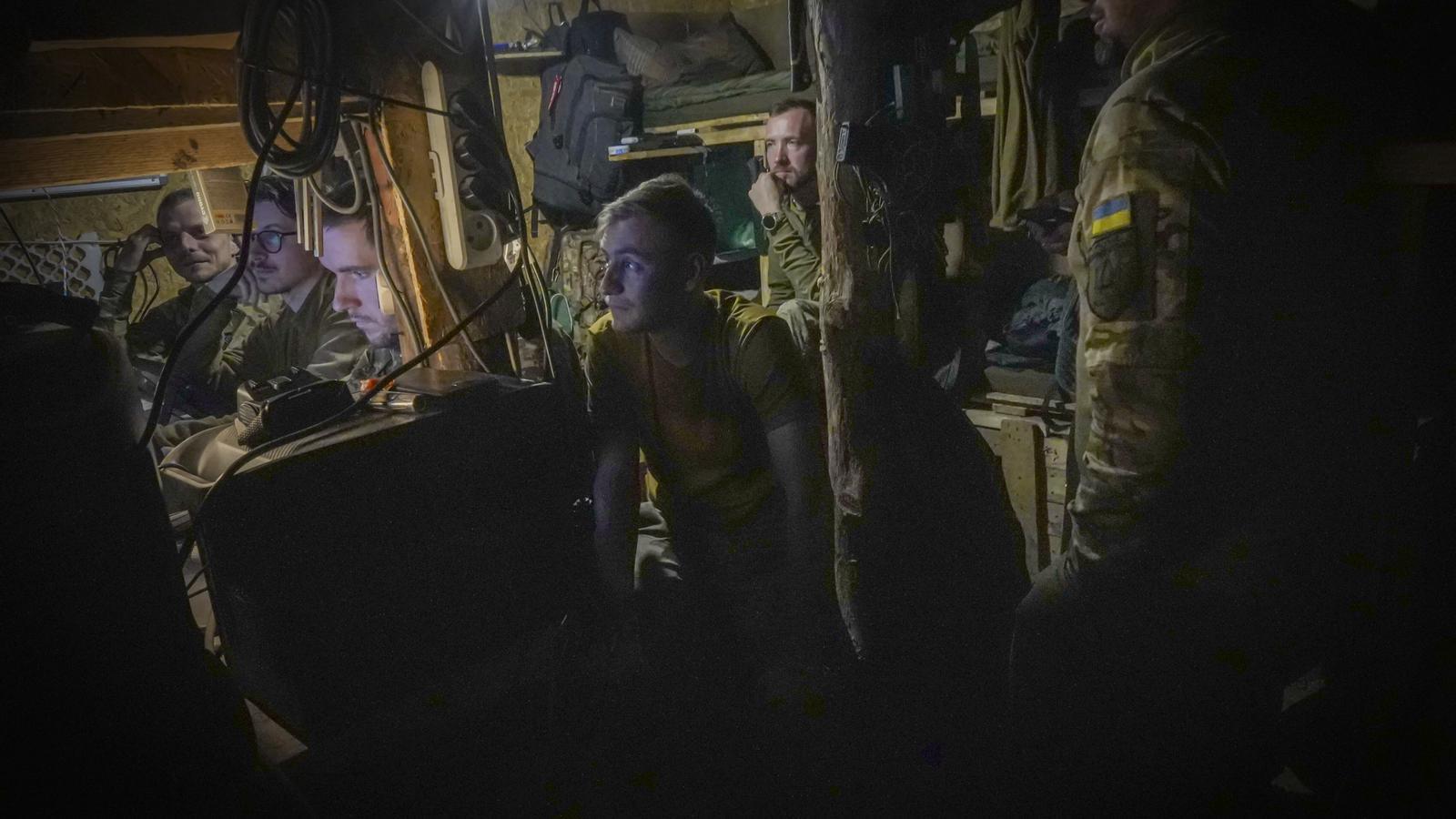
The front, however, is only a few kilometers away, and once again the war is decided in control rooms full of screens. In this case, in the middle of nowhere, camouflaged by trees and other foliage. We arrive in a 4x4 through muddy roads. The vehicle stops and is hidden in a slope with vegetation, undetectable by Russian reconnaissance drones. Even if it were, the command post is still several hours' walk away over impassable trails.
Finally, we access an entrance covered by bushes that leads to a descending gallery towards the basement, to a wooden door. Inside, a team of five people, in front of four screens, are in charge of controlling the drones. They work with two types of drones: one large and long-range for reconnaissance, and another smaller one, dedicated exclusively to attack; both are prepared before each mission.
"Recently, the Russians attacked a position," they reply when asked if the enemy also uses the same tactics. They take turns for several hours in front of the screens. "Now artificial intelligence helps us a lot in target selection; when you've been looking at a screen for many hours, you no longer know what you're seeing. AI points out targets that we are sometimes unable to identify."
The fact is that, if anything has changed this war, it is the war itself. When the Russian invasion began in 2022, the concept of a drone was practically non-existent. Now it has become a central element of any offense or defense, and there are no longer just aerial drones: there are also land and amphibious ones. "This is just the beginning," says Nineth, the war name of the unit's operations commander.
