The global players vying for control of the Arctic: who's who at the North Pole?
The world's major powers are fighting for control of the waters and natural resources of the Arctic region.


-
CAT -
CAST
Barcelona"Let us make the northern part of the planet, the Arctic, a zone of peace. Let the North Pole be a pole of peace. We suggest that all interested states initiate talks on limiting and reducing military activity in the North as a whole, in both the Eastern and Western Hemispheres." In this way, four decades ago, Mikhail Gorbachev advocated for "a radical reduction in the level of military confrontation" in the Earth's far north. In a famous speech from Murmansk, the last leader of the Soviet Union emphasized the importance of the Arctic for moving toward a more cooperative world: "The Arctic is not just an ocean [...]. It is where the Eurasian, North American, and Asia-Pacific regions meet, where mutually opposing and non-aligned borders intersect."
It was 1987, at the end of the Cold War. And, indeed, the Arctic saw its geostrategic importance diminish over the next thirty years. Through the Arctic Council, the world's major powers sought common ground rather than competition. But this is now a thing of the past. Over the last decade, geopolitical tensions in the Arctic have skyrocketed, and this region, rich in hydrocarbon and mineral reserves, has become a kind of chessboard for a game of global strategy and conquest.
It is estimated that the region holds 13% of the world's untapped oil and 30% of its undiscovered natural gas reserves. It also has many other natural resources such as iron, nickel, copper, and rare earth elements. Until now, exploitation has been hampered by the high costs involved, but climate change could make it more accessible. At the same time, the increasing thaw This makes the northern (or northeast) sea route a viable alternative for trade between Asia and Europe.
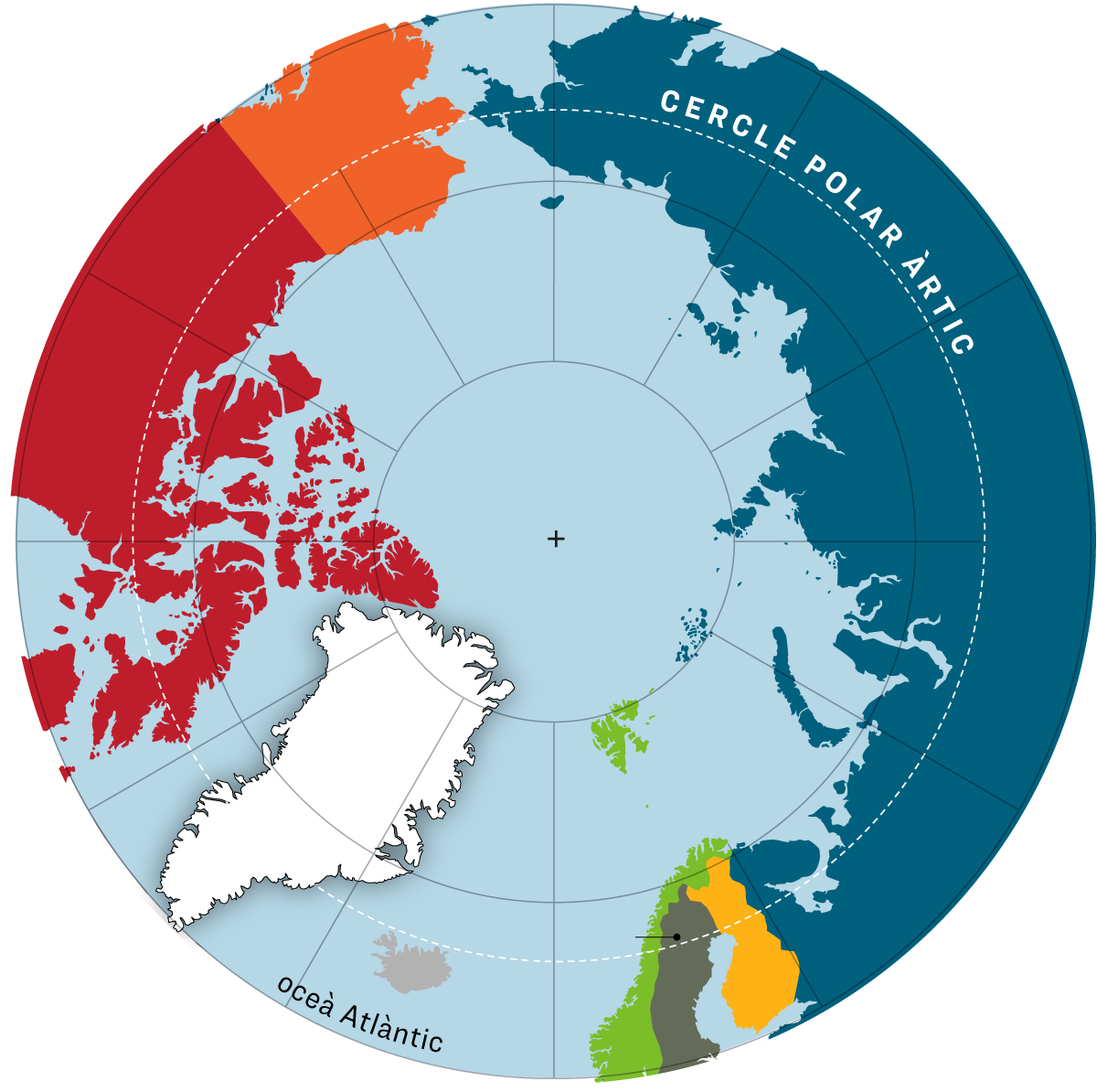
ALASKA
CANADÀ
RÚSSIA
POL NORD
GROENLÀNDIA
Svalbard
(Noruega)
NORUEGA
SUÈCIA
FINLÀNDIA
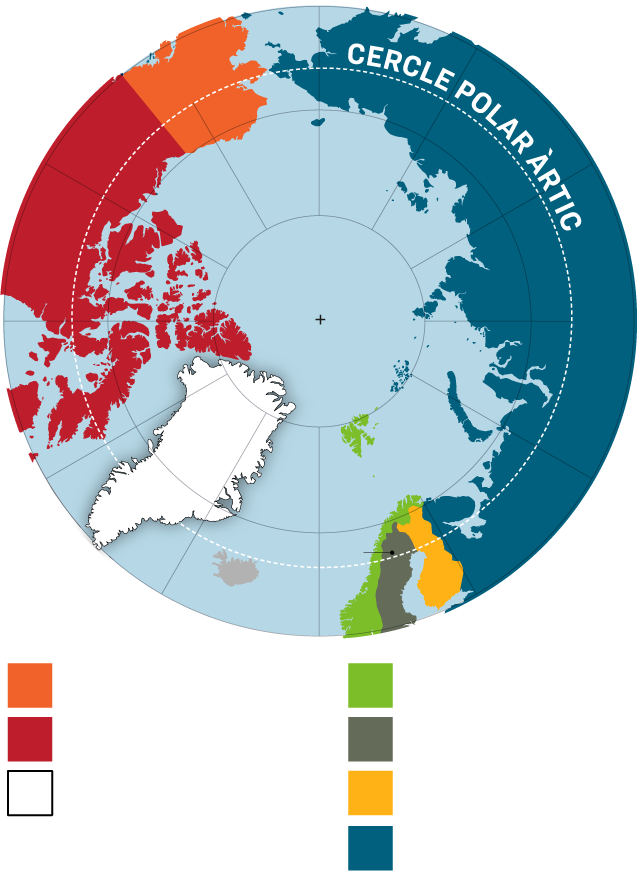
POL NORD
Alaska (EUA)
Noruega
Suècia
Canadà
Finlàndia
Groenlàndia
Rússia
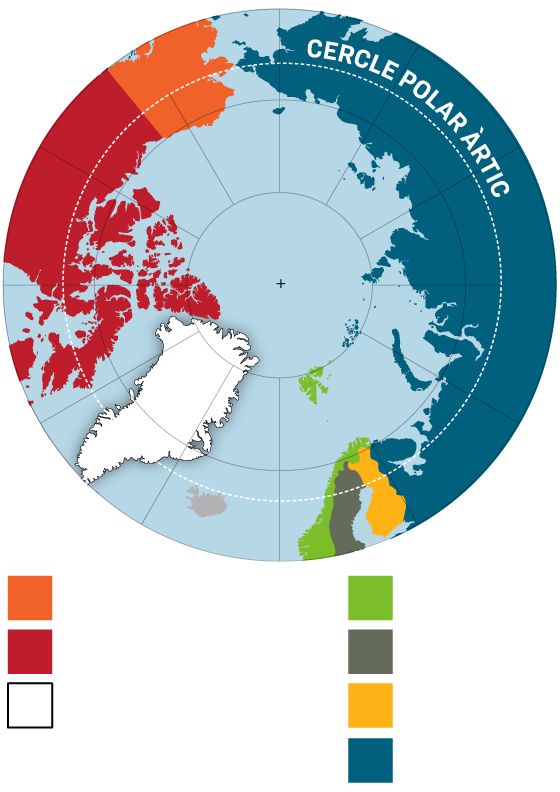
POL NORD
Alaska (EUA)
Noruega
Suècia
Canadà
Finlàndia
Groenlàndia
Rússia
Russia's annexation of Crimea marked a turning point in this dynamic of cooperation. And the global escalation of conflict following the war in Ukraine has further intensified the confrontation between blocs. Moreover, Sweden and Finland, traditionally non-aligned, are now NATO allies, meaning that all Arctic states are members of the Atlantic Alliance, except for Russia. But now, with Donald Trump's return to the White House, the traditional division into geopolitical blocs (the West vs. the Russia-China bloc) has also been shattered, as demonstrated by the US president's threat to conquer Greenland by any means necessary. Among his main arguments is the need to guarantee the island's security against threats from Russia and China. Trump has also suggested that Canada, another country with an Arctic presence, should become a US state. Meanwhile, Europe—which has a presence through Denmark, Sweden, Norway, and Finland—is adrift in this context of a return to a kind of Cold War, this time with a new actor, China, despite the distance that separates it from the North Pole.
Who are the main actors in this Risk What's being played out in the Arctic, and what interests are involved?
Russia
Hydrocarbons, maritime trade and defense
Russia is the Arctic state with the most Arctic coastline and also the country with the largest population in Arctic territory. In 2020, the Kremlin published its strategy for the region through 2035. It focuses on the exploitation of natural resources, especially liquefied natural gas—projecting a tenfold increase in production—and oil, but also solid minerals. And it plans to strengthen the Northeast Shipping Route to export these resources.

To protect its interests in the Arctic—and in a context of increasing global belligerence—Russia is reinforcing and improving its military capabilities on the Kola Peninsula, where the Northern Fleet, the main base of the Russian Navy, is based. It has reopened facilities that had been abandoned since the end of the Cold War and deployed air defense systems, missiles, fighter jets, and military-capable icebreakers. All countries with territory within the Arctic Circle have the right to exploit resources on the seabed and subsoil within a 200-nautical-mile radius of the coast. Russia has the largest territorial claims on the continental shelf: it claims as its own an area above one of the largest known hydrocarbon reserves, the Lomonosov Ridge. As early as 2007, it sent two submarines, and the expedition planted a Russian titanium flag. But Canada, the US, and Denmark are demanding a clear definition of the borders.
China
A "near-Arctic state"
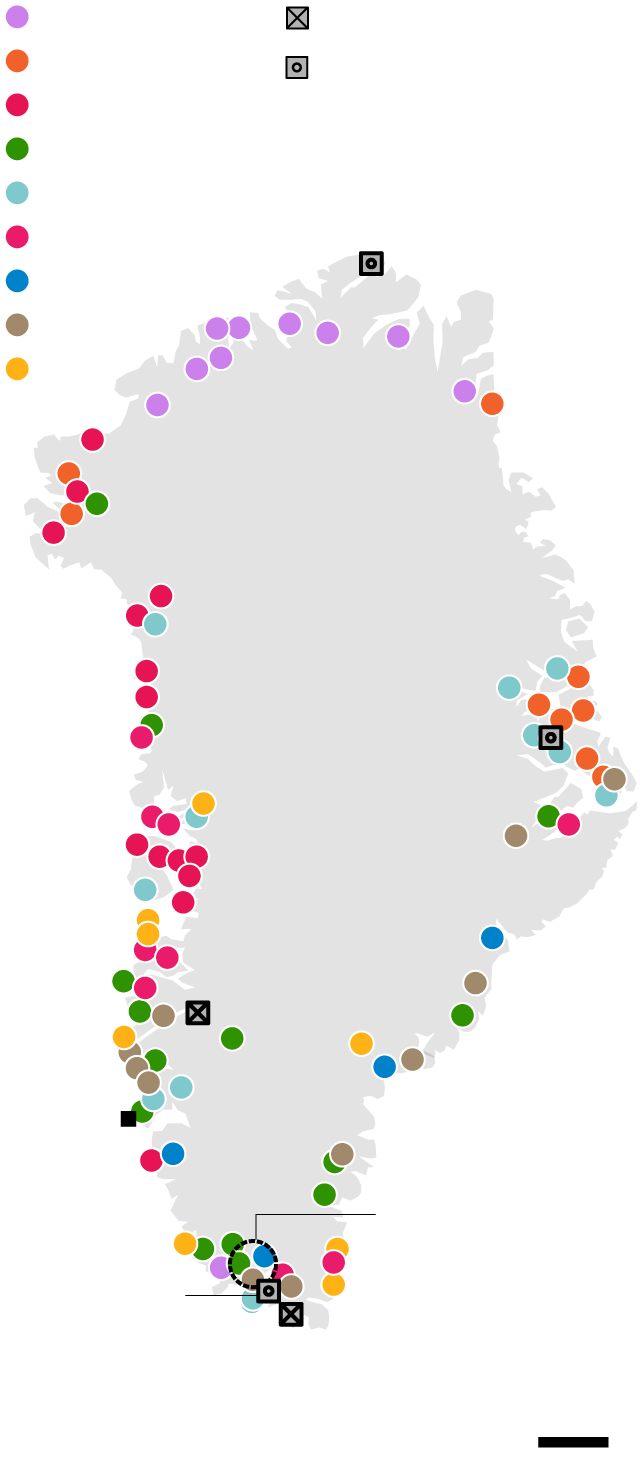
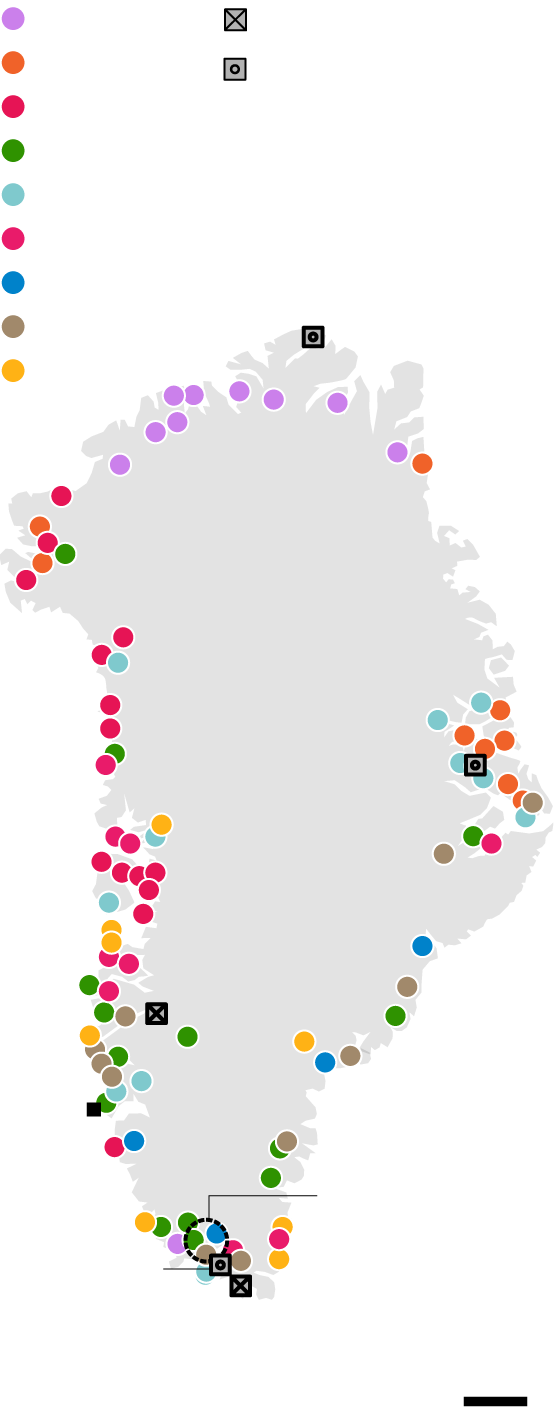
In 2018, China launched its Arctic strategy and referred to itself as a "near-Arctic" state, a definition that has generated controversy and, above all, set off alarm bells in Washington. Over the past few years, China has attempted to increase its presence in the region, primarily through scientific expeditions, infrastructure investments, the development of communication systems, and projects related to the extraction of natural resources. Economically, China is promoting the Polar Silk Road and seeking to develop maritime routes that could significantly reduce transit times between Asia and Europe. It has also attempted to establish a presence in Greenland, so far without success. First, it tried to win the bid to build two airports on the island, but pressure from Washington on Copenhagen led Denmark to ultimately invest in its projects. The other major attempt was through the project to exploit a vast rare earth deposit in the south of the island (Kuannersuit). But in 2021, the Greenlandic Parliament blocked it on environmental grounds, because the project involves the extraction of large quantities of uranium. Although it does not have military bases in the region, Beijing has been strengthening defense cooperation with Moscow. Furthermore, the Pentagon and analysts have warned of the risk that China could use scientific and economic activities in the Arctic for military and intelligence purposes.
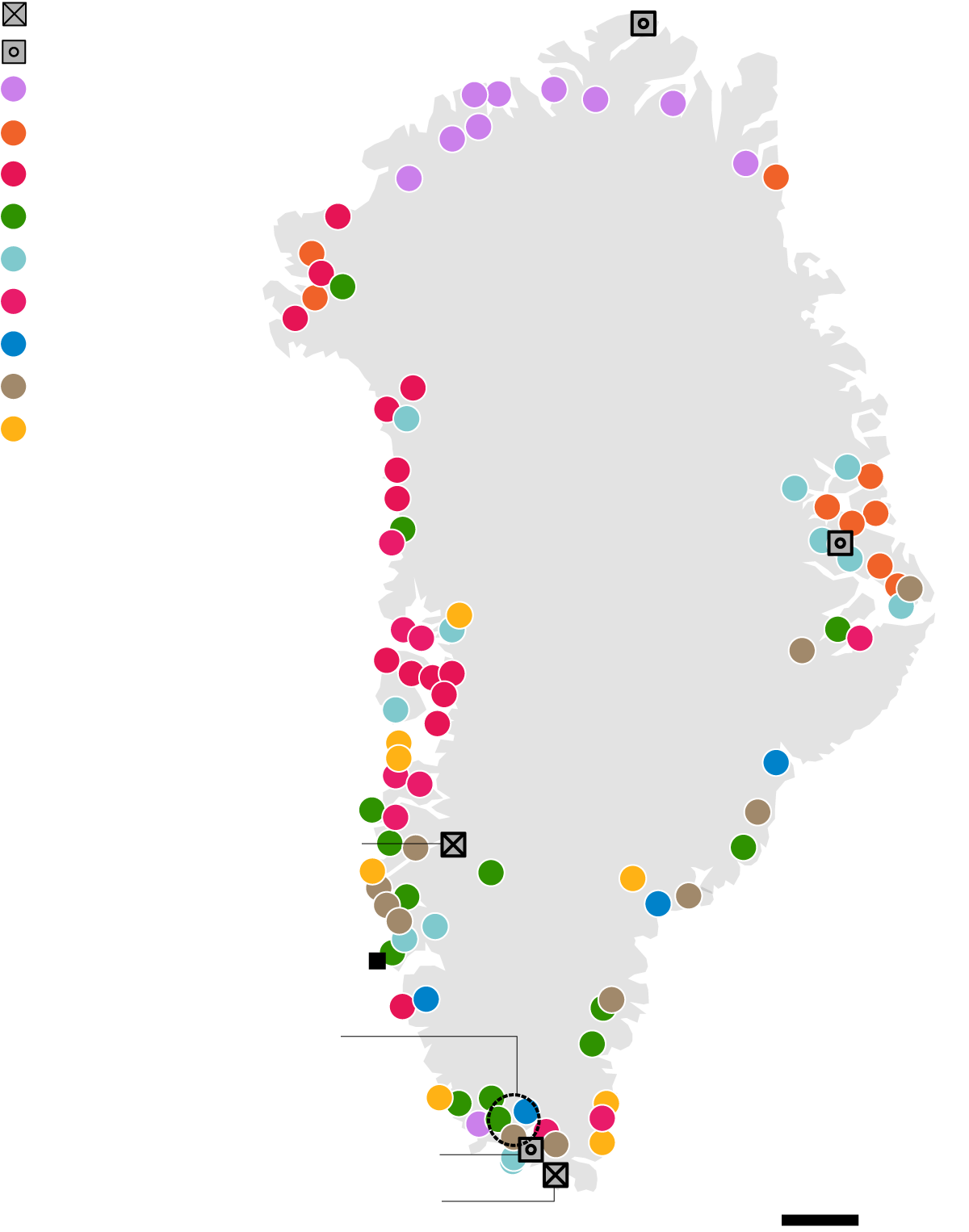
Mina
Citronen Fjord /Zinc
Llicència d’explotació
Zinc
Coure
Ferro
Terres Rares
Tungstè
Diamants
Titani-Vanadi
Níquel
Or
Piiaaffik Høstakken / Tungsté
Qaqortorsuaq / Anortosita
Nuuk
Kuannersuit
Dipòsit important de terres rares
Killavaat Alannguat / Terres rares
Mt. Nalunaq / Or
200 km
Zinc
Mina
Coure
Llicència d’explotació
Ferro
Terres Rares
Tungstè
Citronen Fjord /Zinc
Diamants
Titani-Vanadi
Níquel
Or
Piiaaffik Høstakken
Tungsté
Qaqortorsuaq
Anortosita
Nuuk
Kuannersuit
Dipòsit important
de terres rares
Killavaat
Alannguat
Terres rares
Mt. Nalunaq
Or
200 km
Zinc
Mina
Coure
Llicència d’explotació
Ferro
Terres Rares
Tungstè
Diamants
Citronen Fjord
Zinc
Titani-Vanadi
Níquel
Or
Piiaaffik Høstakken
Tungsté
Qaqortorsuaq
Anortosita
Nuuk
Kuannersuit
Dipòsit important
de terres rares
Killavaat
Alannguat
Terres rares
Mt. Nalunaq
Or
200 km
USA
Imperialist expansionism in the Arctic
The United States has a presence in the Arctic Circle through Alaska. Washington's interest in this region has grown significantly over the past five years, primarily in response to Russia's strategy and China's growing influence in the area. Greenland, as has become clear in recent weeks, plays a crucial role In this game between the world's great powers, due to its strategic position and the wealth of its subsoil.
In recent years, Washington has reinforced its military bases in Alaska and Greenland, especially for missile defense, and has carried out several military operations with nuclear submarines.
Canada
Protection of sovereignty
Canada has the second longest Arctic coastline in the world, after Russia. Ottawa's priority in the Arctic is protecting its sovereignty in the region. In addition to threatening to annex Greenland, Trump has also threatened to annex its northern neighbor, which he wants to make the "51st state." Prime Minister Mark Carney has announced Canada's largest increase in military spending since World War II and has promised major infrastructure projects to reinforce Canadian dominance in the Arctic. One of its main battles is the territorial claim over sovereignty of the Northwest Passage, a historically frozen sea passage connecting the Atlantic and Pacific Oceans, which is becoming increasingly open due to melting ice. However, the US rejects this claim and considers it an international waterway, even though it crosses Canadian territory.
The struggle to gain influence
The European countries with a presence in the Arctic are Denmark (through Greenland), Norway, Sweden, and Finland. This global competition for influence in the region and the shift in global geostrategy have caught Europe off guard. The Nordic states have been forced to strengthen their defenses, especially in the face of growing Russian threats, now compounded by the threat from Trump. This week, Denmark announced that both Danish soldiers and other NATO allies will be deployed to the Arctic. They will reinforce security in GreenlandBeyond rearmament, Europe will also try to secure access to natural resources crucial for the industries of the future if it wants to advance its strategy of gaining autonomy from China, the world's leading player in the extraction and processing of rare earth elements.2023 passed the EU's critical raw materials lawwhich sets the objective that by 2030 at least 10% of European demand for these materials be extracted within European territory and that no more than 65% come from a single third country. This should be achieved, at least in part, with the exploitation of large European reserves in the Arctic.

