The extreme right sweeps in Saxony-Anhalt with 44% of the votes, according to the first polls
It means more than doubling the AfD's result compared to the 2021 elections, but it is still not clear if it will have enough support to govern
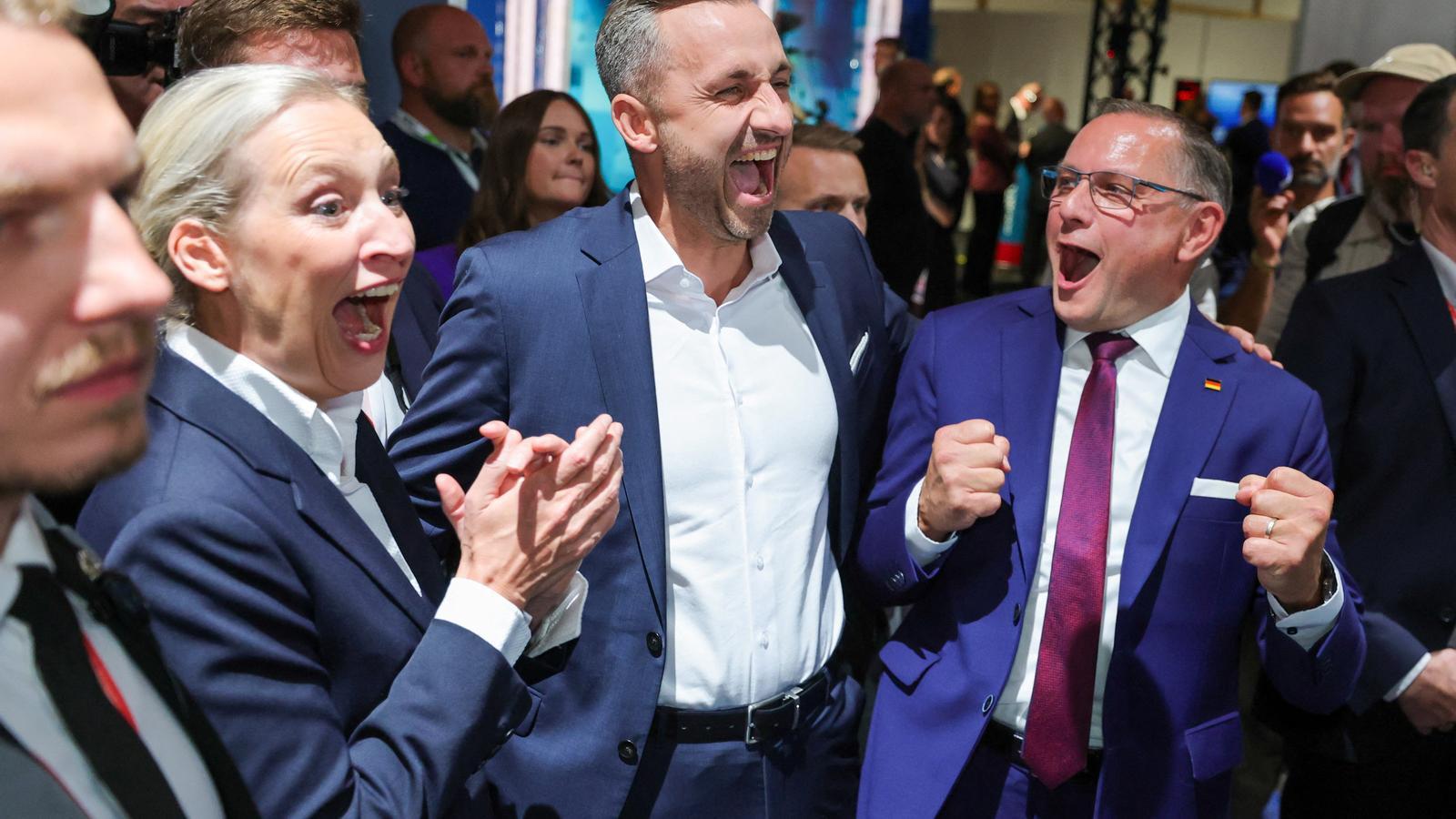

BarcelonaThe far-right party Alternative for Germany (AfD) has swept the elections in Saxony-Anhalt, as all polls had been predicting for months, according to projections released at the closing of the polling stations, on a day with a record turnout of 76.5%. The AfD is estimated to have obtained 44.5% of the votes, according to polls by the broadcaster ARD, compared to the 20.8% of the votes it recorded in 2021.
The provisional results also confirm the clear defeat of the Christian Democrats of the CDU, led by the current Minister-President of the state, Sven Schulze, who would achieve 18.5%, a drop of more than eighteen percentage points compared to the previous elections. Even so, he could revalidate his position if he manages to strike a deal with enough parties by virtue of the brandmauer, the cordon sanitaire that has so far prevented the ultras from reaching any position of power.
The key, at this moment, is to know if the Sahra Wagenknecht Alliance (BSW) party manages to exceed the 5% of the votes required to have representation in the regional Parliament. ARD polls grant it a bare 5%, while the ZDF channel poll gives it 4.8%. This formation –a party considered far-left but with a very tough stance on immigration– is the only one that has shown itself in favor of supporting the AfD to govern. But if it stays out, it could also favor the AfD in the distribution of seats and the ultra party could end up totaling 43 deputies in an 83-seat chamber, according to data from Infratest Dimap. For the moment, the projections grant 39 seats to the ultra party.
If this happens, it will be the first time since Nazism that a far-right party returns to power in Germany. "We have made history in this country," celebrated the AfD candidate in Saxony-Anhalt, Ulrich Siegmund, who has extended a hand to "all democratic forces that want to carry out better policies" and stressed that issues such as migration and national security are non-negotiable. His main rival, the leader of the CDU, has already congratulated the AfD on the victory. "Some say it is a dark day for Saxony-Anhalt. I say: It is democracy," he stated, and said that the party will have to manage this result.
The good results for the AfD in this state could be repeated on September 20th in the state elections in Berlin and Mecklenburg-Western Pomerania, both also in the east of the country. This would place even more difficulties on the federal government, led by the Christian Democrat Friedrich Merz, who is increasingly unpopular.
The state leader of the AfD, Alice Weidel, has considered the results as "a clear mandate to govern" and has said that they are willing to talk to any "reasonable" group. The party already made history in September 2024, when it came in first in the elections in the state of Thuringia —led by the party's most extreme leader, Björn Höcke, convicted twice for making Nazi proclamations in public—, with 33% of the votes, ten points ahead of the CDU. In the last federal elections, in February 2023, the AfD achieved 20% of the votes, the second most voted party. Until now, however, the radical group has only managed to win four mayoralties in small municipalities, and the strategy of the cordon sanitaire has generally prevailed.
The nostalgia for a past not lived
Siegmund has exploited the nostalgia for the past before the reunification of the two Germanys, even though he did not live through it. The AfD has seized upon what is known as the Vespa of East Germany, the Simson brand, with which the party leader in Saxony-Anhalt has been seen during the campaign. With this, he wanted to reinforce the sense of identity of East Germans and reinforce the feeling of grievance and structural disadvantage with respect to those in the West. Although East Germany has largely recovered its standard of living, many young people still express concerns about financial security and inequality of opportunity. And the AfD has taken advantage of this to capture the youth vote: in the 2025 federal elections, voters in this state between 18 and 34 years old reached 40%, compared to 25% in the previous elections.

The state governments of the states have significant powers in areas such as education and culture. And the AfD proposes a change in schools and cultural institutions to reinforce conservative values (in favor of "normal families" with a father and mother) and marginalize migrants, for example, by segregating refugee children into special classes.
The concern over a landslide victory for the ultra-party also stems from the fact that it is one of the parties closest to the Kremlin in Europe. German security services have warned that disinformation campaigns promoted by Russia against AfD rivals have increased.
Possible minority government
The party that seems clearly left out of Parliament is the liberal FDP, current government partner of the CDU in this state, to which both projections grant between 2% and 2.5% of the votes. The Social Democrats, the third leg of the current governing coalition, have remained with support of around 8%. But the loss of the partners makes things even more difficult for the Christian Democrat leader if he wants to try to form an alternative government to that of the far right. With the FDP out of the equation, only the Social Democrats and the Greens (8.5%) remain, because the CDU has refused to make a pact with Die Linke (third force, with 9%), which it considers far-left.
But an agreement between Christian Democrats and Die Linke will not be an easy task. The chancellor and leader of the CDU himself, Friedrich Merz, has maintained his rejection of Die Linke this week: "Both the AfD and Die Linke have such significant differences with the CDU that cooperation with them is out of the question," he told the newspaper Mitteldeutschen Zeitung. And he stressed that the Christian Democrats are closing the door to any participation of Die Linke in the government or any kind of joint government program. This leaves practically only one option if the goal is to prevent the AfD from governing: that of a three-party minority executive, with the occasional external support of Die Linke, the current model in the states of Thuringia and Saxony.

