The advance of the Houthis in Yemen puts global maritime traffic even more at risk
The group, aligned with Iran, consolidates control of strategic points of the Red Sea while it continues attacking Saudi territory
JerusalemThe Houthis have once again attacked targets in Saudi Arabia this Tuesday, in a new escalation that comes after the group took control of several strategic points on the Yemeni coast of the Red Sea and the Bab el-Mandeb Strait. The missile and drone attacks, which threaten to further extend the conflict throughout the region, have triggered air defense alerts in six Saudi cities, including Yanbu, the country's main oil port on the Red Sea, and Riyadh has warned that it will respond "firmly," adopting "all necessary operational measures."
These new attacks come after the Houthis claimed they had launched several missiles and drones against the King Khalid airbase in Khamis Mushayt, in southern Saudi Arabia, and following a rapid offensive by the rebels, aligned with Iran, along the coast of Yemen.
The Houthis have controlled the north of the country since 2014, including the capital, Sanaa, and a large part of the western coast, where the majority of the population lives. The internationally recognized government, with the support of various local armed forces, maintains control of much of the south and east, including the port of Aden.
On Monday, the Houthis announced the capture of the Hanish Islands, located about 160 kilometers north of the Bab el-Mandeb Strait, a strategic maritime passage that connects the Red Sea with the Gulf of Aden and, from there, with the Indian Ocean. In other words, it is a key strait for cargo ships heading from Asia and the Middle East toward the Suez Canal.
In recent days, the rebel group has taken the port city of Mokha, on the mainland coast, and the island of Perim, located within the Bab el-Mandeb Strait, which is only twenty kilometers wide in some parts. Shipping routes through the strait pass less than five kilometers from the island of Perim, very close to the Houthis' missiles and drones.
These conquests strengthen the group's control over one of the region's main maritime routes and have placed it just about 32 kilometers from the United States military base in Djibouti, on the other side of the strait.
- If you want to investigate the chart in more detail, open the high-resolution version in another tab.
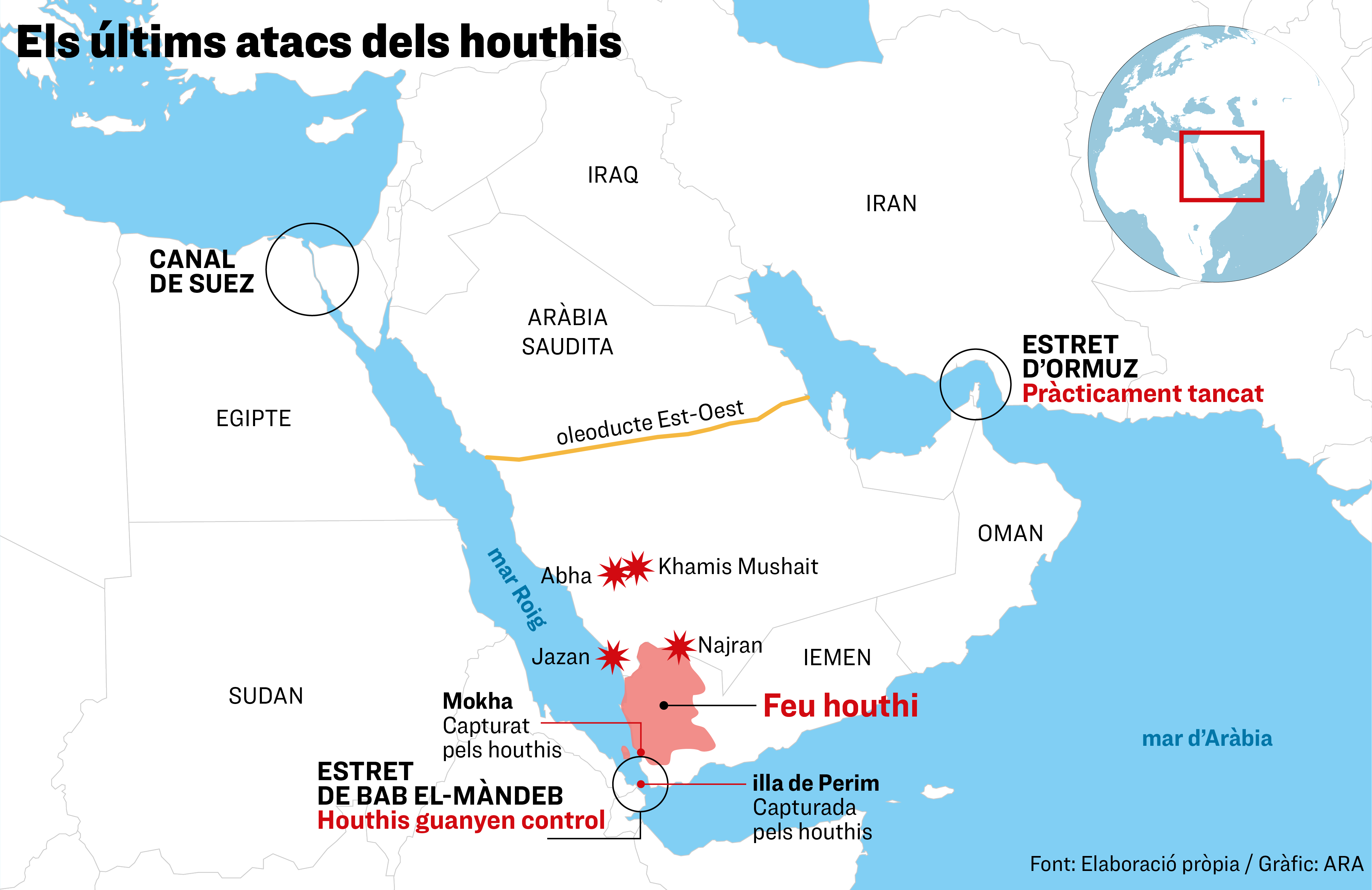
Control of Bab el-Mandeb has acquired growing importance amidst the war between the United States and Iran and the de facto blockade of Hormuz since February 28, especially because it is a key route for the transport of Saudi oil. With transit through the Strait of Hormuz heavily restricted, the Saudi kingdom depends increasingly on the infrastructure that allows crude to be transported from the country's eastern oil fields to the Red Sea ports without having to pass through the strait.
Attacks on oil infrastructure
In this context, the Houthis' advances along the coast and the attacks that the rebels have maintained for more than a month against Saudi oil infrastructure add pressure on their exports. The fighting intensified in July, when the rebels declared a maritime blockade against Saudi Arabia and began attacking Saudi ships in the Red Sea.
But Saudi Arabia is also under growing pressure from other fronts. On Friday, in fact, the Saudi government reported that a strategic oil pipeline that crosses the country from east to west and connects the producing areas with the Red Sea ports had suffered "several attacks," which Riyadh attributes to drones launched by Iraqi militias aligned with Iran. The pipeline has been closed "as a precautionary measure" and the Saudi authorities have not specified when it will be possible to reopen it, but experts estimate that repairs could take between three and five weeks. All of this is already having an impact on the markets: this Tuesday morning the price of Brent crude was up 1.17%, to 106.92 dollars per barrel.
The Yemeni government is trying to regroup its forces
While the attacks between the rebels and Saudi Arabia show no signs of stopping, Yemeni government forces, with the support of Saudi Arabia, are attempting to reorganize following the rapid advances of the Houthis. On Sunday, the government army reported airstrikes against rebel positions in Mocha, the coastal town of Dhubab, and other points in the Taiz province.
In Yemen, the new escalation threatens to plunge the country back into a war that, since 2014, has already left more than 150,000 dead and has caused one of the worst humanitarian crises in the world, with millions of people on the brink of famine. After years of fighting, the front had remained relatively stabilized since 2022, although without a formal peace agreement, but the last few months have broken that calm once again. According to the Yemeni government's Ministry of Human Rights, about 150 civilians have died in the fighting since September 3rd and more than 200 are said to have been wounded. These figures have not been able to be verified independently.