Tensions rise in the Strait of Hormuz as Iran attacks cargo ships
Tehran warns that any ship carrying oil to the US, Israel, or their partners will be seen as a "legitimate target"


BarcelonaThe Strait of Hormuz has become one of the most volatile areas in the Middle East since the start of the Iran-Iraq War, but the events of the last few hours, with four cargo ships attacked, threaten a further escalation of hostilities at a strategic point for global hydrocarbon trade. Tehran warned that the bombing in this area will increase, while the United States also intensified its attacks on Iranian warships and threatened to use more force. On Wednesday, four ships were reported to have been hit by projectiles while in or near the Strait of Hormuz. They are Greek, Japanese, Thai, and Israeli-owned. These attacks bring the total number of commercial vessels targeted in the region since the United States and Israel launched their joint military operation against Iran on February 28 to 17, according to the UK Maritime Commercial Operations Agency (UKMTO), which oversees the safety of ships and seafarers worldwide.

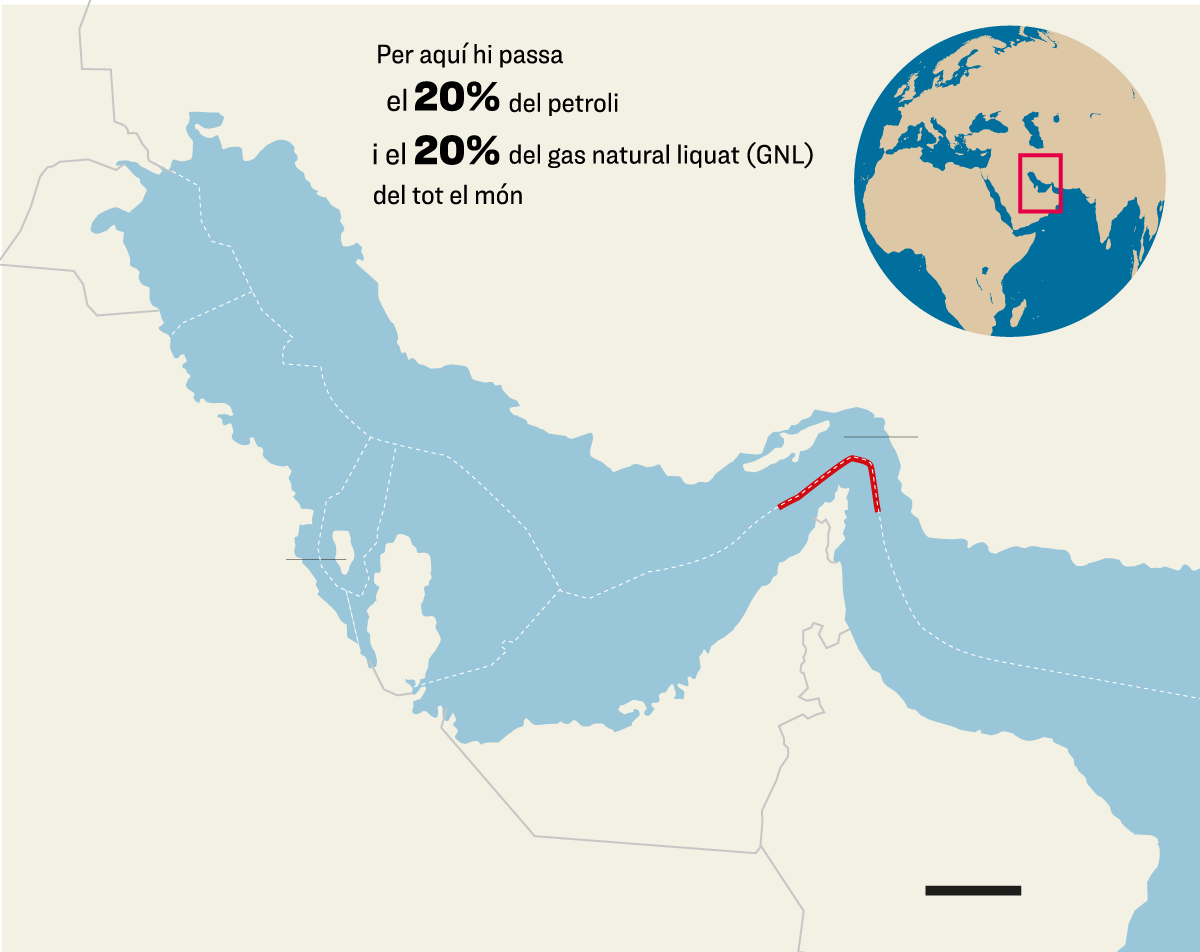
The Strait of Hormuz is a strategic hub for the movement of goods—primarily energy products—between the Middle East and Europe, China and the US, and connects the Persian Gulf with the Indian Ocean. Under normal conditions, some 3,000 ships pass through it daily. It is a maritime passage only 33 km wide, one side of which is controlled by Iran. Between a quarter and a fifth of the world's oil, some 20 million barrels per day, passes through it: tankers from Kuwait, Iraq, Qatar, and the United Arab Emirates must transit to reach international markets. It is also an essential passage for the export of liquefied natural gas (LNG), as Qatar, the world's leading exporter, transports almost all of its production via this route.
IRAQ
KUWAIT
golf Pèrsic
IRAN
ESTRET D’ORMUZ
160 km de longitud
33 km d’amplada
BAHRAIN
QATAR
golf d’Oman
ARÀBIA SAUDITA
EMIRATS ÀRABS UNITS
OMAN
OMAN
100 km
ESTRET D’ORMUZ
160 km de longitud
33 km d’amplada
IRAN
golf d’Oman
EMIRATS
ÀRABS
UNITS
OMAN
OMAN
100 km
ESTRET D’ORMUZ
160 km de longitud
33 km d’amplada
IRAN
golf d’Oman
EMIRATS
ÀRABS
UNITS
OMAN
OMAN
100 km
One of the ships attacked in the last few hours is the Mayuree NareeA Thai-flagged vessel was struck by two projectiles, which caused a fire and damaged the engine room, according to the ship's operator, the Thai company Precious Shipping. They also reported that three crew members are missing and believed to be trapped in the engine room, while the other 20 sailors were evacuated and taken to Oman.
Iran's Revolutionary Guard confirmed that it shelled the Thai vessel, claiming it was "illegally" transiting the strait after receiving warnings from the Iranian navy. They also said they attacked an "Israeli-owned" Liberian-flagged ship.
Earlier, the Japanese container ship had been attacked ONE MajestyA ship sustained minor damage above the waterline from an unknown projectile 46 kilometers northwest of Ras al-Khaimah in the United Arab Emirates. A Greek bulk carrier flying the Marshall Islands flag was also struck by a projectile about 80 kilometers northwest of Dubai. No crew injuries were reported in either incident.
Iranian Threats
Iranian authorities had insisted in recent days that the Strait of Hormuz was not closed. However, the ongoing armed conflict has resulted in a blockade. de factowith thousands of ships stuck around the passage. And in recent hours, the Iranian regime has escalated its rhetoric and threats. "We will not allow a single liter of oil to reach the US, the Zionists [Israel], or their partners. Any ship or tanker heading this way will be a legitimate target," said Ebrahim Zolfaqar, spokesman for the Khatam al-Anbiya headquarters, which coordinates the military with the Revolutionary Guard. "Prepare for the price of oil to reach $200 a barrel, because the price of oil depends on the regional security that you have destabilized," he added. In a statement, the Revolutionary Guard indicated that the Strait of Hormuz remains under the "intelligent management" of its naval forces and warned that "the US aggressors and their partners have no right to transit through it." Minelayers
Media outlets such as CNN and Reuters have reported that Iran is beginning to mine the strait. This morning, Donald Trump warned against it. In a confusing message to Truth Social, he said, "If Iran has laid mines in the Strait of Hormuz, and we have no reports that they have, we want them removed IMMEDIATELY!" He added that if they have laid mines and have not removed them, Iran will face consequences "on a scale never seen before." However, he added that if Tehran removes "what they may have laid, it will be a giant step in the right direction." Following this message, US Secretary of Defense Pete Hegseth reported that the military "has been taking out idle ships that were laying mines in the Strait of Hormuz, destroying them with ruthless precision." And US Central Command announced on social media that it had attacked 16 Iranian mine-laying vessels near the Strait of Hormuz. Hours later, Trump asserted that the US had destroyed "in a single night" almost all of the Iranian ships tasked with laying mines in the Strait of Hormuz and that virtually its entire navy had also been eliminated since the start of the war. One of the options being considered by the United States and other partners is sending warships to the Strait of Hormuz to escort commercial vessels. This has been suggested by, among others, French President Emmanuel Macron, although on Wednesday he admitted that the operation is not very feasible at the moment. Yesterday, US Energy Secretary Chris Wright said that the US had already done so with an oil tanker. However, shortly afterward he deleted the message he had posted on Twitter, and Iran's Revolutionary Guard denied that the US had carried out this operation.

