Genís Rigol: "Entering Fatbottom made me a comic book author"
The Barcelona-based author debuts in the long comic with the feast for the senses of ‘Brunilda en la Plata’
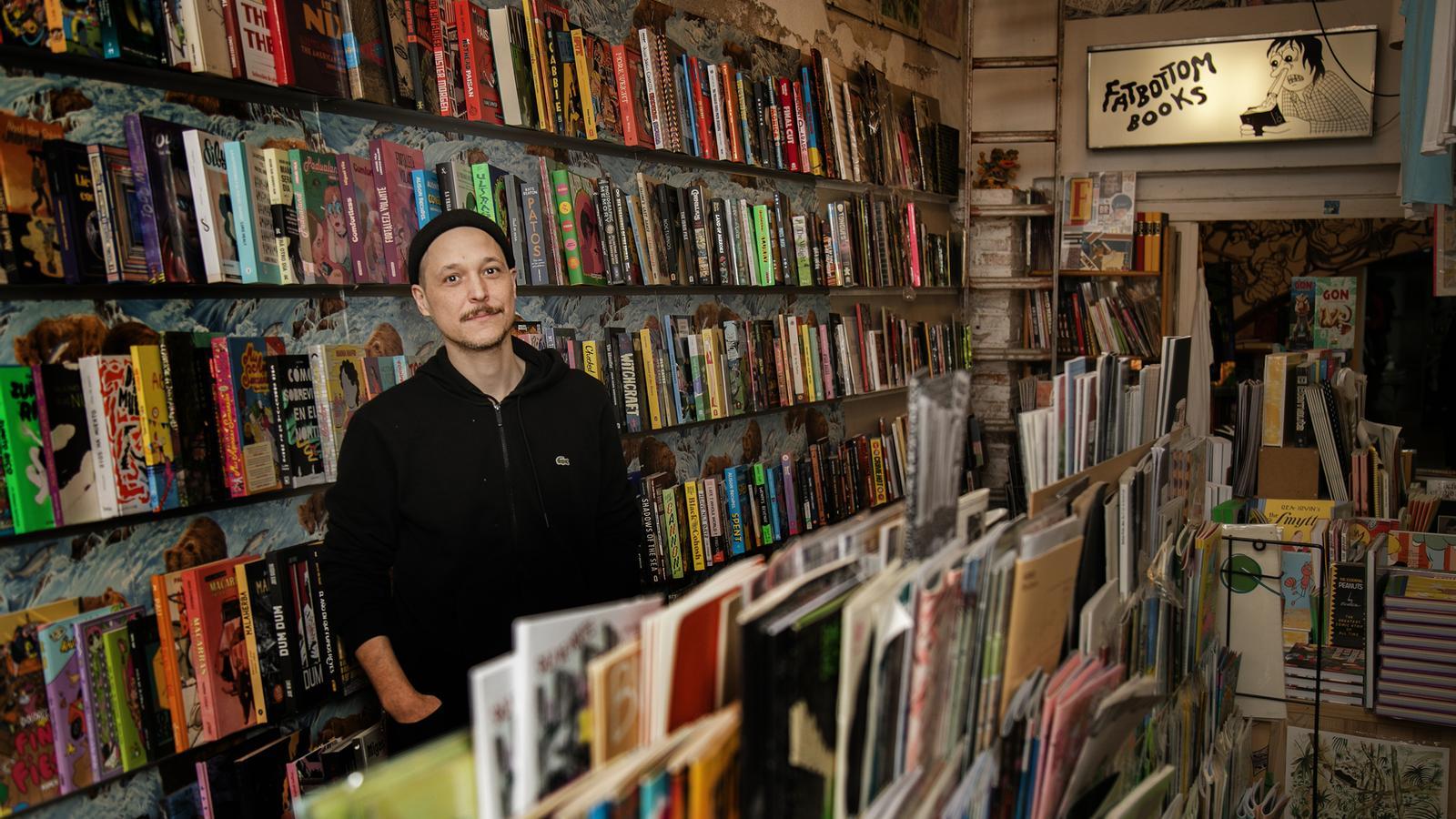
BarcelonaLike so many other children, Genís Rigol (Barcelona, 1982) grew up reading comic books, especially from the golden age of Franco-Belgian comics such as Tintin, Spirou and Marsupilami. But the moment that led him to want to draw comics came as an adult, when he discovered a comic book store in Poble-sec. “I liked to draw and I had done animations, but entering Fatbottom made me a comic author – he recalls–. I discovered the fanzines of Alexis Nolla, Pau Anglada and Marc Torices and I started making short strips. And it helped me realize that I could jump in and make comics simply as a playful act, without needing formal training. In the end, it's a technologically very simple medium: all you need is paper, a pen, and a boring afternoon. But before, I thought you had to be Franco-Belgian, at least, to make a comic.”
In November 2025, after many years of fanzines, collaborations, and animation projects, Rigol published his first full-length comic, Brunilda en la Plata (Apa Apa), an impressive debut that ARA chose as one of the five best comics of 2025. Set behind the scenes of a giant theater where a play has been running for days, the comic follows Norman's efforts to be on time for a date he has with a girl outside the theater. The problem is that to leave he would have to cross the stage, and the play seems to go on forever. As if in a feverish dream, Norman explores every corner of this impossible theater to convince the playwright to write him a small role so he can enter and exit the stage without interrupting the performance. “For a while I read books on dramaturgy and they all talk about the same thing: the inciting incident, the goal, and a series of obstacles to achieve the goal – Rigol recalls–. In theory, the obstacle will be more interesting and profound when it is more internal and has to do with the character's contradictions, but I found it very amusing that it was the other way around, something physical and external like crossing a stage now.”

It also seems like a challenge to dramatic conventions, the choice of a character without personality like Norman, almost a blank canvas onto which the reader can project whatever they want. “Yes, he's a bit like Tintin, who is a somewhat empty character whose likes and desires in life are not very clear, but it wasn't a conscious decision, I arrived at it by chance,” explains Rigol. Although integrated into a kind of surreal vaudeville, Brunilda en la Plata is full of very personal elements for the author, starting with the dream that served as the seed for the comic, to his grandmother's recipes or the embarrassment he felt long ago when he liked a girl, which made him hide his emotions just like Norman does.
In fact, Rigol's comic is above all a personal exorcism of his self-critical voice, the one that questions and sabotages his creativity, an inner voice that, according to the cartoonist, “if we are honest, we all hear inside our heads”. In this sense, making humor about the subject has allowed him to “silence and attenuate these voices” and, therefore, to work on the comic “with much more lightness and without so much stress”. Although, ironically, the success and good reception of the comic is now spoiling the therapeutic benefit. “The other day I found myself thinking that until I make four or five comics that are good, I won't have proven anything, because maybe this one turned out well by pure fluke,” he reflects, between amused and resigned to living with insecurity.
Copying the classics
One of the most fascinating aspects of Brunilda en la Plata is the splendor of Rigol's drawing, which encompasses influences from modern art (Oliver Schrauwen) to, above all, many references to the pioneers of early 20th-century comics. “At first, I copied many authors from that era: George McManus, Winsor McCay, Frank King, George Herriman... And later, while looking for films about the world of theater, I found Children of Paradise by Marcel Carné, which influenced me a lot,” explains Rigol, who prefers to talk about copies rather than influences. “There’s a page that is very similar to a mythical sunday page by Frank King, and I like to say I copied it to demystify that notion of originality –Rigol says–. When you’ve been making a comic for a long time, your life goes on, and everything that happens to you or what you read is incorporated in some way into the final result.” These classic influences can also be seen in the series the cartoonist is publishing in the ARA since April 12: Renau el capgrós.

Beyond references, Rigol's drawing seduces with the voluptuousness of page designs and architectural structures, a feast for the senses that intoxicates the eyes and, above all, conveys an absolute joy in drawing itself. “There are excellent authors who don't enjoy drawing, but I'm one of those who really likes to draw, and I think it shows in the result, because I let myself go and suddenly you reach new places,” he assures. This flow with the rhythm also leads him to include Enric Casasses' poem, Declaration, in the middle of the comic. “It's a poem that Miguel Poveda set to music and that I love because it talks about catúfols, the clay containers that draw water from the well – he explains–. It has something mysterious: some verses I understand perfectly and others I don't understand at all, but I love how it sounds in Catalan.” Catalan is, in fact, the language in which he wrote the comic, although he later translated it into Spanish and this is the final version that has been published. “But I would love for it to be published in Catalan – he assures–. All the fanzines I made before were in Catalan, they were the underground of the underground. And now that I live in France, I have even more of a passion for Catalan. Living abroad makes you value your own language”.
In France, Rigol lives precisely in Angoulême, the capital of Franco-Belgian comics, where he first went with a scholarship from the Maison des Auteurs and then stayed to live there. A good part of Brunilda in the Plata was drawn there. “Life at La Maison des Auteurs was a bit difficult at first, because it coincided with the lockdown and I felt very isolated – he recalls –. But over time you get used to it and you meet people. And I really like the size of the city, that it is small and has a river. If you take the bike, in five minutes you are in the forest”. Rigol, of course, lived firsthand the controversy that caused the cancellation of the last Angoulême Festival, but he has mixed feelings about it. “On the one hand, I feel proud that a stand is taken because what the festival directors did is unacceptable and I am in favor of the reaction against the festival, but at the same time I think there are many people who are not sincere with the reasons they give to defend the boycott, and who are only interested in the battle for control of the new festival”, he explains. Rigol organized with his girlfriend an exhibition about Brunilda in the Plata at an alternative and independent festival that was held in the city on the dates of the cancelled edition. And a few days ago he inaugurated another exhibition at the Huberty & Breyne gallery in Paris. “I would love to be able to exhibit in Barcelona”, he admits.
