Putin travels to China four days after Trump's visit
Beijing boasts of being the center of world diplomacy and accumulates visits from top leaders

-
CAT -
CAST
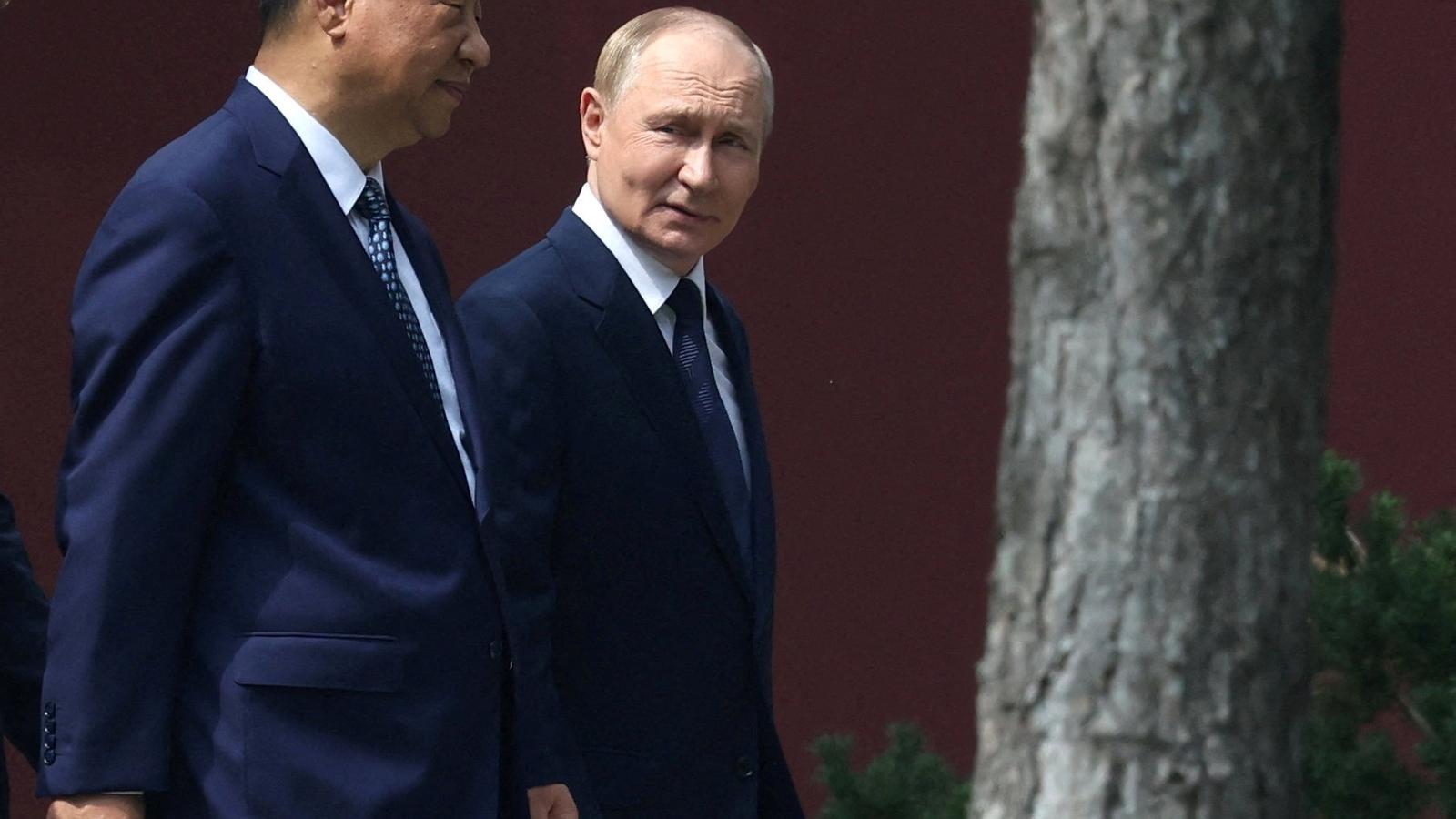
BeijingChina boasts of being the center of world diplomacy and accumulates visits from top leaders. After bidding farewell to Donald Trump four days ago, tonight it will welcome Russian President Vladimir Putin. Xi Jinping has had practically no time to put away the red carpet reserved for distinguished visitors as he is already receiving his main ally, who will be in Beijing for two days.
The leaders will celebrate the 25th anniversary of the Friendship Treaty between the two countries, signed in 2001, and will hold an agenda dominated by bilateral issues. Although agreements related to the economy are expected to be signed, the recent meeting between Trump and Xi Jinping looms over the visit. The results of this meeting and the crisis arising from the US attack on Iran, an ally of both Moscow and Beijing, will focus part of the conversations.
Kremlin spokesman Dmitry Peskov assured on Friday that the trip will be "a good opportunity to share views on the contacts that the Chinese had with the Americans." Beijing emphasizes that the meeting and the relations between Russia and China bring "more stability" to the international stage.
Putin's weakness
Putin arrives in China at a moment of weakness. Ukraine has begun to regain territory from Russian troops and has also managed to get its drones to reach the neighborhoods of Moscow and impact strategic points, such as refineries. China was Russia's little brother for decades, but now the relationship has been reversed. International sanctions imposed on Russia have turned the Asian giant into its main trading partner. In 2025, bilateral trade exceeded 240 billion dollars. China buys a quarter of Russian exports and is the main buyer of Russian gas and oil. Putin would like to close a deal for the construction of a new gas pipeline, which would be added to the two already existing ones and would connect the Siberian fields with China, passing through Mongolia.

Xi and Putin are expected to show good chemistry. The Chinese president will surely not deny Putin the treatment of “friend”, a word he avoided using with Donald Trump. The two countries maintain a relationship of “limitsless friendship” declared in 2022, weeks before the Russian invasion of Ukraine. China has never condemned that invasion. The EU believes that Beijing's economic and political support for Moscow weakens Europe.
¿Epicenter of diplomacy?
Trump and Putin are not the only leaders visiting the Asian giant to meet with Xi Jinping. In recent months, the Chinese president has hosted the French and Spanish presidents and the prime ministers of the United Kingdom and Ireland, not to mention the leaders of Canada and South Korea.
Chinese media, all state-run, boast that China is becoming the epicenter of global diplomacy. An editorial in the Global Times states that the Chinese capital is “easily emerging as the central point of global diplomacy” and that it is exceptional for the leaders of the United States and Russia to visit China within a week. The newspaper also highlights that the visit to Beijing by the other four countries with permanent seats on the UN Security Council shows the Asian giant's weight on the international stage.
Despite this, Putin's visit is considered normal, as the Russian president travels to China every year, almost always in the spring. Since Xi assumed the presidency, the two leaders have met more than 40 times, including official visits, attendance at commemorations, and meetings at forums. Xi Jinping, for his part, has made important state visits to Russia in 2015, 2019, 2023, and 2025.

Donald Trump's visit was indeed more exceptional, as it was the first by a United States president in almost ten years. The North American delayed the state visit to Beijing initially planned for April.
The result of so many meetings with Xi Jinping so far amounts to no more than trade agreements. China's role on the international stage has not translated into any mediating role, neither in Gaza, nor in Ukraine, nor at the moment in the Persian Gulf.
Beijing seems more interested in its own agenda than in resolving international conflicts. From Donald Trump's visit, China has highlighted the warning that Taiwan could be a source of conflict with the United States if Washington supported the island's independence. However, the White House has never defended Taiwanese independence, nor has it distanced itself from adhering to the "one China policy". Although Donald Trump has a weaker position than Biden in supporting Taiwan, it remains to be seen if he will actually cut arms sales and reduce support for the status quo.
Taiwan leads the design and manufacturing of the microchip industry, and a large part of global merchandise transit circulates through its strait. It would be difficult for the United States to leave this industry in Chinese hands. Allowing Taiwan's annexation would provoke a crisis in relations with Japan and South Korea and would redraw the power of the United States in the Indo-Pacific.
