Gaudí and Pepeta's impossible love
The testimonies and biographies reveal a human Gaudí marked by professional difficulties and family losses
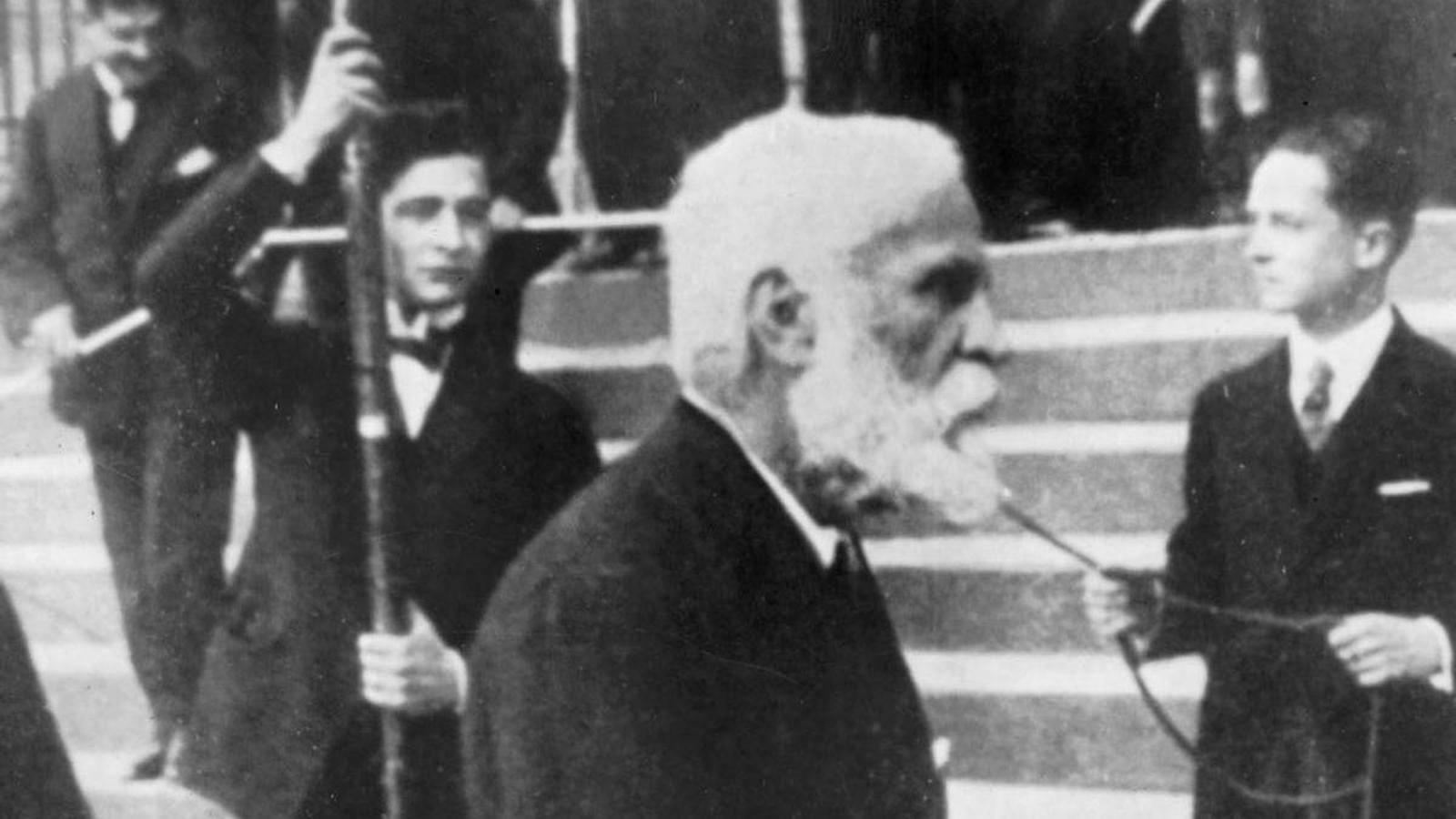

BarcelonaThe draftsman Ricard Opisso (1880-1966) had bitter memories of the Nativity façade of the Sagrada Família: for some years he dedicated himself to killing and dissecting sparrows and canaries to use them as models for the sculpted birds found all over the work. "By Gaudí's inexorable decree, I was in charge of the killing," said Opisso, in a text recovered by architect and Gaudí expert Chiara Curti in the collective biography My Gaudí (Triangle Books). "After taking their lives - he explained - I then had to remove their abdominal viscera, to then arrange them in suitable positions to serve as models for the official sculptors [...] Even today, when I pass by and gaze ecstatically at all that overhang and the ornithological bustle, after more than half a century, I seem to sense in the atmosphere a strange putrid and nauseating stench of decomposing entrails". But the story had a happy ending, because the feat Opisso recounted was saving a canary that an imposing Gaudí had brought him. "Gaudí, with his half-monastic, half-demonic face, looking at me intently, with those blue eyes that pierced the soul and caused shivers, handed me the small cage, at the same time telling me in a rough and domineering voice, in which there was no inflection of tenderness: 'Richard, take this; kill this bird, place it with its wings outstretched in a flying attitude'," recalled the draftsman.
Whether monastic or diabolical, the character who appears in the texts of My Gaudí" is profoundly human, far from the idea of a genius isolated in his ivory tower. "Gaudí was truly a man attentive to his historical moment - affirms Chiara Curti -. We are in this era where everything is judged, instead of trying to understand why things happen. Various disciples of Gaudí comment in their texts that, instead of rebelling against the kind of suffering that the satires caused him, he decides to build something else, his own society. It was a society that did not reflect the one of the moment, but one in which children, poets, friends of all kinds participated, from a shepherd from Puigcerdà to a bishop; that is, a particular society of people who were distinguished not by their position, but by having a pure heart".
In the pioneering biography that appeared about 25 years ago and is published in Catalan by La Campana, Gijs van Hensberg assured that his personality was "totally inaccessible". On the other hand, the theologian and bibliologist Armand Puig, author of Antoni Gaudí, vida i obra (Pòrtic), defines him as "a man sincere in himself, with his imperfections and with his bad temper". Puig also attributes to him "an enormous sweetness of spirit", but acknowledges that Gaudí's inner life has remained a "mystery".
An architect less fortunate than he seems
Currently, Gaudí is the most popular architect worldwide. His buildings receive millions of visitors every year, and some of them are UNESCO World Heritage sites. However, his career was not easy. Curti points out that most of his works share a characteristic: "incompletion." "La Cooperativa Obrera Mataronense was not finished, Casa Batlló is a renovation of a pre-existing house, Las Teresianas were already half-built when he arrived as architect, Parc Güell was never urbanized, the first mystery of glory of the monumental rosary of Montserrat was not finished by him, Torre Bellesguard was also not finished by Gaudí," says the author. And the list continues: "The church of Colònia Güell was also not finished by him, the Episcopal Palace of Astorga and the renovation of the cathedral of Mallorca were not started by him and also not finished by him, not to mention his masterpiece, the Sagrada Família, which he neither started nor completed. Even Casa Vicens, completely designed and built by Gaudí, was modified by another architect shortly after its completion, as he did not want to intervene in it." Furthermore, El Capricho de Comillas was never seen built by him, and the schools of the Sagrada Família, which he himself promoted, were built knowing that sooner or later they would have to be demolished to continue with the works of the basilica.
In addition, the most intimate part of Gaudí's life was determined by family relationships and by the impossible love of Pepeta Moreu, daughter of a wealthy family whom he frequented during the construction of his first building, a factory for the Cooperativa Obrera Mataronense, the current Nau Gaudí. When they met, she was 28 years old, and he was 33. Gaudí declared himself to her four years later, and she rejected him. Among the objections Pepeta had was a lack of hygiene. The refusal caused Gaudí to distance himself radically: as explained by the historian, politician, and man of action Agustí Soler, a distant relative of Pepeta, in the book Pepeta Moreu, Gaudí's Great Impossible Love (Duxlem), Gaudí never returned to the Moreu house or to Mataró.
In his biography, Puig recalls that Gaudí experienced a great spiritual transformation in 1894 following a Lenten fast that brought him to his limit. It was then that he began to resemble the rather ascetic man of his old age portraits, far from the proud man of his youth portraits. At that time, he had lost his mother, brother, sister, and brother-in-law in a short period. And a decade later, he went through another difficult moment when he lost his father in 1906. He stayed with his niece, Rosa Egea i Gaudí, who had fragile health, in the house he owned in Park Güell. Rosa died in 1912 of tuberculosis, and Gaudí remained in that house until 1925, when he decided to move from the house he owned in Park Güell to his workshop at the Sagrada Família.
