New test of fire in Germany: the extreme right aspires to win in another eastern state
Merz risks it all in elections in which the CDU fights for survival in Mecklenburg-Western Pomerania and battles with the left to prevail in Berlin
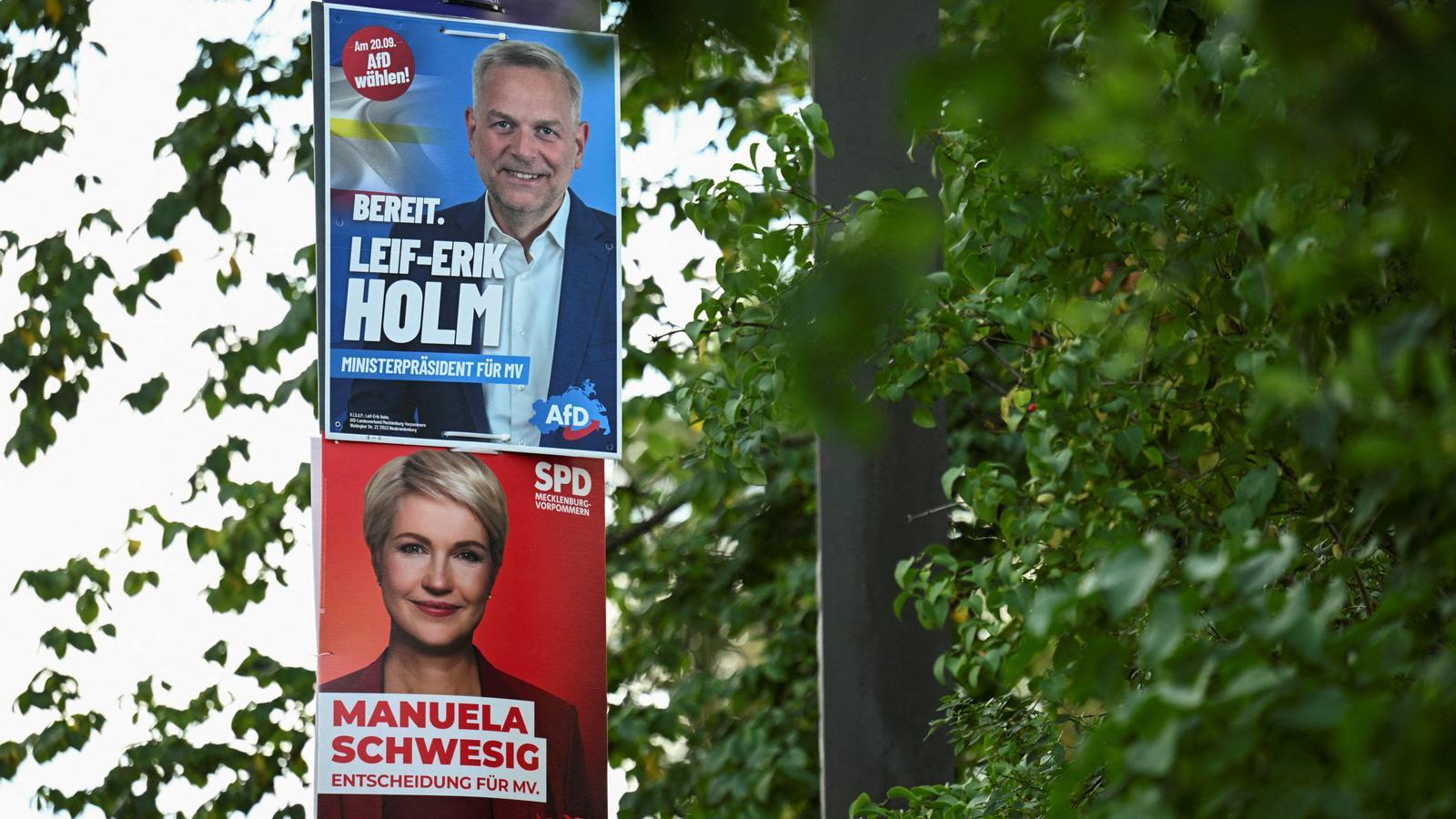
BarcelonaStill in shock from the far-right victory in the eastern state of Saxony-Anhalt two weeks ago, Germany is taking the temperature of the ultra-wave this Sunday in the elections in Mecklenburg-Western Pomerania and also in Berlin. The far-right party Alternative for Germany (AfD) seeks to take advantage of the momentum of the victory in Saxony-Anhalt to try to repeat it in Mecklenburg-Western Pomerania, the second eastern state to head to the polls. And it could achieve it, although far from an absolute majority and with few options to govern. Polls give the AfD 37% of the votes, followed very closely by the Social Democrats, currently in government, with 35%.
Everything points to the traditional right-wing CDU being not just a spectator in the struggle between the far-right and the Social Democrats, but also fighting for its survival in the Parliament of Mecklenburg-Western Pomerania. Polls give Chancellor Friedrich Merz's party 7% of the votes, a collapse that leaves it near the precipice: it needs to reach 5% to retain representation in the regional Parliament.
The elections will be, in any case, a litmus test for Merz, on thin ice since the resounding victory of the far-right in Saxony-Anhalt. Although several regional party leaders rallied around the chancellor, the defeat fueled speculation about whether the conservative leader, who has been governing since May 2025, will finish his four-year term.

The Social Democrats are betting everything on the high popularity of the current head of government in Mecklenburg-Western Pomerania, Manuela Schwesig, who, if the elections confirm the polls, could repeat the left-wing coalition to remain in government. The Social Democratic leader has held power since 2017 and her party has gone all out in recent days: it has filled the streets with posters that position her as the woman against the blue, in reference to the color of the AfD. The Social Democrat is also not exempt from controversy. For many years she had a strong bond with Russia, although her discourse changed following the invasion of Ukraine, and she was also a great defender of the construction of the Nord Stream 2 gas pipeline.
The CDU and the left, neck and neck in Berlin
In Berlin, the CDU –currently in government– and the left ofDie Linkearrive very evenly matched at the regional elections that are also being held this Sunday. In the event that the left wins, it would be the first time it could lead a regional government in Berlin and its candidate, Elif Eralp, could become the first German-Turkish mayor of the capital.
In the two elections this Sunday, the result in Saxony-Anhalt will have an "impact", points out Sophia Russack, from the think tank Centre for European Policy Studies (CEPS), because it was a "warning sign". Left-wing parties are those that especially rely on a greater mobilization of the electorate after the ultra triumph in Saxony-Anhalt. According to the polls, the AfD would double its results in the Berlin regional elections to around 18%, very close to the Left (20-23%) and the CDU (20%). The Greens would be in fourth position, a fact that would open the door to a possible coalition between the Social Democrats, the Left, and the Greens to replace the current conservative government.
In the case of Berlin, the city is electorally very divided. The center is a progressive stronghold that connects with the Greens and the left, while in the west the CDU traditionally wins and in the east the far right. Electoral behavior is explained, says Russack, by the precariousness and living conditions of the citizens of these neighborhoods, and also by the historical separation of the city. "In less than 40 years, you cannot unify [the city] as quickly as one would like," he adds.
Merz, under pressure
The triumph of the AfD and the defeat of the CDU in Saxony-Anhalt have substantially increased the pressure on Merz, to the point that the internal crisis has led him to cancel international trips, such as the one he had planned to New York to participate in the UN General Assembly. "With this chancellor, elections can no longer be won," a representative of the CDU youth wing went so far as to claim. According to the poll by the Forsa polling institute, only 10% of Germans are satisfied with Merz's work.
With his party threatened by the worst result in history in Mecklenburg-Western Pomerania, the outlook does not improve ahead of the general elections, scheduled for 2029. The latest polls point to a decline of the conservatives to 20% of the votes, seven points less than the AfD, and this has set off alarms within the party.

Although the party's top figures have rallied around Merz –including the eight regional ministers of the CDU–, more radical proposals are beginning to emerge among second-tier leaders: from breaking the current federal coalition with the Social Democrats to govern in the minority, to replacing Merz as chancellor. According to some German media, there are about thirty CDU deputies who are considering these options as a dramatic move to deal with the crisis.
The unrest in the CDU stems from the grassroots, and some are directly attacking their governing partner, the Social Democrats, and very specifically the Minister of Labour, Bärbel Bas, whom they consider an obstacle to pushing through the reforms the conservatives want to apply to the social system.
Russack considers that the results in Berlin are more decisive for the federal coalition than those in Mecklenburg-Western Pomerania because the same coalition of conservatives and Social Democrats governs there. Beyond the results, the CEPS expert predicts a bleak future for the federal coalition. "It is a very unfortunate alliance. It is not working because the partners are heading in different directions," she points out.
At the same time that the rift between the conservatives and the Social Democrats is growing, second and third-tier CDU figures in Mecklenburg-Western Pomerania have spoken out in favor of ending the cordon sanitaire with the far right. "We must be open and look for the coalition partner that is best for us, and that partner could be the AfD," said the vice president of the CDU in the Greifswald district, who has emerged as the main enemy of the cordon sanitaire.
