'Mind the noise!': The deafening noise of the Tube tests the health of workers and passengers
Many sections of the London Underground exceed the advisable decibels for health, which the use of headphones can aggravate

-
CAT -
CAST
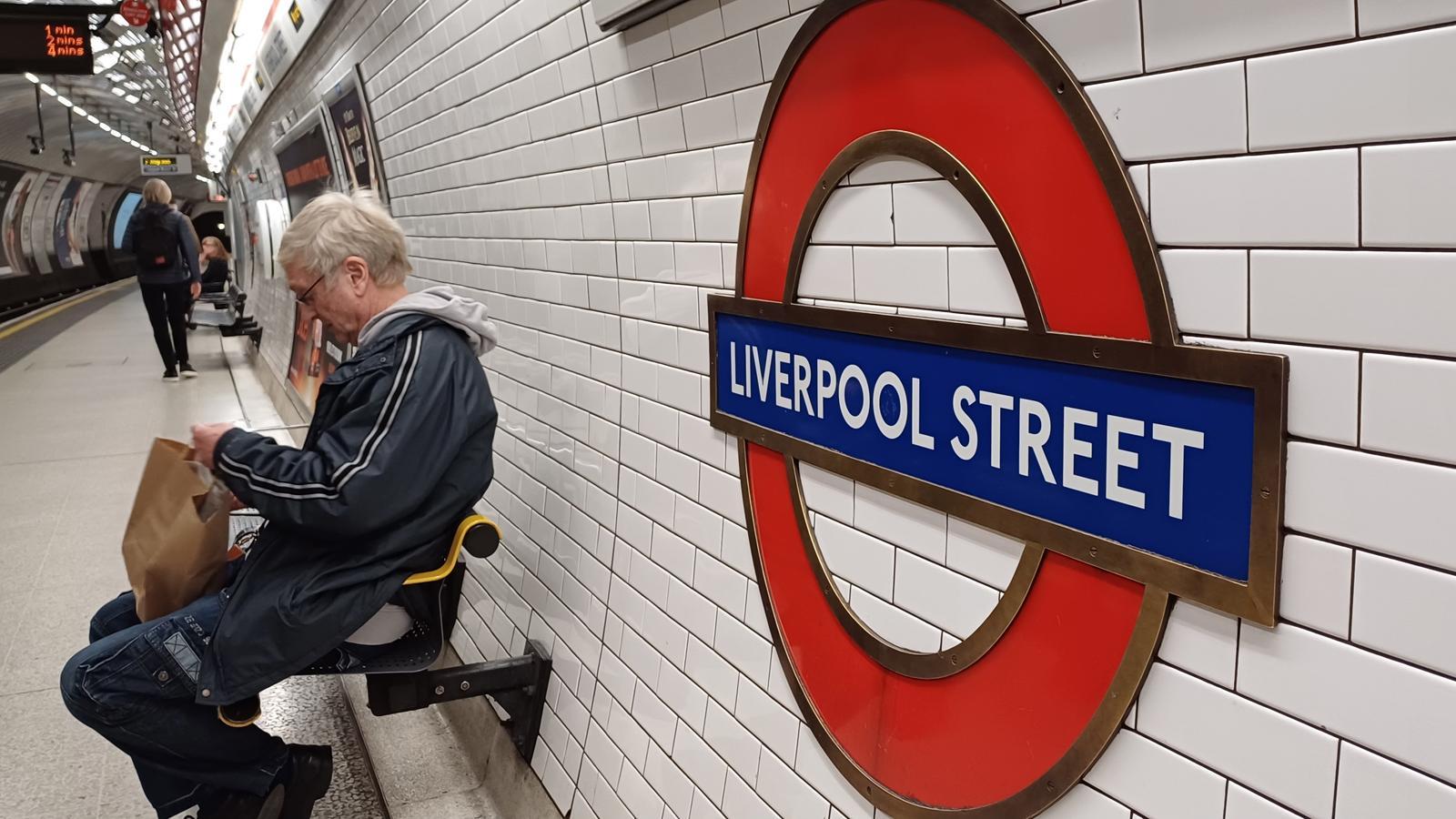
London"Mind the gap!"? No! The popular London Underground slogan to avoid falling into the gap, sometimes huge – at Liverpool Street station on the Central line, for example – between the platform and the tracks, should be replaced by another attention-grabbing phrase: "Mind the noise!" (Watch out for the noise!).
Why? Have you ever tried to hold a conversation between Highbury & Islington and Finsbury Park stations on the Victoria line? Or between Finsbury Park and Seven Sisters, also on the Victoria line? Difficult or very difficult if your interlocutor or companion is next to you. And completely impossible if they are sitting on the other side of the central aisle of the carriage. Before you could understand each other, you would be hoarse. The London Underground is not an ideal place to debate anything.
Every day, on average, around 1.7 million people make at least two journeys, and they all share an annoying experience: a persistent, metallic, and often deafening noise accompanies every journey like a soundtrack steeped in the commute.
The screech that echoes between Highbury & Islington and Finsbury Park or between Finsbury Park and Seven Sisters is not an acoustic anecdote, but the clear symptom of a structural problem that Transport for London (TfL) has been trying to contain for decades. Other lines, such as the Northern or the aforementioned Central, have also been identified in a July report by the London Assembly as some of the most critical areas of the network. This is a recurring problem.
The soundscape, which Londoners have no choice but to normalize, hides figures that explain why every conversation on the Tube becomes a frustrating exercise in vocal projection. The measurements taken by the London Assembly for the aforementioned study place the usual noise between 70 and 90 dB, but in specific sections it exceeds 100 dB, a level comparable to attending a music concert or being next to a helicopter at takeoff.

These detected levels, expressed with a weighting that takes into account the sensitivity of the human ear to different frequencies, show that on the Victoria line operators are systematically exposed to more than 85 decibels; on the Jubilee, between Swiss Cottage and Finchley Road, peaks of up to 103 decibels have been recorded; on the Northern, near Tufnell Park, the volume reaches 93 decibels; and, on the Central, in the deep tunnels between Liverpool Street and Bethnal Green, 92–93 decibels are exceeded.
However, intensity does not explain everything: potential hearing damage also depends on exposure time. A peak of 103 decibels lasting a few moments does not have the same effect as prolonged exposure to high levels. For metro workers, who spend hours every day in their work environment, this accumulation is particularly relevant, even though they wear protection. But, in the long term, the problem can also pose risks for regular passengers when, in addition to the noise of the train, they add their own headphones.
Because a factor that particularly concerns audiologists is the way passengers react to the extreme noise of the Tube. When the metallic screech exceeds 90 or 100 dB, users traveling with headphones may tend to turn up the volume to counteract the external noise. It is an intuitive response, but it can considerably increase sound exposure. In an already very noisy environment, listening to music at a high volume during daily commutes can increase the risk of cumulative hearing damage and tinnitus. The problem, therefore, is not only the noise generated by the metro, but also what passengers add to it in an attempt to stop hearing it.
The World Health Organization sets the reference threshold at 80 decibels for exposure of up to 40 hours per week, but the margin is rapidly reduced as noise increases: every three additional decibels reduce the recommended exposure time by approximately half.
Causes and solutions
The causes of so much noise are multiple and, for the most part, structural. For example, what they call rail corrugation: the wavy wear in the form of small regular waves on the surface of the track, caused by the friction of the wheels, which generates noise and strong vibrations. Also, sharp curves, traction motors, braking systems, and the resonance box effect of deep and, in some cases, very narrow tunnels (like tubes, hence the popular name). Added to this is the Pandrol Vanguard system, which supposedly reduces vibrations in buildings directly above the ground where the tracks pass – there are also many complaints from London residents for this reason, and in different parts of the city – but, in some sections, it increases the noise perceived by passengers.
TfL has deployed various strategies to combat decibels – polishing rails, replacing fastening systems, renewing worn sections, reinforcing workers' auditory surveillance – but the results are irregular and often temporary. The noise always returns, like a migraine, as the tracks degrade again, and passengers continue to report episodes of ear pain, pressure, temporary tinnitus, or the need to turn up the volume on their headphones, which, as has been seen, can aggravate the problem.
All this fuels a debate that is no longer just technical, but a public health issue. The Tube, with its very intense, albeit brief, peaks, represents a type of exposure that is little studied and requires more specific research. The objective of the capital's city hall is for 80% of journeys in London to be made on foot, by bicycle, or by public transport by 2041. If the projection proves correct, the problem of noise on the underground could affect more and more people.
