Magyar and Von der Leyen stage Hungary's return to the EU
The future Hungarian prime minister intends to save the money that Brussels has frozen in Budapest
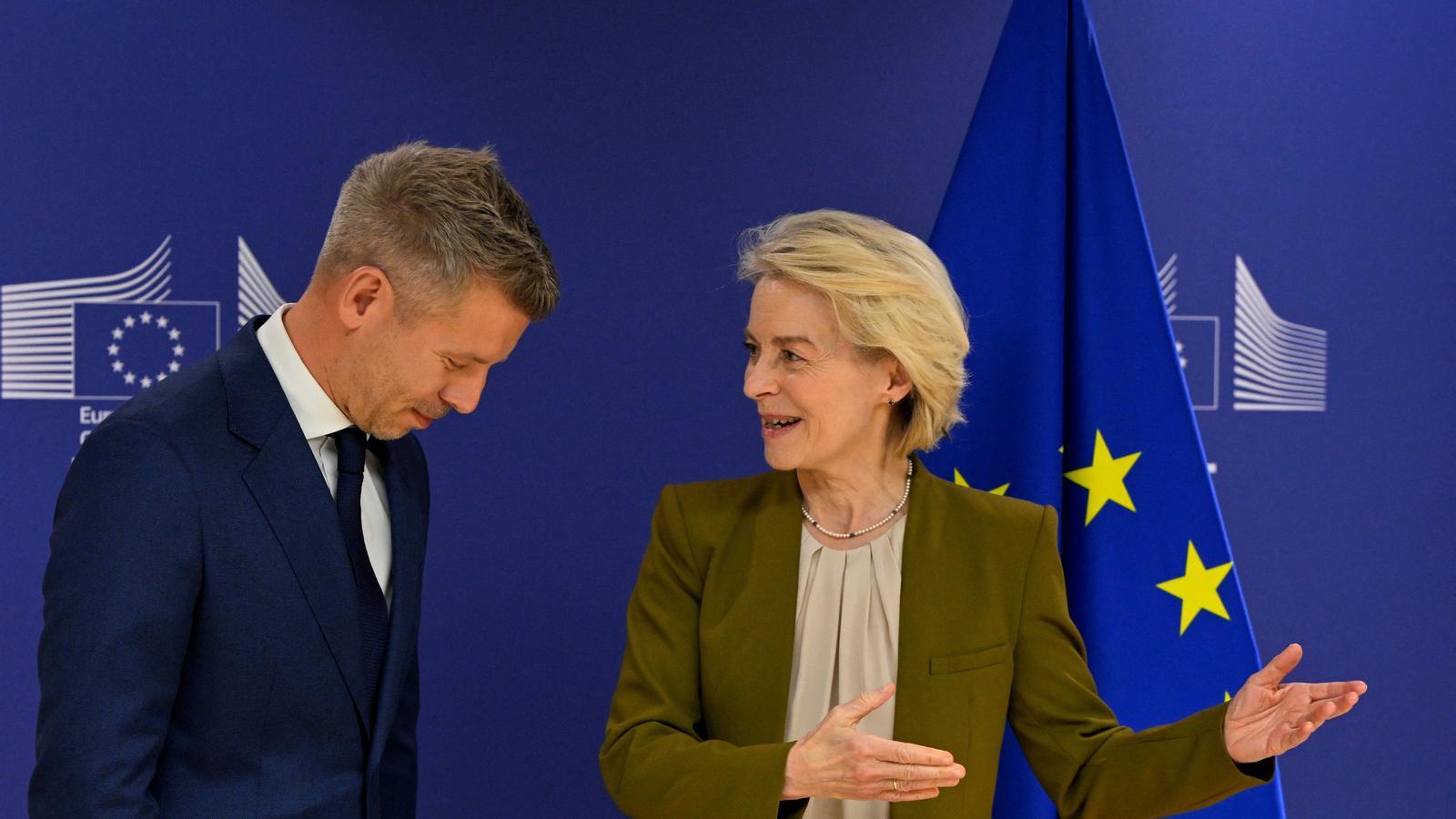

BrusselsAn era has ended and a new one begins. With the farewell of Viktor Orbán, the main black sheep of the European Union, comes Péter Magyar, a conservative who aims to bring Hungary back into the fold. The intentions of the future Hungarian prime minister have been staged with the trip to Brussels and the meeting he had with the President of the European Commission, Ursula von der Leyen, and the President of the European Council, António Costa. Budapest aims to recover ties with Brussels and, in the short term, save money from European funds, which are in the balance due to the breaches of Orbán's government.
Currently, the European Commission has blocked 17 billion euros of European funds that belong to Hungary. Of this money, 10 billion is part of the pandemic recovery fund and its disbursement expires in August. And, for this reason, Magyar is in a hurry. "We have to do in three months what Orbán has not done in three years," said the winner of the Hungarian elections in a video disseminated on social networks. In fact, the new Hungarian government has not yet been formed and has already wanted to meet this Wednesday with community leaders, a very unusual move in relations between new executives and European institutions.
Brussels, however, has also not hidden its euphoria at Orbán's defeat at any time. Von der Leyen celebrated Magyar's electoral victory with completely unusual speed and enthusiasm, and declared without nuance the return of Budapest to the club of reliable partners of the European Union. In fact, according to announcements by sources from the European Commission, a few days after the elections, a group of senior European officials already traveled to Budapest. Thus, the community authorities have worked with the Hungarian ones from the beginning on what reforms and measures the future Magyar executive must take to comply again with community regulations and, therefore, recover the frozen European funds.

Budapest must take many measures regarding the rule of law to obtain 10 billion euros. The disbursement of the recovery plan has 27 conditions and the Hungarian government must comply with all of them to receive it. Thus, before August, Hungary will have to approve regulations that restore judicial independence to the country, increase the auditing and control mechanisms of public administrations, and, among other things, will have to create an agency to combat fraud, measures that Magyar has already committed to implementing.
Magyar would like the Von der Leyen executive to disburse this money now, and this Wednesday it said it expects to reach an agreement in this regard with the European Commission this month. Specifically, the winner of the Hungarian elections has announced that he intends to sign a political pact with Brussels on European funds on his next trip to the Belgian capital, as prime minister, on May 24 or 25. Von der Leyen, however, has avoided setting dates and pointed out in a tweet that they will continue working with the Hungarian authorities. "We have discussed the necessary steps to unlock the European funds corresponding to Hungary, which are frozen due to corruption and concerns about the rule of law," tweeted the President of the European Commission.
Magyar's good predisposition
Although Magyar is clearly more pro-European than Orbán, there is a certain moderate optimism in the community institutions. Various diplomatic sources point out to ARA that the future Hungarian prime minister has made ambiguous statements regarding support for Ukraine and cutting ties with Russia, which makes them doubt to what extent he will support the EU's measures favorable to Kiev and contrary to Russia.
Despite this, the same sources, as well as the European Commission, celebrate Magyar's first steps and the Hungarian election winner's good predisposition to work hand in hand with Brussels. In fact, the next Hungarian prime minister explained in the video released this Wednesday that he worked for nine years in the Belgian capital, at the Hungarian embassy to the EU, and has championed the work of both European institutions and NATO.
