Iran challenges Trump from the UN podium: "We will not lower our head"
The Iranian president demands that Israel's nuclear program also be supervised by the IAEA

-
CAT -
CAST
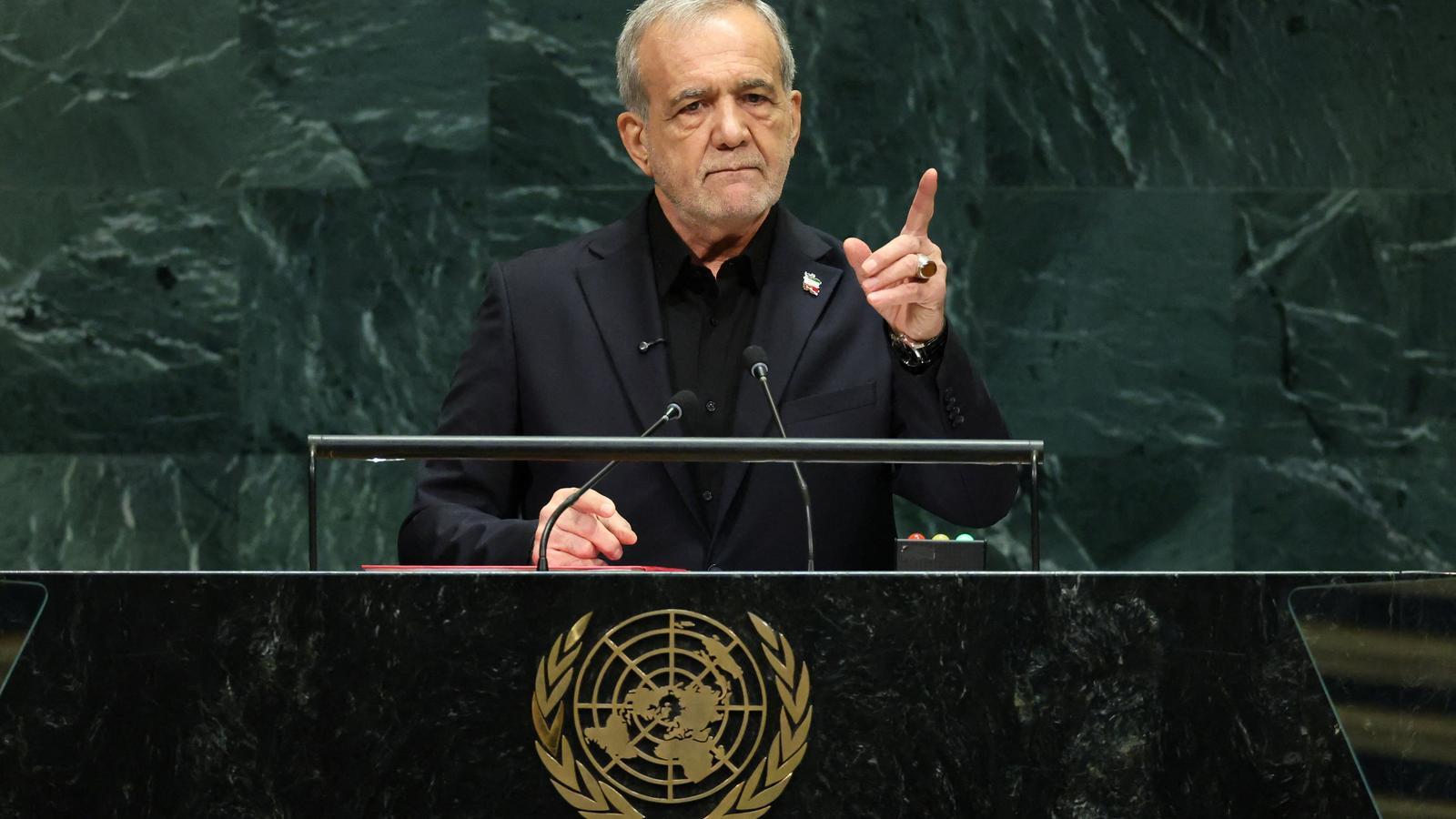
WashingtonIn February, Donald Trump gave the Islamic Republic of Iran no more than four weeks of life after the United States and Israel jointly killed its supreme leader, Ali Khamenei. Seven months later, the ayatollahs' regime is still standing and its president, who was then hiding from bombs inside a bunker, has appeared from the UN headquarters in New York. Masoud Pezeshkian addressed the General Assembly this Wednesday in a new gesture of defiance: "They have tested the strength and firmness of Iran, and they have learned that Iran cannot be made to surrender".
"Mr. Trump and those who intend to intimidate us must understand that we are prepared for dialogue, diplomacy, and negotiations, but without accepting the language of force," said Pezeshkian from the same rostrum where yesterday, Tuesday, the American president returned to threaten the Persian nation with "annihilating it". "We will not bow our heads," he insisted. War rhetoric from the podium of the United Nations.
Despite the threats, Trump confirmed on Tuesday that an American delegation managed to meet with the Iranian delegation in the halls of the UN. Special envoy Steve Witkoff and the president's son-in-law, Jared Kushner, participated in the meeting, according to Trump. The spokesperson for the Iranian Ministry of Foreign Affairs, Ismail Baghaei, also confirmed the contact, but it did not appear that there had been a substantial change in Tehran's negotiating position. Among the conditions that Baghaei cited were "the end of the war in all its dimensions and the cessation of aggressive American actions, the naval blockade, and the economic war".
Despite the ravages of war, the ability to resist the US offensive and retaliate with the blockade of the Strait of Hormuz has emboldened the regime. Iran feels strong and is now imposing new conditions on US demands regarding the Iranian nuclear program. "We state it clearly: we do not want nuclear weapons and we do not want limitations on peaceful nuclear technology," said Pezeshkian, who has demanded that Washington stop using a double standard regarding its nuclear non-proliferation demands.
The Iranian leader has denounced that Israel already has nuclear bombs –a fact that many analysts consider possible– but it has never "been a member of the non-proliferation treaty". Tehran was, until Trump decided to withdraw from the agreement that the Barack Obama administration had signed. For all these reasons, Pezeshkian has requested that Washington's partner be subjected to the same controls by the International Atomic Energy Agency (IAEA) that are being sought to be imposed on Iran.
"The issue of this meeting is mutual trust, which cannot be achieved only with words, but by refraining from applying double standards. Atomic and nuclear bombs are in the hands of the Israeli regime, but inspectors are asked to go to Iran", said Pezeshkian, who stressed that Tehran will only return to the negotiating table if Washington stops behaving like a "bully".
The control of Hormuz
The Iranian leader also reiterated his demands regarding the Strait of Hormuz. "We cannot allow some to have free access to a maritime route and benefit from it, while at the same time using that same route to impose their aggressions on us, to impose insecurity on us, and to prevent us from accessing our own navigable waterways," the Iranian said.
The pressure caused by the blockade of the maritime passage has been aggravated after the Houthi militias also entered the conflict, destabilizing the Bab el-Mandeb passage. This other strait was the alternative that Saudi Arabia had used until now as an alternative to provide an outlet for its oil.
Pezeshkian began his speech by showing an image of the late supreme leader, Ali Khamenei, and the children from the Minab primary school who also died under American bombs during the first day of attacks on February 28, as Tehran claims. A recent United Nations report concluded last week that the American bombing of the primary school could constitute a war crime.
The representative of the ayatollahs also recalled that peace will not be possible in the region as long as Israel continues its genocide in Palestine: "A lasting peace in West Asia is impossible without justice for Palestine," he said. The Iranian leader emphasized that the US and Israel have punished innocent people in their military campaign: "And we have only defended ourselves," he asserted. Pezeshkian, who now cries out about the cruelty the Iranians have suffered, seems to have forgotten the harshness with which the regime suppressed the protests that took place in the country just before the war began. Protesters to whom Trump also promised he would send help but who never received it.
The intervention at the UN coincides with a moment in which the regime is standing up to the United States, but at a very high price. The civilian population, which in the weeks prior to the start of the conflict had revolted against the regime, is the one most harmed. After suffering the repression of their own government, Iranians have also had to survive under the siege of American bombs. By mid-April, at least 3,468 Iranians had already died, according to data from the Iranian government.
