In Israel, opposition to the war is growing in a climate of tension and police control
The mobilizations against the conflict with Iran and the expansion into Lebanon intensify while the police continue to arrest the protesters
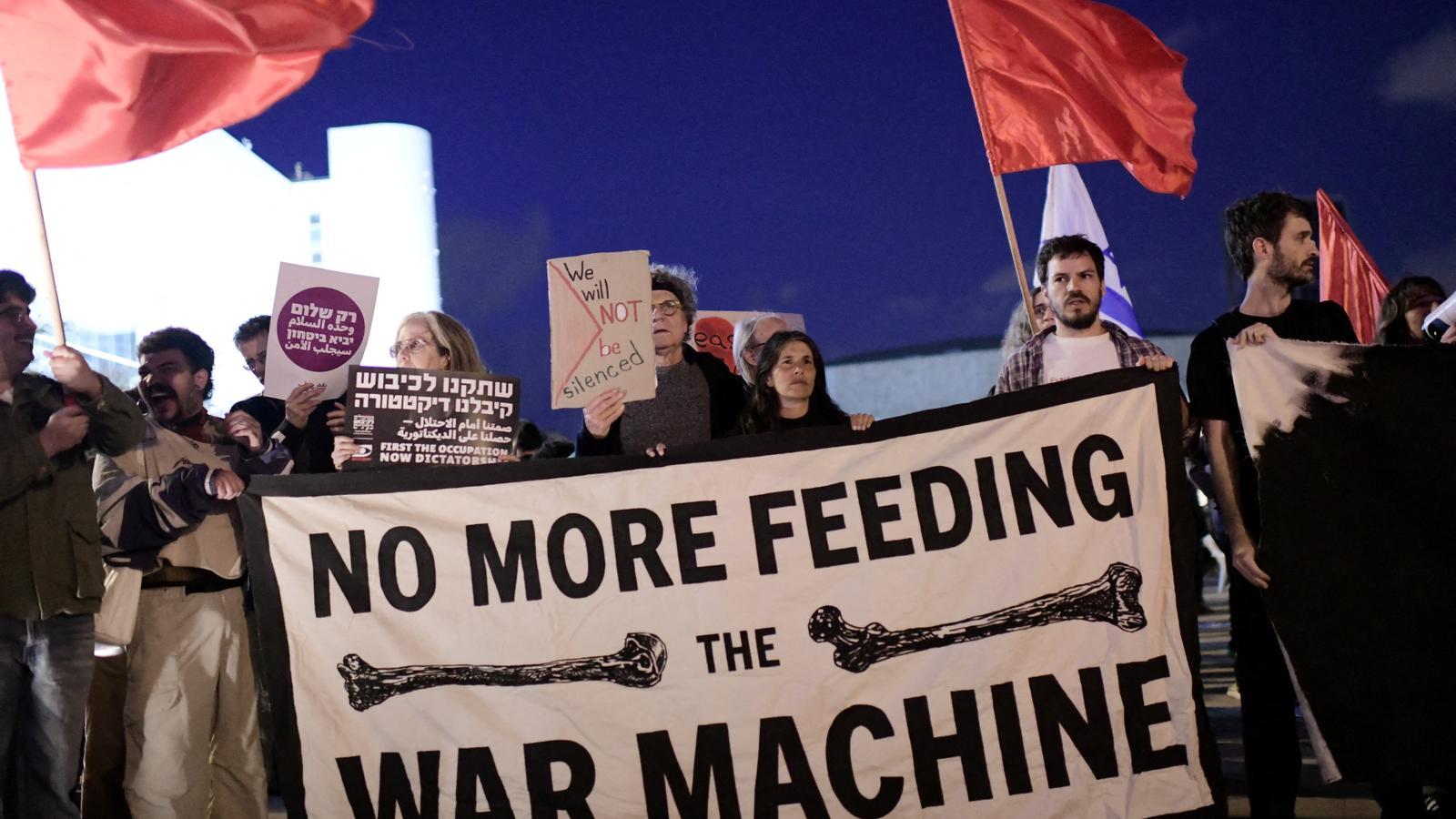
Jerusalem"This is not defense, it's an endless spiral. We are normalizing war as if it were the only option," says Michael, holding a purple sign written in Hebrew and Arabic: the only way out is through agreements. "What we are doing is barbarism." In Paris Square in Jerusalem, next to the official residence of Prime Minister Benjamin Netanyahu, the protest that has been repeated for six weeks has been gaining intensity, although it remains a minority. But what defines these mobilizations is not only their political content, but also the police response they receive. Since the beginning of the offensive against Iran, the Israeli police have been controlling demonstrations more closely: limiting the number of participants, cordoning off public spaces, dispersing gatherings, and making almost immediate arrests.
In Jerusalem, Saturday's rally was surrounded from the start by a large police presence and demonstrators were confined within a strict perimeter. After an hour, three people were arrested for crossing a police line and were later released with a fine. One of those arrested was a young woman known to the authorities.
—Why are they arresting her?
—We wanted to take the demonstration to Bibi's house —responds a protester who prefers not to give his name, referring to the popular name of Prime Minister Benjamin Netanyahu.
—But you have the right to protest, don't you?
—Yes… but it depends on the situation.
This "it depends" summarizes the current moment. The right to protest is recognized by Israeli legislation, but it has been heavily conditioned by the state of emergency following the attacks from Iran and the clashes with Hezbollah in the north, as well as by police interpretation in the context of the current truce with the Persian country.
Disproportionate police action
Tel Aviv has become one of the places where repression has been most visible. In recent weeks, several protests have been dispersed under the pretext of exceeding the limits set by the Supreme Court. Last week, at a gathering in one of the city's most important squares, Habima Square, police intervened against attendees – who exceeded the limit of 600 people – and arrested at least seventeen demonstrators. Authorities stated that the protest was prohibited by emergency regulations and that they were acting in the face of a real risk due to possible missile alerts. They also reiterated that the right to protest “is not absolute” and must be weighed against the “duty to maintain public order”.
However, according to witnesses and civil rights organizations, police action has often been disproportionate: shoves, blows, confiscation of banners, and widespread identification checks. Activists speak of gratuitous and unjustified use of force. According to the Israeli newspaper Haaretz, the protest, shortly after it began, was violently suppressed by security forces, ignoring an express request from the Supreme Court urging the guarantee of the right to demonstrate. The court had authorized an increase in demonstration limits, but the police rejected it and stated that their efforts to disperse the demonstrators they consider “rab-rousers” would continue.
This weekend, the Supreme Court has once again tried to put a stop to this dynamic. In the context of the truce, it has extended the limit of participants to 1,000 people in areas with shelters. It has also recalled that exceeding this threshold does not automatically justify the dissolution of a protest and has ordered the police to balance security and freedom of expression. This decision comes after a petition from the Association for Civil Rights in Israel (ACRI), one of the most active organizations in the defense of civil rights and which has been denouncing police abuses in demonstrations for years.
The mobilizations, which will take to the streets again this Friday and Saturday, bring together diverse groups: opponents of the war with Iran, activists against the offensive in Lebanon, critics of judicial reform and exemptions from military service for the ultra-Orthodox, as well as voices denouncing government corruption.
For many, the open front with Hezbollah calls into question the very truce with Iran. “First Iran, now Lebanon. It’s all part of the same thing: a government that needs constant conflict,” summarized Tomer, a university student in Jerusalem. Around, some protesters shouted that “Israel is not a democracy,” while drums beat and a message was projected onto the facades of buildings: “You are responsible,” referring to Netanyahu. On one side, a giant banner with the prime minister’s face accused him with a single word: “culpable”.
Although the protests have gained strength, they remain a minority in a society that, in large part, supports the conflict in the region. According to a recent survey by Channel 12, 53% of Israelis oppose a ceasefire with Iran and 79% reject a truce with Hezbollah. 45% believe that attacks with Iran will resume soon.
