How should Europe defend itself without the United States?
Josep Borrell urges CIDOB to make defense the force of European integration
-
CAT -
CAST
BarcelonaHow should Europe defend itself without the United States? Should there be an alternative alliance to NATO if Washington withdraws? What capabilities should the European continent develop to guarantee deterrence from other powers? Is a common defense strategy for all European states viable?
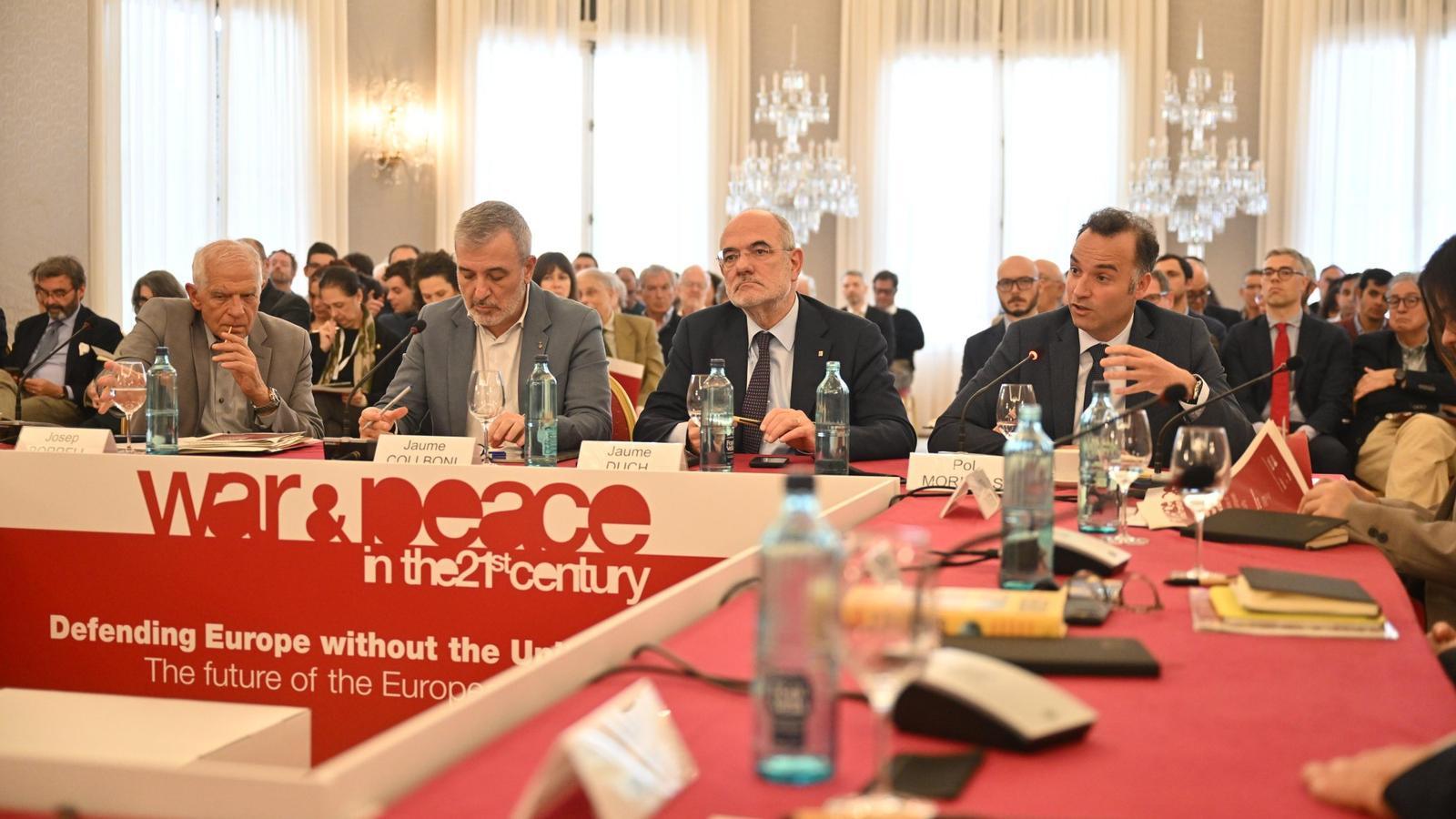
These and other questions have been the focus of the 24th edition of the international conference War and Peace in the 21st Century organized by CIDOB this Saturday at the Palau de Pedralbes to question the future of European security. The event featured speeches by Josep Borrell and Pol Morillas, president and director of the institution, as well as institutional representatives such as minister Jaume Duch and mayor Jaume Collboni, who accompanied a day of debate on the direction of European security.
Donald Trump's second term has made Europeans realize that Washington is an unpredictable partner. Given this fact, the premise of the meeting was shared: Europe must be able to defend itself alone. The president of CIDOB and former High Representative of the European Union for Foreign Affairs, Josep Borrell, clearly stated that the Atlantic Alliance "has suffered unprecedented internal weakening due to President Trump's aggressiveness." After decades living "under the American umbrella," Borrell warned that it only serves "as long as it is open." The challenge facing Europe is "existential," according to the former European representative, who argues that the "radical change" in transatlantic relations implies a change in strategy: just as the euro was in its time, now the force of European integration must be defense, according to Borrell.
The deterioration of transatlantic relations is such that European experts conclude that the United States has gone from being a partner to a factor of instability. Steven Everts, director of the EUISS, has placed the North American power in a "pressure triangle" alongside Russia and China for the first time. This new reality, according to Everts, forces the Old Continent to "break free from the psychology of weakness."
The consensus on the need for EU autonomy is clear. The question is how to achieve it. In this regard, Borrell has acknowledged that taking this "great step forward in political integration" is difficult, but necessary: "To replace the American umbrella requires a lot of effort, a lot of organization [...] and also a lot of financial resources, but the latter is not the most important thing, because if they are lacking, they will be found; the problem is the political will to do what needs to be done," he stated.
Everts has argued that "the problem with European defense is not money: Europe is rearming, but we need more integration." Daniel Fiott, head of the Defense program at the Center for Security, Diplomacy and Strategy in Brussels, expressed a similar view, arguing that "the big problem today is European unity." "More money does not necessarily mean more Europe, it can mean more nationalization of defense," he warned.
The Commissioner for External Action, Jaume Duch, echoed Borrell's sentiment, stating that we live "in a more violent world where confrontation" has replaced multilateralism and cooperation. "The recent world was not easy either, but at least it was predictable," asserted the head of Catalan diplomacy. Paraphrasing the President of the European Council, António Costa, he argued that "Europeans must stand for values and trust" and raised the question of whether NATO should be Europeanized. These changes, Duch said, will require a shift in public opinion, and therefore he maintains that it is the responsibility of leaders to guide public opinion in political decisions.
Ukraine, the acid test of credibility
In this new geopolitics "full of turbulence", the Ukrainian front has defined itself as the epicenter of European security. "Russia continues to be a long-term threat to Europe," warned Kridti Raik, director of the International Centre for Defence and Security, who recalled that "the most urgent task is to continue supporting Ukraine in the European security architecture." For this expert, if Ukraine collapses —which is the Kremlin's objective— and Europe does not save it, the European security architecture will lose all credibility.
Finally, the conference focused on the need to diversify alliances. "The war in Iran has destroyed the credibility of the US as a strategic partner," explained Amitav Acharya, distinguished professor at the School of International Service, American University of Washington. Acharya urged Europe to find alliances with other actors, such as the Global South, without "treating it as inferior."
In this regard, Tara Varma, of the German Marshall Fund, cited India as an example of the new alliances Europe must forge. "We cannot substitute our dependence on the United States with a single partner. Europe must diversify and build multiple alliances," she recalled.
The closing of the event, by Pol Morillas, was a warning that summarizes the continent's sense of urgency: "Perhaps peace through strength can also be the right formula for Europe. The test is now in our internal solidarity: the challenge is not only our ability to respond, but our ability to continue united," concluded the director of CIDOB.
