Fear at Orbán's bastions: "If he loses, everything will be unpredictable"
Small towns will have the last word in Sunday's elections in Hungary, in which Péter Magyar could snatch power from the prime minister

-
CAT -
CAST
Szár / Felcsút (Hungary)Sándor drains the bottom of a beer glass in the bar in Szár, a small town about 50 kilometers east of Budapest. In the establishment, apart from the woman serving behind the counter, there are only men. Four retirees, all with a pint of beer on the table. It is Friday morning and in this inland town of Hungary, surrounded by fields and small hills, calm reigns. But among the bar patrons there is concern about what might happen in Sunday's elections. Szár and the surrounding towns have been a stronghold of Fidesz in recent years, Viktor Orbán's party, which has governed the country with supermajorities for sixteen years. According to many polls, this could be about to end.
— What do you expect to happen on Sunday?
— Change would not be good.
— Why?
— Because if they change the system, prices will go up.
— What prices?
— Oil and fuel prices will be higher.
Sándor, who is 76 years old, with tanned skin and well-marked wrinkles on his face, also refers, without being asked, to the war in Ukraine: "If another leader comes to power, Hungary could go to war." "We will have to pay the cost of the war and [Péter] Magyar will eliminate all retirement benefits," he adds, referring to the opposition leader who threatens to wrest power from the man who until now seemed untouchable in Hungary. His table companion simply ratifies everything: "I think the same."
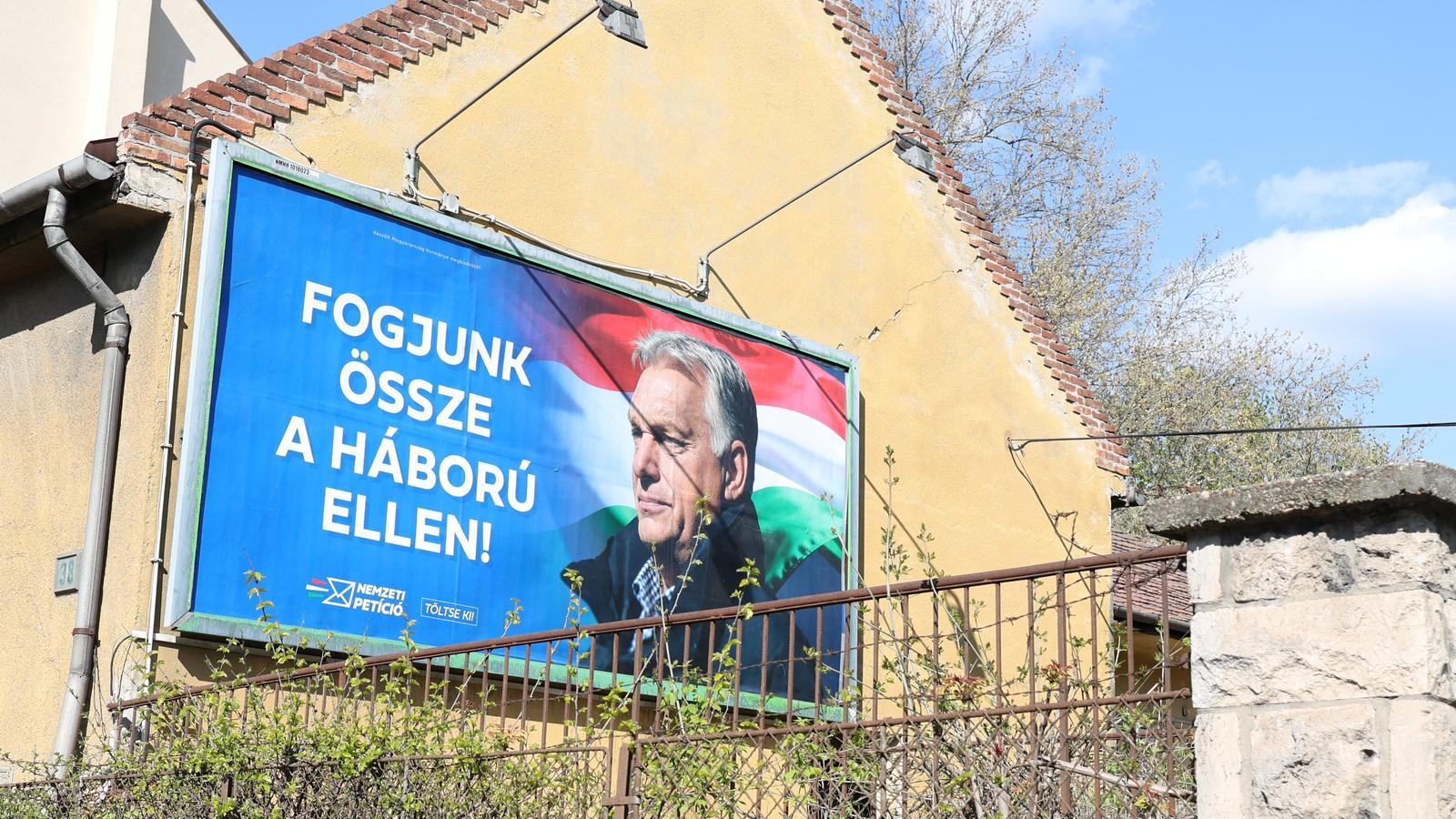
The fear of war is one of the themes most exploited by Viktor Orbán and his propaganda machinery during the election campaign. "Hungary is the only country in Europe that has said no to war," the prime minister said at a rally a few days ago, accusing Kyiv of interfering in the electoral process. In fact, in the capital, Budapest, the face of Volodymyr Zelensky is much more present than Orbán's, in posters created by Fidesz in which they accuse the Ukrainian leader of being "dangerous." In these posters, Zelensky appears next to Péter Magyar.
Szár looks like a typical small Hungarian village: a main street, with one-story houses on one side and the other. As everywhere these days, there is an election poster on every lamppost. Mainly, from the two parties vying for power this Sunday: Fidesz and Tisza, Magyar's party. And small villages carry great weight in the results. Orbán has always shown great influence in smaller, more conservative communities, where pro-government messages dominate. Furthermore, the electoral system, which is not proportional, benefits Fidesz because it gives more weight to rural and sparsely populated districts.

"I hope Viktor wins again, not the Tisza people," says Agotha, a 64-year-old woman waiting at a bus stop that also serves as a second-hand bookstore, with conviction. "He will surely fulfill what he promises. That's for sure. If he wins, he will keep his promises," she emphasizes. She says she is very worried: "If Orbán loses, everything will be unpredictable." "Now we receive money, especially the elderly; if not, we will receive nothing," she predicts.
We are in Felcsút, a few kilometers from Szár. This is the hometown of the prime minister, and one of Fidesz's historical strongholds. "In the village, Fidesz is very strong, we hope he wins," adds Agotha.
Behind her, however, a man who has just arrived at the bus stop shakes his head with a wry half-smile. “There is no government; they don’t know how to govern. The healthcare system doesn’t work,” he complains.
The man, a former firefighter—he does not want to give his name—is accompanying his daughter, who has a disability and requires continuous care. He says the state support he receives is completely insufficient, around 400 euros per month.
But he hopes that Tisza will win. “What matters is change. It doesn’t matter whether it’s Péter Magyar or whoever. What we need is change,” he sums up. He assures that many of the people he knows have decided to vote for Tisza. “My mother hasn’t; she’s afraid of war,” he adds.
He ends the conversation with a small revelation: “I went to school with Viktor.” I ask him what the prime minister was like back then. “Very skilled, very clever. The best in the class. And a very good football player.”
The Pancho Aréna, a symbol of power
In Felcsút is the most evident symbol of Orbán's love for football. And for power. In this small town, with about 1,500 inhabitants, the prime minister built a sophisticated stadium with a capacity for more than 3,800 people, the Pancho Aréna, a benchmark in sports facility architecture, with the characteristic style of Hungarian architect Imre Makovecz. The interior, with concrete columns that merge with wooden vaults, makes one think of the inside of a church. The union of two of Orbán's great interests: football and traditional Christian values.
"I'm worried about whether there will be a change, because we don't know where the country will go if this happens," says a man sitting outside the stadium. He is about to turn 47, explains he has three children, and prefers not to give his name. "Fidesz provides a lot of aid to families and for paying for housing," he points out. Orbán's government implements various policies to encourage birth rates, such as tax exemptions for mothers with four or more children (with reductions for those with fewer); aid for mortgages for couples with children, and three free meals a day for children from families with at least three children. "The country is working, Orbán is the one who made it work," he declares. And he adds, referring to the numerous reports about government corruption: "There is no proof they have stolen."
The diaspora's support
Also outside the stadium, there is a family that exemplifies another large group of Fidesz voters. "We live in Romania, in Transylvania, so our perspective is perhaps different from that of people living in Hungary," says the 19-year-old girl. She is with her parents watching the match in which her teenage brother is playing. "Honestly, we have voted for Fidesz because we have only benefited from their help," states the mother. They prefer not to give their name. She explains that the Hungarian government finances their children's education, the learning of traditional Hungarian dances, and many other activities.
Before the 2014 elections, in the pursuit of the maximum possible votes, Orbán offered citizenship and the right to vote to about two million ethnic Hungarians living in neighboring countries, such as Romania, Slovakia, Serbia, and Ukraine. This is a group of voters who tend to opt for Fidesz. In recent years, hundreds of thousands of people living in areas that had been part of Hungary before World War I – during the Austro-Hungarian empire era – have become full Hungarian citizens. There are about 600,000 voters who are part of this group within a total electorate of about eight million people, which means they can make a difference.
"In many places I read that Fidesz is not a good party, that change is needed. And around me, among young people, there are many who think this way," says the girl. "Maybe they are right, but I see it from another perspective, which is that Fidesz has only benefited me and my family," concludes her mother.

