Charles III warns Trump that allied unity is essential for global security
It is the second time in history that a British monarch addresses the joint session of the US Congress
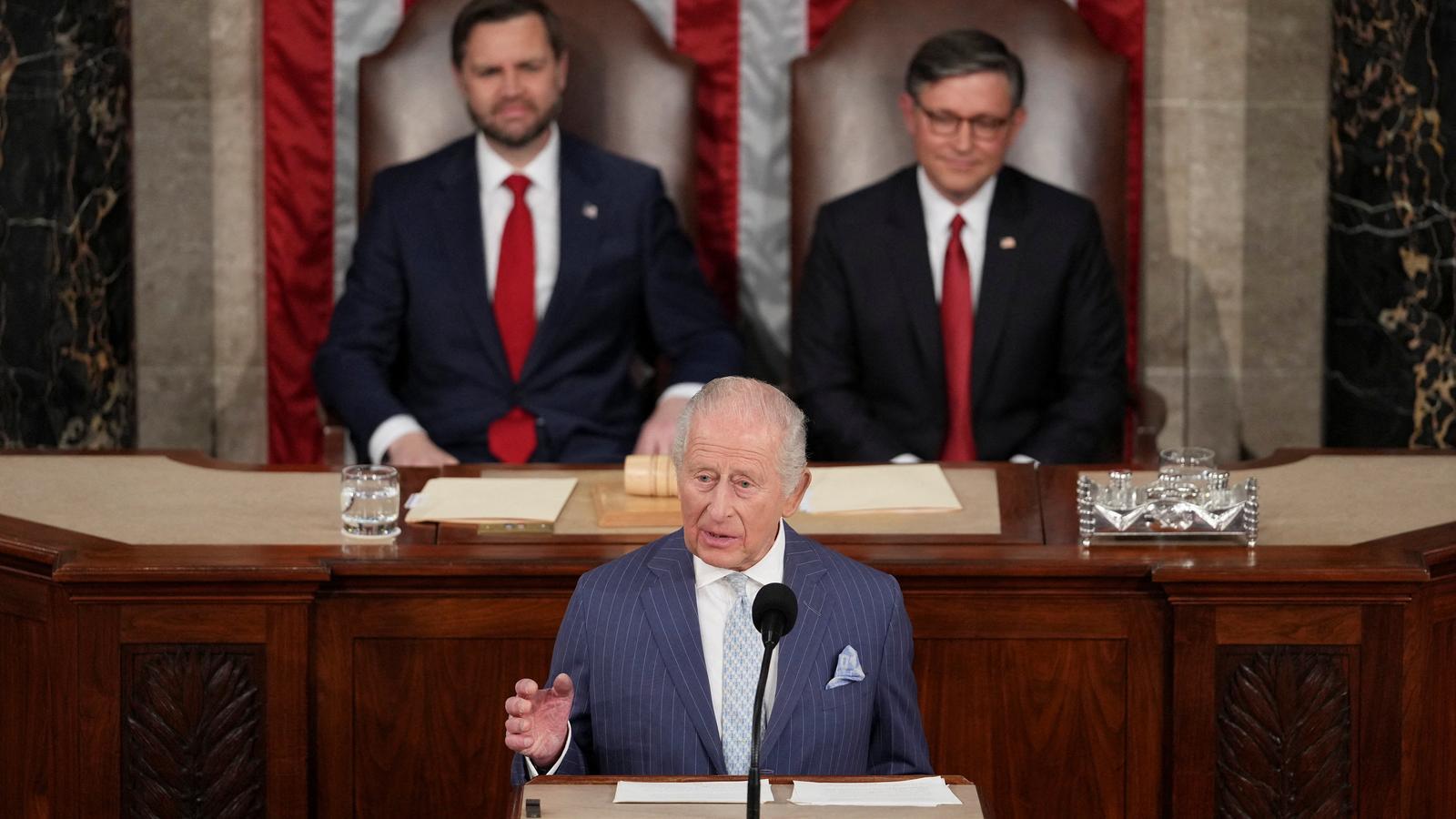

WashingtonAfter days of dazzling sunshine in Washington, the city's sky has conspired to give a more British welcome to the crown of England. Umbrellas were the silent companions in the halls of the Capitol today, despite staying outside the House of Representatives where Charles III addressed the joint session of Congress this Tuesday. Despite the protocolary rhetoric, the king sent a clear message: the need to defend NATO in the face of Donald Trump's repeated threats to unilaterally abandon the Alliance due to the Europeans' refusal to help him in his war with Iran. Despite being a thorny issue, the European refusal to help him in his war with Iran. Despite being a thorny issue, the royal had a grateful audience, which erupted in applause from the benches when the monarch began his speech recalling the reason for the visit: the 250th anniversary of the USA's independence from the United Kingdom.
"In the immediate aftermath of September 11, when NATO invoked Article 5 for the first time and the United Nations Security Council stood united against terror, we answered the call together, just as our people have done for more than a century, closely, through two World Wars, the Cold War, Afghanistan, and moments that have defined our shared security," Charles III politely recalled, before adding: "Today, Mr. Speaker, the same unwavering determination is needed for the defense of Ukraine and its brave people, to ensure a truly just and lasting peace." The remark prompted another wave of applause from the benches. The monarch once again put Kyiv on the map at a time when the European conflict has been overshadowed by the smoke from the fire in the Middle East.
The king spoke for 29 minutes under the watchful eye of Vice President JD Vance —who is also President of the Senate— and the Speaker of the House of Representatives, Republican Mike Johnson. Among the members of the executive cabinet, two absences were notable. Despite being a historic visit to celebrate 250 years of transatlantic relations, the Secretary of State and head of diplomacy, Marco Rubio, was not among the listeners. Nor was the Secretary of Defense, Pete Hegseth. The head of the Pentagon did not attend, although the Chairman of the Joint Chiefs of Staff, General Dan Caine, did.
Charles III addressed the joint session of Congress 35 years after his mother, the late Queen Elizabeth II, did so in May 1991. At that time, the monarch praised the close relationship between the two countries after the United Kingdom participated in the Gulf War alongside the administration of George Bush. "It was the [Gulf] post-war position that the United Kingdom and the United States worked together for the common good," she said. His son's intervention today, although also marked by the shadow of war, has been radically different. Rather than celebrating, the British monarch has called for the preservation of defense ties: "I pray with all my heart that our alliance continues to defend our shared values, with our partners in Europe, the Commonwealth and around the world, and that we ignore the voices calling us to increasingly withdraw into ourselves."
Politically, the monarch reminded the occupant of the White House that his presidency will be reduced to a mere anecdote in the historic relationship. "As President Trump himself observed during his state visit to Great Britain last autumn: 'The bond of kinship and identity between America and the United Kingdom is invaluable and eternal. It is irreplaceable and unbreakable,'" Charles III stated. With this quote, the monarch also ensured that the tycoon would grasp at least one of the many subtle rebuffs he received.
In case any detail was missed, King Charles grounded the rhetoric by recalling how "today, hundreds of American personnel, defense officials, and their families are stationed in the United Kingdom." He also mentioned the joint manufacturing of F-35 fighter jets and the Aukus agreement, signed under the presidency of Joe Biden and which also includes Australia.
Defense of the British Navy
The UK's refusal to cooperate with Trump's war against Iran has become one of the new low points in the two and a half centuries of their relationship. Beyond the already usual attacks on the British Prime Minister, Keir Starmer, the US president has been particularly aggressive with one of the symbols of national pride: the British Navy, whose ships he has described as "toys". The King has not made direct reference to the insult to the navy, as expected. But he has thrown a small velvet knife at Trump. "For part [of the Cold War], more than 50 years ago, I served with great pride in the Royal British Navy," the King recalled, after reviewing all the royal lineage who have also been enlisted in the corps: from his father, the Duke of Edinburgh, to King George V. A reference soft enough not to be interpreted by the Republican as an attack, but which subjects can see as a defense of the homeland.
Practically, the King has fulfilled all the talking points that were expected. Throughout his speech, he has also reiterated, in one way or another, the long and "deep" relationship between the two nations. A friendship "for which we are deeply grateful to the American people" and which he has defined as "unique".
Beyond NATO, Charles III has also emphasized the importance of the fight against climate change: "As we look to the next 250 years, we must also reflect on our shared responsibility to protect nature, our most precious and irreplaceable asset." Words that, despite having been applauded by the chamber, Vice President Vance did not celebrate. One of the first executive orders that Trump signed upon returning to the White House was to withdraw the United States from the Paris Agreement.
The Epstein case has been the elephant in the room today. Charles III addressed the same Congress that forced the publication of over 3 million new documents about the pedophile Jeffrey Epstein and which at the beginning of the year unleashed an earthquake in the United Kingdom. In fact, the new documents about the pedophile and his child trafficking ring, instead of shaking the White House, once again stirred up the dirty laundry of the British crown. The former prince Andrew - the king's younger brother - gifted a new front page to the English press after spending 12 hours detained at a Thames Valley Police station due to the new revelations about his relationship with Epstein. after spending 12 hours detained at a Thames Valley Police station due to the new revelations about his relationship with Epstein.
Four hours before the king entered the chamber, the Capitol police had been examining all the empty seats in the lower chamber with flashlights. The explosives detection dog was walking around the press gallery, as well as the rows of legislators' seats. Federal agents, wearing bulletproof vests with the acronyms of the Department of Homeland Security, were also walking on the staircase leading up to the third floor. After the foiled assassination attempt, Trump had assured that all necessary security measures would be taken for the state visit. Nevertheless, this morning the security check to access the Capitol was the same as every day for workers and accredited press: the metal detector scanner. However, just like during the state of the union address, only those with a ticket for the event could be in the press room.
