"Removing Francoist symbolism is whitewashing the past"
Debate on justice and memories in public space with Núria Ricart Ulldemolins at the Monastery of Pedralbes
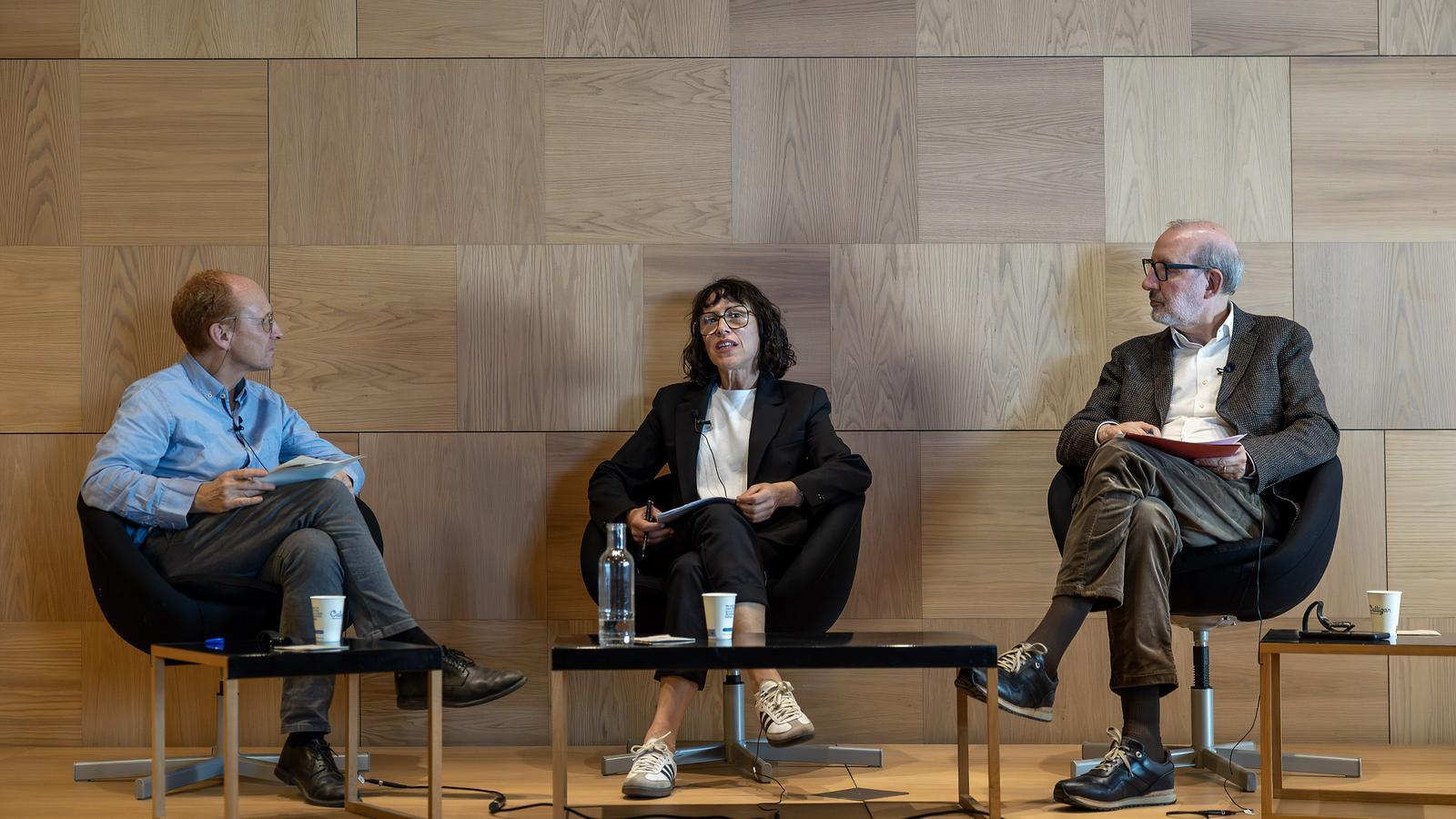
BarcelonaMemory is sensitive and, if you pull the thread –as was done this Tuesday at the Pedralbes Monastery in a new session of the Pedralbes Dialogues, organized in collaboration with ARA and under the intellectual direction of philosopher Daniel Gamper and the moderation of Antoni Bassas—, it can open many debates. Starting from the statement Remembering, doing justice, with Núria Ricart Ulldemolins, professor at the Faculty of Fine Arts of the University of Barcelona, the discussion was about how thinking about the past is often a way of doing justice and, above all, about memory in public space. For more than twenty years, in the field of memory, there has been an effort to recover the memories of the vanquished and to reclaim what has been silenced. Ricart admitted that she came to political memory because that was where she found the most interesting projects: “It is where the most effective and radical art is,” she said.
Current events were very present. The controversial Francoist symbolism was brought up, such as the polemical phallic-shaped monument in the middle of the Ebro River, in Tortosa. Ricart was absolutely opposed to its removal: “It is often thought that removing them is the solution, but this can end up being a way of erasing or whitewashing the past,” assured Ricart, who worked on a project that proposes not to remove the monument, but to contextualize it and transform its meaning from a pedagogical dimension. “It is about taking advantage of problematic elements to turn them into spaces for public explanation and reflection,” she detailed. She also criticized the removal of the Victory of the Diagonal: “Somewhere it should be explained that on the Diagonal the arm was raised and masses were held. Removing is childish; I don't understand how a problematic object can be replaced with nothing. Making it disappear is a very strong violence, it is a great responsibility.”
Ricart has worked on different projects that claim the memory of the vanquished. He explained one that was a long struggle about the Les Corts prison. In 2010, a small plaque was placed on the facade of El Corte Inglés on Diagonal, where the prison had been. "It was almost an insult," said Ricard. From then on, work began with academics, women's associations, and memorialists. It was a long process: it began in 2011 and ended in 2024. "It was argued that public space should recover the memory of the prison and that things should happen there: routes, actions, theater, dance, school visits... we placed five totems, on the perimeter of the old prison, with phrases from women who were repressed there," he explained.
When the enemy is not external
For the Fine Arts professor, justice and art do not go hand in hand. "The concept of justice is very closely linked to aspects of memory, but from art we need to work with absolute freedom of elements. Memory and art provide conditions for justice processes to occur afterwards, but a priori we cannot talk about artistic projects where justice is exercised," she assured.
No one was able to give an example of a well-resolved project that confronted the Francoist past, but perhaps we will see one in the future... Examples of dignifying victims were mentioned, such as the one done in the Lleida cemetery, or the monument to Walter Benjamin in Portbou. Bassas spoke about the Fossar de la Pedrera. "All students should go to the Fossar de la Pedrera," said Ricart, who recalled that in France it is mandatory to visit some monuments to victims. Bassas pointed out that they have it easier there because there is an external enemy. "Here, if a teacher takes students there, they may have to face a complaint from parents," he said.
