Canada extends its hand to the EU: "A single tree falls in the middle of the storm; a forest, resists"
Mark Carney bets on strengthening the alliance with the Twenty-seven with more cooperation in defense, AI development and critical minerals
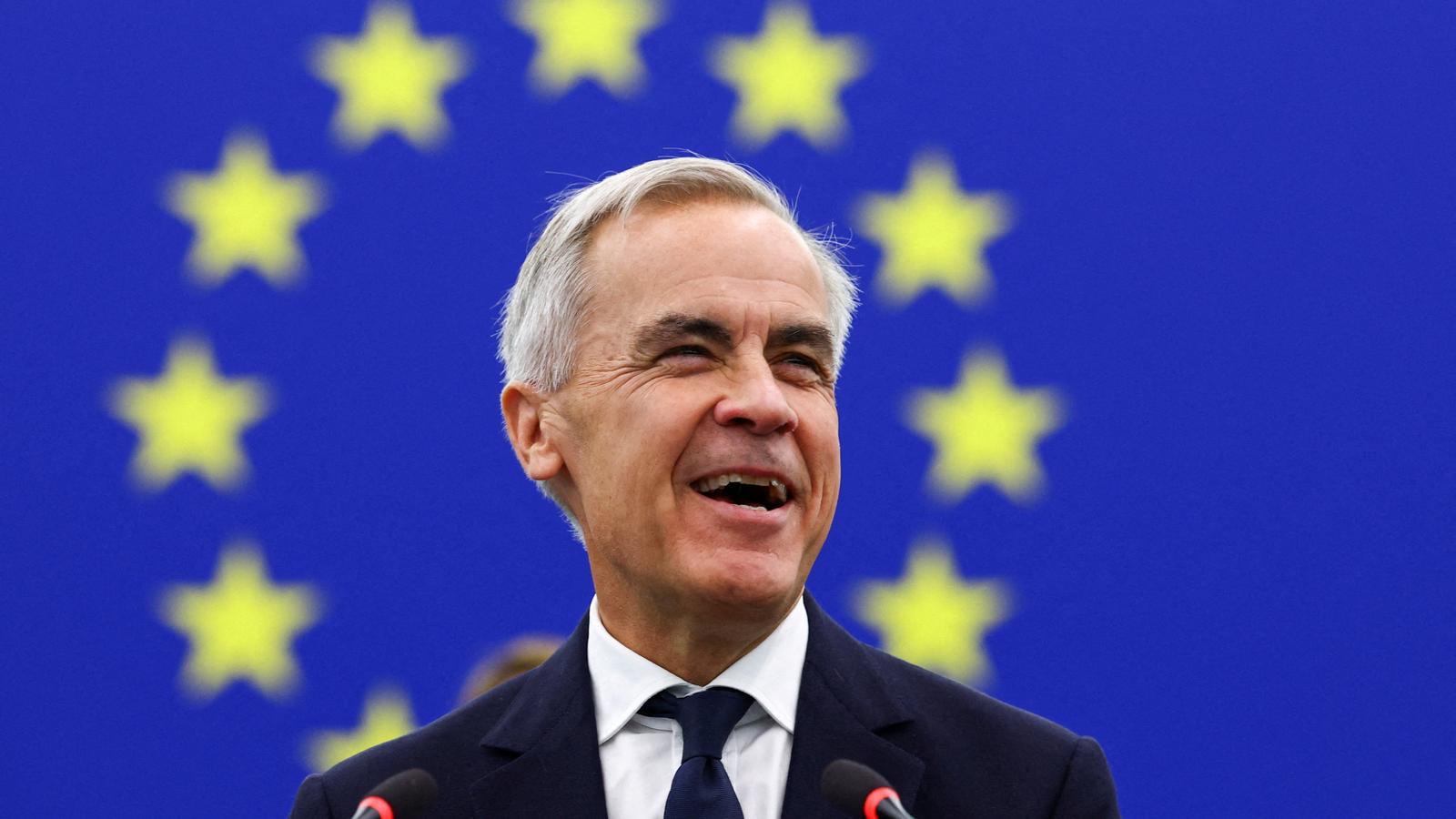

BrusselsThe last time Canadian Prime Minister Mark Carney delivered a speech before a major international forum, his message sounded like a wake-up call to the offices of European capitals. Amidst escalating tensions with Donald Trump and a transformation of the international order, Carney proposed that middle powers join forces to gain room for maneuver against the great powers. "When we only negotiate bilaterally with a hegemonic power, we negotiate from a position of weakness. (...) This is not sovereignty. It is representing sovereignty while accepting subordination," he asserted in January at Davos.
Eight months later, the Canadian Prime Minister addressed the European Parliament in Strasbourg with a European proposal on the table: to make Canada the first associate member of the European Union, a formula that does not yet exist in European treaties. This Thursday, Carney "welcomed" Von der Leyen's proposal to strengthen the relationship with the Twenty-seven with an "alliance for the future," despite the threats from the American president, who had warned early this morning that he would cut off trade relations with the EU if he considered this bond "a hostile act."that had warned early this morning that he would cut off trade relations with the EU if he considered this bond "a hostile act". "Canada and Europe are strong on their own. Europe and Canada are stronger together," he declared.
The Canadian leader, who was given a standing ovation by MEPs upon entering the hemicycle, detailed how, in his view, the alliance with the European Union should be concretized. The purpose should not be to guarantee "self-sufficiency" but "collective resilience." Thus, he argued that cooperation should focus on "the entire spectrum of strategic capabilities," such as critical minerals, industrial defense capacity, artificial intelligence and computing capacity, energy security, space, and payment systems.
The Canadian Prime Minister—who alternated between English, French, and German during the speech—highlighted what he believes his country can offer: one of the largest reserves of critical minerals in the world, great capabilities in the fields of space, artificial intelligence, and quantum computing, one of the most solid banking systems, a unique Arctic geography, and privileged access to both Atlantic and Pacific networks. "Where our strengths are different, they complement each other. Where they overlap, they generate scale," he stated.
The alliance should not be limited to strategic capabilities. Carney has also claimed that Canada's participation in the Erasmus+ exchange program would give students "more opportunities to study at some of the best universities in the world, broaden their horizons and build those lasting ties that will sustain our alliance in the future."
"New storms"
The Canadian Prime Minister began his speech by evoking Goethe's oak, in the Ettersberg forest, near Weimar. The same tree that for years had symbolized the European ideals of reason and freedom was trapped inside the Buchenwald concentration camp, built around it. From this metaphor, Carney drew a message: freedom is not won once and for all; "it must be defended every day."
Today, our societies "are once again being shaken by new storms," he lamented. Climate change, the erosion of democratic norms, the use of trade and law as instruments of coercion, the fragility of supply chains, and the way technological platforms aspire to control society are some of the challenges he enumerated. In this context, "A tree alone falls in the midst of the storm; a forest, resists," he stated.
Although he did not mention the President of the United States at any time, he was present throughout the Canadian leader's speech. After the trade agreement they were negotiating failed this summer, both countries ended up imposing mutual tariffs of 50%. To calm the waters, Carney made it clear that the alliance does not seek to create a "third bloc" or become a rival power "with better manners." Rather, it wants to strengthen sovereignty to prevent anyone from controlling open markets, democracies, or freedoms.
Canada is one of the European Union's priority partners. Since 2016, both have maintained CETA, the economic agreement that has accompanied an 80% increase in bilateral trade, reaching 130 billion euros in 2025. The arrival of Donald Trump at the White House – and the constant threats he has launched against Canada's sovereignty – have highlighted the seams of Ottawa's economic dependence on its neighbor, and pushed it to seek new alliances. Europe has been the natural partner with whom Canada has accelerated agreements, not only in trade, but also in defense. In June, Carney traveled to Brussels to sign a defense pact that provides for joint responses to international security emergencies and stabilization missions. Now, Canada wants to take this approach much further than defense.

