50 years after the coup d'état, Argentina continues to widely reject the dictatorship
Not even five decades of distance, nor the "reconciliation" discourse of the Milei government have managed to dilute the social consensus around the process of Memory, Truth, and Justice

-
CAT -
CAST
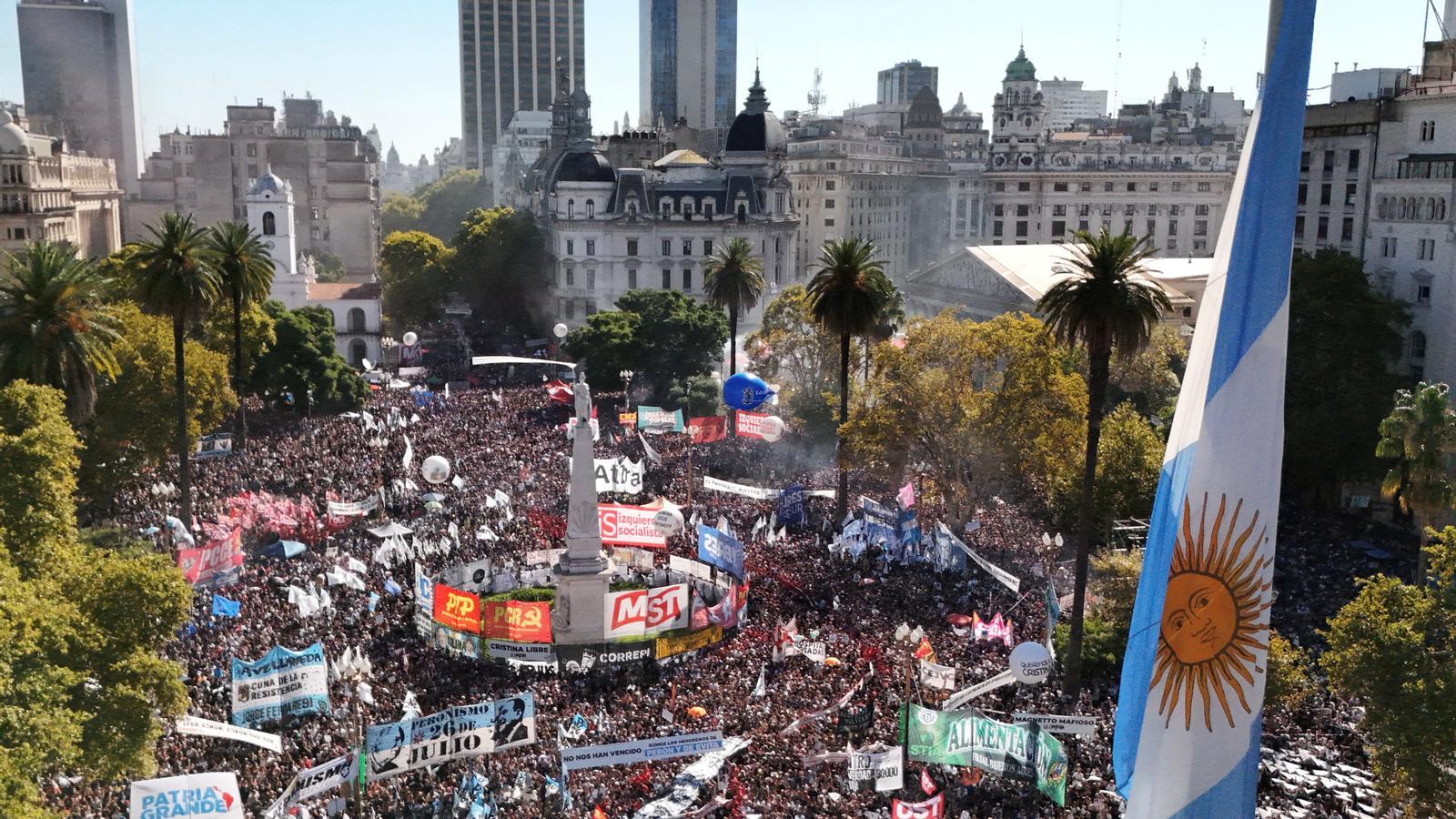
“We do not forget, we do not forgive, we do not reconcile”, said dozens of banners last Tuesday in Plaza de Mayo, in the center of Buenos Aires, in a historic demonstration for the Day of Memory for Truth and Justice in Argentina. Although March 24 is always a marked date on the calendar, this year’s was not just another appointment, as it marked 50 years since the civic-military coup d’état that led to the cruelest dictatorship in the country’s recent history, from 1976 to 1983.the cruelest dictatorship in the country’s recent history, from 1976 to 1983.Human rights organizations, such as the Mothers and Grandmothers of Plaza de Mayo, had called to fill the square, as always, and the response was massive. Hours earlier, the Casa Rosada had published a video of an hour and a quarter in length, in which it claimed, as it has every March 24 since Javier Milei has been in government, a "Day of Complete Memory," in an insistent – and so far, unsuccessful – exercise to reconfigure the narrative and relativize the crimes committed by the State during the dictatorship.The Centre for Legal and Social Studies (CELS), an organization dedicated to safeguarding human rights and democracy in Argentina, has recently published the report Retrospective glances at the Argentine dictatorship: 50 years later, which confirms that 70% of the population rejects the 1976 coup d'état. While it is true that the official government condemns the assault on democracy itself – the day after the demonstration, spokesperson Manuel Adorni reiterated at a press conference that it is an event that "should never have taken place" – it also justifies it indirectly, as it points to left-wing terrorist organizations as the creators of a context of violence that needed to be controlled. Faced with this, the CELS study once again reveals the population's non-negotiable stance on the motives for the coup: 45% consider that there were no reasons to justify it, and 18% that there were "few".Regarding what happened with the military government, 61% consider that the so-called “National Reorganization Process” was a dictatorship that carried out a systematic plan of disappearances of people and violation of human rights, and not a government that faced a fight against terrorism, in which there would have been “excesses”, as the government of Javier Milei maintains. In this case, the differences between one vision and the other are notable, and they widen even more when we delve into the management of memory policies: according to Milei's government, they are “bias and revengeful”, and require a review that incorporates the so-called “complete memory” where victims and relatives of victims of terrorist guerrillas are taken into account, to help “reconcile” Argentine society.Only 1,600 bodies recovered
“If they want «complete memory», let them tell us where the disappeared and appropriated babies are”, Francisco, 44, told ARA, who went to the demonstration with his wife and his 5-year-old son: “We continue to wait for those missing to appear”. So far, the Argentine Team of Forensic Anthropology has recovered 1,600 bodies of people disappeared during the dictatorship, of which it has been able to identify around 800 – the last 12, this March in the excavations at the former clandestine center of detention and torture La Perla, in the province of Córdoba–. According to human rights organizations, the total number of disappeared by the dictatorship exceeds 30,000, a figure that the Milei government also disputes.“More than a denialist government, we have a government that advocates for the dictatorship”, Verónica Castelli, a militant of the organization HIJOS, tells ARA, “and it does so because it needs to continue the economic plan of that time, which is based on the destruction of national industry”. According to data from the Center for Argentine Political Economy, more than 20,000 companies have closed in the country during Milei's government. In fact, the slogan established for March 24th of this year has been “The same plan, the same struggle”, thus weaving a timeline between past and present that, on the one hand, equates the economic strategies of the dictatorship with the current ones, and on the other hand, vindicates and recovers the ideas that led the militants of that time to organize politically.Precisely in this juncture between the past and the present is where Castelli finds a key opening: young people. Part of her work as a member of HIJOS is to give talks about the dictatorship to children and adolescents in schools. “When they listen to you, and they see a first-person testimony, they understand many things and disbelieve what they receive through social networks.” This activist, who found her sister Milagros – illegally appropriated by the military – thanks to the Abuelas de Plaza de Mayo, finds it important to distinguish the reason for young people's support for Milei: “We all know that this government comes to power, in large part, thanks to the youth vote, dazzled by economic promises – but I doubt that the young people who voted for Milei have massively thrown themselves into vindicating the dictatorship or rejecting a process of Memory, Truth, and Justice in Argentina.” Sol, 27 years old, had not seen the video that Casa Rosada posted in the morning, but she is not interested. She looks at the square, full of people, and smiles: “It’s simple: we are a lot of people looking at history in an active way to decide how we want our present to be.”
