The transatlantic artist who blurs borders from Empordà
Lluís Lleó, established in Serra de Daró after three decades in New York, presents in the AWL Girona gallery a solo exhibition of his most recent work

-
CAT -
CAST
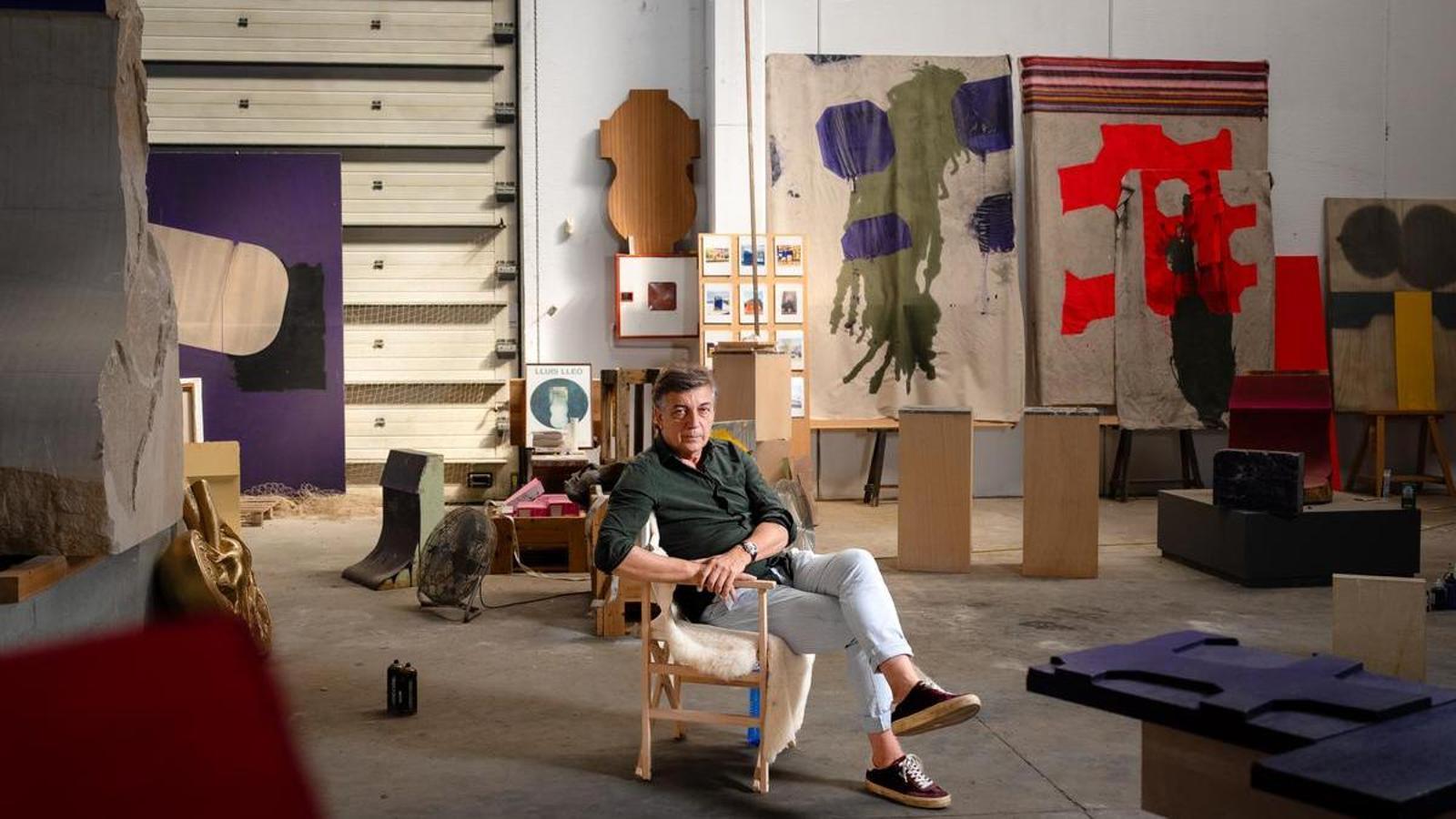
Serra de Daró (Baix Empordà)After 30 years living and working in New York, the artist Lluís Lleó (Barcelona, 1961) has decided to settle in Empordà. In Serra de Daró, between Montgrí Castle and the Iberian settlement of Ullastret, he has his studio, which occupies half of a large, open, and spacious industrial warehouse with a very high ceiling, from where he continues to explore new lines of creation, on the hybrid border between painting, sculpture, and installation. With one foot in the Empordà plain, but always with an open gaze to the world, Lleó boasts a first-class international career. While working with gallerists and curators from Mexico and Venice, this July he has just inaugurated at the AWL gallery in GironaVeure amb les mans (Seeing with hands), an exhibition of very powerful pieces, which are a very vivid reflection of his current moment of maturity.
An exhibition of light
Seeing with the hands is not a retrospective or a collection of old work, but rather a display of more recent work, conceived in the Serra de Daró studio. "Artists go through many valleys of shadow, but this is a moment of sun and light," explains Lleó. The pieces, some of them exhibited in a room dyed a very vivid yellow, radiate harmony and tension at the same time. They are also articulated on a relief, both physical and metaphorical, which brings many layers of interpretation and depth. "I want to go very deep into things, to delve into the great mysteries," continues the artist. They are paintings with a base of sculpture, or sculptures with painted canvases. Paintings on paper instead of papers on paintings: "Where is the dividing line between disciplines? Perhaps it doesn't exist. For me, going from the wall to the floor and vice versa is normal. Everything is painting, but expressed in different supports and ways," he argues. The works are extremely sensory, they ask to be seen and experienced live, but they shy away from the idea of art as a decorative object for immediate consumption. "This model of a piece that looks good on the sofa is becoming more and more established, but I flee from that at full speed," he concludes.

The connection with the gallerist Pepe Baena
The Girona gallery AWL, hidden on a first floor on the way to Santa Eugènia, has a clear commercial vocation. It is run by Pepe Baena, with whom Lleó has established a very fruitful and inspiring relationship. Baena, who has worked for many years in the art markets of London, South America, and New York, went to see Lleó in his studio in Empordà and they immediately hit it off: "Most gallerists the first thing they want to know is how we will sell and to whom we will sell the pieces, but he was interested in understanding what he was doing. In fact, he helped me understand my own work," recounts Lleó. That synergy quickly convinced him and, when he received the proposal to exhibit at AWL, he did not hesitate: "I immediately visualized a train stopped at a station in front of me with the doors open," he states. For the artist, this collaboration goes beyond a commercial relationship and responds to the conviction that "finding a younger person on the way, from another generation and with another way of seeing things, can be very important" in the trajectory of a consolidated artist, who runs the risk of falling into stagnation and monotony. And he concludes: "What makes art possible is the collector and the public, the observer is as powerful or more powerful than the artist."
L'Empordà as a nerve center
Moving from living in the social and artistic bustle of New York to the calm of Empordà represents a radical change of life. During his stay in the city of skyscrapers, Lleó would come every summer to Baix Empordà to rest and renew his energies. New York gave him ambition, demands, and contacts. And Empordà, the moment for pause and reflection. Now, he has settled there permanently, but he continues to keep an eye on everything happening in the major artistic hubs of the world, traveling and establishing international projects, convinced that the artist must flee comfort and idleness: "For an artist, Empordà is an ideal place, but you can't stay here all the time," he admits. For Lleó, Serra de Daró is not a fixed destination but a base from which everything else pivots. In fact, his work already has this component of fusion of worlds, spaces, and cultures: "It's a transatlantic work, going back and forth, it's neither entirely American nor entirely European," he defines. It brings together everything from the abstraction of Rothko or Pollock to Germanic avant-gardes or the geometric informality of Kazimir Malevich.

From Empúries to Madremanya
Lleó travels often, but the feeling of belonging and admiration for the privileged place of Empordà is strong and sincere. He lives at the very top of the hill of Sant Iscle d'Empordà, within the same municipality of Serra de Daró. He is particularly captivated by the entire Empúries area, "with the sea, the ruins, and all that coincidence of so many magical things" full of history. Also, outside the coast, the charm and tranquility of the inland villages feed his imagination: "Madremanya, Sant Martí Vell, and Monells, with streets and places that most people don't know exist, with their silent nights and the Gavarres nearby," he describes. A whole landscape that, he insists, fascinates him, but does not trap him or tie him down with chains, but quite the opposite: "It is the best place to have your feet and, from here, leave wherever necessary," he concludes.
