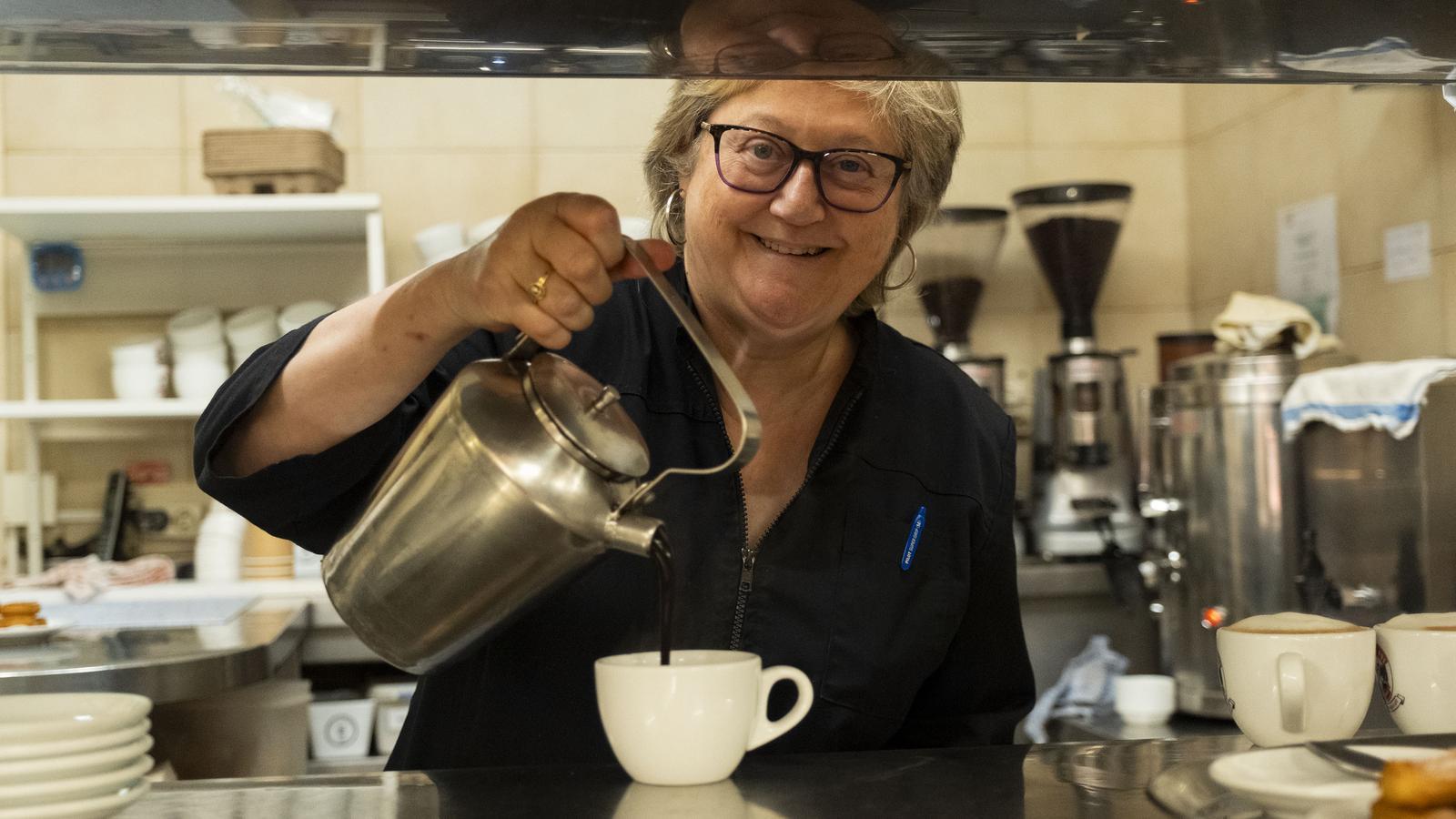
Mercè Casademunt's latest chocolate at Granja Viader
Marc Espuny Casademunt, the son, remains in charge of the family business, also specialized in Catalan cream and mató

-
CAT -
CAST
BarcelonaIt is Tuesday afternoon, and at Granja Viader in Barcelona (c. Xuclà, 6) the tables are full of people eating melted hot chocolate with a side of whipped cream and another small plate of churros with sugar on top. They are served by Marc Espuny Casademunt (Barcelona, 1986), who today is his first day working as the owner. He does so just one month before his mother, Mercè Casademunt Viader (Barcelona, 1959), retires at 67 years old. "I would have liked to retire earlier, but I didn't have the years counted for it, and there was also the fact that Marc had never told me that he wanted to take over the farm." He didn't tell her until we interviewed him, two years agoand she told us she didn't have a successor. "As a result of your article is when Marc and I talked, and he told me: «Mother, I want to take over Granja Viader»", explains Mercè, happily. She has Marc by her side, who has spent the day working there as he did at seventeen, the first time he worked there.

Anyone who has been to Granja Viader knows that it is an establishment with a lot of history. Mercè Casademunt knows it all, with the notable years. The establishment is one hundred and fifty-six years old; it dates from 1870. First it was a dairy, but without cows, that sold milk. Marc's great-grandfather went to ask for work around the year 1900, and after years he had already bought it. Around the 1920s he transformed it into a farm, as it is today, but with the great obstacle of the Civil War. His six sons went to the war, and the only one who stayed was the daughter, Marc's grandmother and Mercè's mother, who saw how the CNT committee confiscated the premises and stayed to live with her. "It was during this time that the premises were expanded, because in the first instance it was a smaller space," recalls Mercè, who adds that her mother had told her that the anarchists stayed to work at Granja Viader some time later.
Each recipe, from a different family member
While mother and son are talking, a waitress approaches me and tells me to please write that "La Granja Viader is not closing, they will continue as always". And Marc emphasizes: "I don't plan to touch anything, because everything is fine: the chocolate formula, the recipes, which are from great-grandmother, grandmother, mother and mine". It's very fun to ask them whose recipe each of what they sell is. "From mother, the mató flan; from great-grandmother, the mató cake; mine, the chocolate pudding, the catalan cream mousse, the fresh cheese cake with jam", points out Marc, who when he left the family farm as a young man, worked in other companies and also traveled to Mexico. There was also a moment when mother and son understood that it was better for them to work separately, and it wasn't because they didn't get along but because they had different ways of doing things, because they are from different generations. "For all this, and because he had never told me anything, I thought he wouldn't want to keep La Granja Viader", explains Mercè, who reveals that when Ara Mengem published that she was looking for someone to take over the business, she received all kinds of offers. "They even offered me blank checks, where they told me to set the price I wanted, that they would accept it". Of course, the establishment is very well located, it is central and has an established client portfolio.
And no, it hasn't been necessary for anyone to buy Granja Viader for Marc to want to work there for at least forty more years, he comments: "I'm forty now, and I feel strong enough to stay for many years." On the table where we are sitting, and where we start to eat hot chocolate (made with cocoa, corn flour, salt, sugar, and cinnamon), is the menu of food that can be ordered. "Mom, you've made it new; I didn't know it," says Marc. His mother replies yes, that she has just designed it with the help of artificial intelligence, with which she has transformed a photograph of the interior as if it were a drawing. Inside is the top three most ordered products, which are crema catalana, Cacaolat, and honey and curd cheese with walnuts. By the way, with the menu design change, there has also been a price increase. "Minimal, because until now the chocolate with churros cost 6.50 euros and now 7."
I pick up the thread of the other ways of doing things that they told me about before, and I ask Marc if there's anything he'll want to change regarding what his mother used to do. "The hours, the closing days, I want to rethink them, because I think perhaps we could have the midday open and only close on Sundays." At this point, Mercè enters, who explains that closing from 1:30 PM to 5 PM and having Sundays and Mondays off has been the balance she has found with the staff so that everyone did their hours. "I don't know if it would work at midday, because we are not a restaurant, but it's true that we make sandwiches. I don't know, all this is what Marc will have to try," she says. Marc believes it could be changed, except for Sundays, which he does want to be holidays because he remembers his grandfather telling him that Sundays are for resting: "Great-grandfather rested on his saint's day, Saint James, and on Reyes, but Viader was open; he only took two days off."
The conversation now turns to sales figures. "On December 6th, we sold four nine-liter pots of melted chocolate in four hours, it was non-stop," says Mercè, who acknowledges that cold weather is the best time for Granja Viader. When it's hot, business slows down a bit, even though they sell Catalan cream and melted chocolate all year round, at all hours, until 9 PM when they close. Today, the day of Marc's return, she started with fifteen liters of Catalan cream, which they torch on demand. "And we also fry the churros on the spot, in a fryer dedicated only to churros," they explain.
To finish, we need to talk about Mercè's last day of work. It will be on June 10th, and she has already arranged to meet friends who will stop by in the morning and afternoon. There will surely be champagne to celebrate her retirement and that she will have time for other activities. "I'm looking forward to resting, reading, doing other activities, like living outside of Barcelona, away from the center here, because I live above Viader, and you can't walk around here." Mercè wants to go to Cardedeu, where she has a house with a garden. When she retires, she also wants to celebrate with the workers by visiting the Viader Museum in Cardedeu. "And I won't go too far, because I'm the one in charge of the numbers, and until Marc learns them, I'll continue to handle them." There will be a moment, one day, when she will have completed the entire handover and then Marc will indeed take on all the tasks. There will still be one pending task, which Marc is kindly asking her to do: "Explain everything you know about Granja Viader to my father so he can write a book." Marc reveals that his parents are Catalan teachers, that they both met at university, and that his father enjoys writing. "The way the father writes, and with everything the mother knows, we could create a book so that the history of Viader is not lost." His mother agrees, saying they will do it. And she says this as she stands behind the counter where they sell Catalan creams, because a queue of people has formed and needs to be served. They will do it all.
For now, the most immediate task: on June 10th, she will take off and hang up the black jacket she has worn all these years to serve customers at Granja Viader.
