"L'Hispània is not for sale; we have united with a passionate partner and we will make many more dishes"
The restaurant in Arenys de Mar has recovered old recipes from the Reixach sisters, and has many new projects underway

-
CAT -
CAST
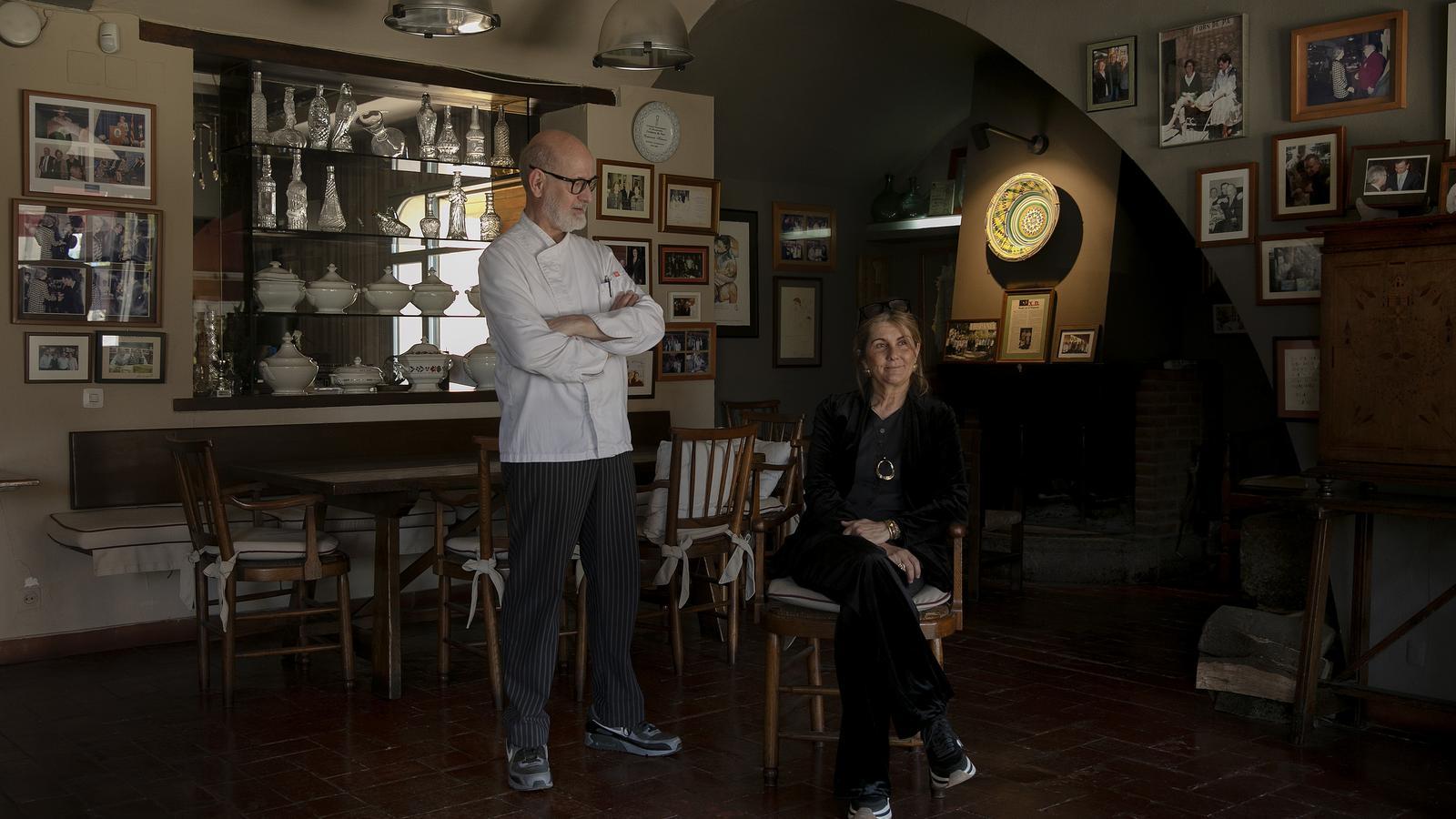
Arenys de MarIt is midday, three o'clock, when Raimon Braun (Arenys de Mar, 1968) and Marta Aulestia (Barcelona, 1972) sit down at the kitchen table of Hispània for lunch. I join them, and between the two of them they decide on the menu: to drink, Jean Leon's Gigi; for lunch, fritters, Russian salad, brains salad; Arenys prawns with salt; jig-caught squid; sea bass, and for dessert, small caramel custard and sponge cake cubes. Raimon and Marta are happier than ever: for a little over a year they have had a passionate partner for Hispània, with whom they have allied to undertake new projects: before the end of the year they will start serving fork breakfasts; they will build an outdoor terrace; they will host evening gatherings and will create rooms above the restaurant to recover the essence of the restaurant, the inn. And all this has come to them at a time when they knew they had no successor because their two children had told them they did not want to dedicate themselves to it: "We saw that we had no one behind us, that we were alone." So they emphasize it clearly: "Hispània is not for sale; we have joined forces with a passionate partner and we will make many more dishes."
Since 2014, Raimon and Marta had been left alone at the helm of Hispània. Raimon's mother, Paquita, and Lolita, his sister, had gradually stopped going. "It was gradual; one day, they would tell us they were going with the grandkids; another, that they were running an errand," he explains. They understood; they were of a certain age and had spent their lives tied to the restaurant. "They never verbally told us that they would stop coming to work, but we understood it," they recount. Even today, customers ask them if they can see them, if it would ever be possible for them to be there. They are 92 and 87 years old, they live a different life, far and near the restaurant, because they are aware of everything that Raimon and Marta do there. "When we told them about joining forces with a person who loved Hispània as much as we did, Paquita told us to go ahead." Marta and Raimon being left alone at the restaurant had meant that between the two of them they had to do the tasks that were previously done by six people in the family, because the two sisters' partners were also in charge of restaurant tasks; Raimon's father, of food purchases; Lolita's partner, of the finances. The two sisters, in the kitchen, with Raimon by their side, and in the dining room, with Marta.
Fork breakfasts and evening gatherings
Let's start talking about the new projects. The most immediate one, the fork breakfasts. Before the year ends, they want to start doing them. In the early hours of the morning, one will be able to eat sardines, capipota, and 'enagos' omelets, which is the expression the Reixachs used to talk about vegetable omelets. They will serve them in the first dining room of the restaurant, in the lobby, where the fireplace is, which is a large and cozy space. By 12 PM, they will have finished serving them, and the people who are there will be able to finish them calmly, without rush, but they will begin to prepare for the lunch service.

Once they have the fork breakfasts up and running, they will tackle another of their projects, the evening sessions, "because people our age prefer going out in the evening rather than finishing dinner late." And to do them, it would be ideal to have the terrace finished. We go to see the space where they want to build it, and it really is a green and beautiful area. It will be located above the pine garden, from where you can see the N-II beltway and the sea. "With the terrace, we have to count on all the permits to build it; it will be slower than we would like, but we will do it," explain Raimon and Marta. They are calm, I would say even more excited than ever about all the projects they explain to each other. And they continue: the rooms on the floor above. Another topic for which they have started asking for permits, but which they are passionate about, because it is about recovering the spirit of the Hispània. When Paquita Rexach opened the garage and the gas station, where she served the first dishes requested by those who stopped there (some sardines and a plate of escudella), she understood that a natural evolution of service was to have rooms there. "The Germans, who arrived in droves in the summers and spent many days there, asked for it; they also brought us modernity in clothes and in the way of behaving," recalls the son, who says they were the first to start staying there. The hostel rooms were not part of the sisters' house, who also lived near the restaurant, but were located on another side of the house, which today is a private space for Marta and Raimon. "One of the rooms we will renovate has a pool, and we know it will be very popular," Marta advances.
We continue with the conversation, and we talk about dishes and Raimon's training. He particularly likes Jean Leon wines, because he worked with Jean Leon, the pseudonym of Ceferino Carrión. “He was a client of Hispània, and he insisted that I go work at one of his three restaurants, L’Scala”. He went there, and he has a great memory of that time. “One day at the restaurant, we had Bruce Springsteen dining”. Ceferino Carrión wanted the Catalan cuisine of Hispània to be practiced in his restaurant, and that is why he wanted to have Raimon there. There are many other restaurants where Raimon passed through, where he learned recipes, such as lentils with duck wings, which is one of those that they will start preparing this autumn. “There is also another one that I had stuck since my mother stopped coming here, which are the meatballs”, says Raimon. It is curious how there are obstacles that we set for ourselves, and we do not dare to jump over. The meatballs were that for Raimon, and this summer he has cleared it up. Thanks to Marta, one morning they got to it: “I had also learned to make them with Paquita, my mother-in-law, and I remembered the steps, so I told Raimon that we had to do it”. It is a laborious recipe, full of tricks to ensure they remain fluffy, and not dense. I ask him what they are: and they especially point out the bread that must be used, which must have a special crumb. They go to the kitchen, and take out a large, fluffy, ethereal bread.
And from the meatballs, we move on to many other recipes, which they have all written down and stored. “In boxes, written on wine labels, on napkins, on coasters, on papers; everything is written but in that way, and now we also want to get to work on it: we will clean it up, we will rewrite them”. It is one more project they are embarking on, and which they will do, because Raimon and Marta are pure energy. They share a passion for a house that is a great benchmark of Catalan cuisine, and which deserves all the respect in the world.

