Temperature, wind and humidity: this is how the next few hours will be in Empordà
The climatic conditions complicate the extinction of the fires

-
CAT -
CAST
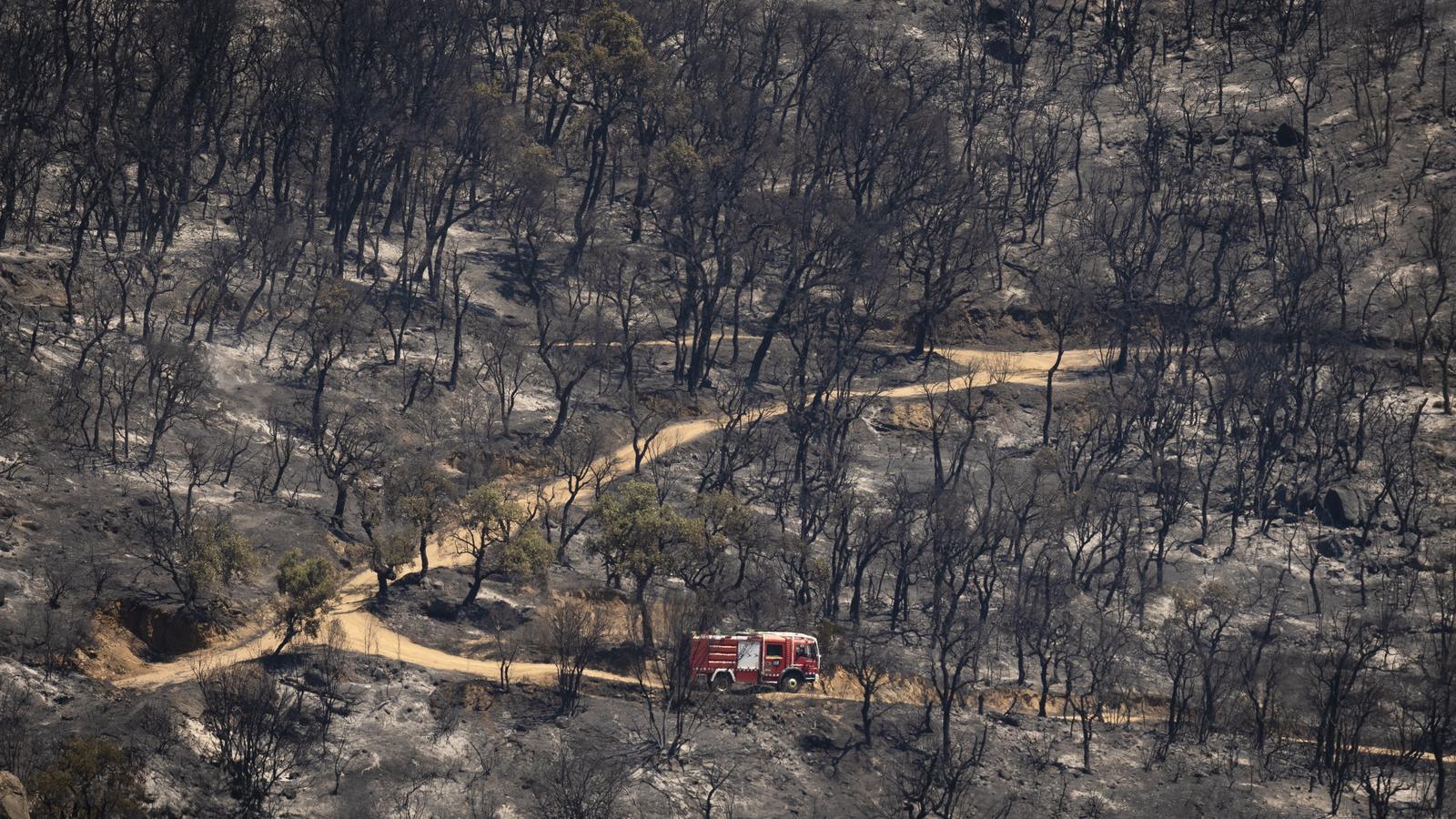
The meteorological conditions in the area of the Bisbal d'Empordà fire have been very adverse for most of the hours it has been active. Throughout Friday and Saturday, the fire burned uncontrollably in the Gavarres massif, but on Saturday night, the Firefighters were able to stabilize it. Its extinction is not expected until at least the middle of the week, if there are no flare-ups.
Wind has been the key factor in this fire, as the tramuntana and marinada winds have conditioned its evolution and extinction tasks. However, the good news is that during the nights and early mornings it has eased considerably and has been very weak, at times the wind has even calmed and turned from the west. The tramuntana gusting has been concentrated mainly further north, specifically in Alt Empordà. In addition, the night temperature dropped over the weekend to 19 ºC, and humidity rose above 50%. A clear improvement in conditions during the night that has been key to helping with the extinction tasks, which, according to the Firefighters, are progressing favorably.
All this after the tramuntana blew with great force on Friday in the Bisbal d'Empordà area, with continuous gusts between 30 and 50 km/h, and occasional gusts exceeding 60%. It is a dry wind that, despite being from the north, is re-heated, and causes the heat to be very intense, with values on Friday and Saturday above 34 or 36 °C at midday, as well as very low humidity that dries out the terrain.
These conditions are known as the rule of three 30s for extreme forest fire risk: winds above 30 km/h, temperatures above 30 °C, and humidity below 30%. A lethal combination that fuels the flames and greatly hinders the firefighters' extinction capacity.

However, the sea breeze managed to win out for a few hours on Friday afternoon on the southern flanks, with a southerly sea wind that also blew with locally moderate gusts, causing a drop in temperature and a rise in humidity. However, in the northern area of the fire, the tramuntana wind continued to blow. Therefore, this confluence of winds in the Gavarres caused erratic behavior in the fire's advance, which made the firefighters' work difficult until the situation improved at night.
On Saturday morning, the tramuntana wind once again dominated the entire area, although with less intense gusts than on the first day of the fire. From midday onwards, the sea breeze eventually prevailed, with weak to moderate southerly gusts – the opposite of the tramuntana – a fact that caused changes in the direction of the flames. For the rest of the days, the tramuntana and strong winds will no longer be news, and in the afternoons, the sea breeze will blow with more humidity, but moderate gusts. Nevertheless, the meteorological conditions will be adverse, as it will continue to be dry and the peak of the new heatwave will be experienced. The fire danger is extreme in this area.
Increasingly fierce fires
In recent years, the number of forest fires has decreased, but those that do occur can be increasingly serious and devastating. These are what are known as sixth-generation fires. They are fires of extreme intensity that can overwhelm firefighters' extinction capabilities. Their high energy allows them to generate their own dynamics, with very rapid and unpredictable spread, which can put people, homes, and infrastructure at risk in a very short time.
One example is the extraordinary fire that occurred last year in Torrefeta i Florejacs (Segarra), which ravaged thousands of hectares in just a few hours in an unstoppable manner and caused the death of two people. That tragedy was considered a warning of the serious fires that our country will have to face in the coming years. And what is happening now in La Bisbal d'Empordà has also shown sixth-generation characteristics.

In Catalonia, the risk of these large fires occurring has recently increased due to the impact of the climate crisis, which favors increasingly hot, dry, and long summers, with more extreme weather episodes. Although we are coming from a rainy year, the very high temperatures we have had since spring have dried out the land and left a scenario prone to large forest fires when we are just at the beginning of summer. All it takes is a spark and adverse conditions - such as the heated tramuntana wind in Empordà - for a major fire to start.
