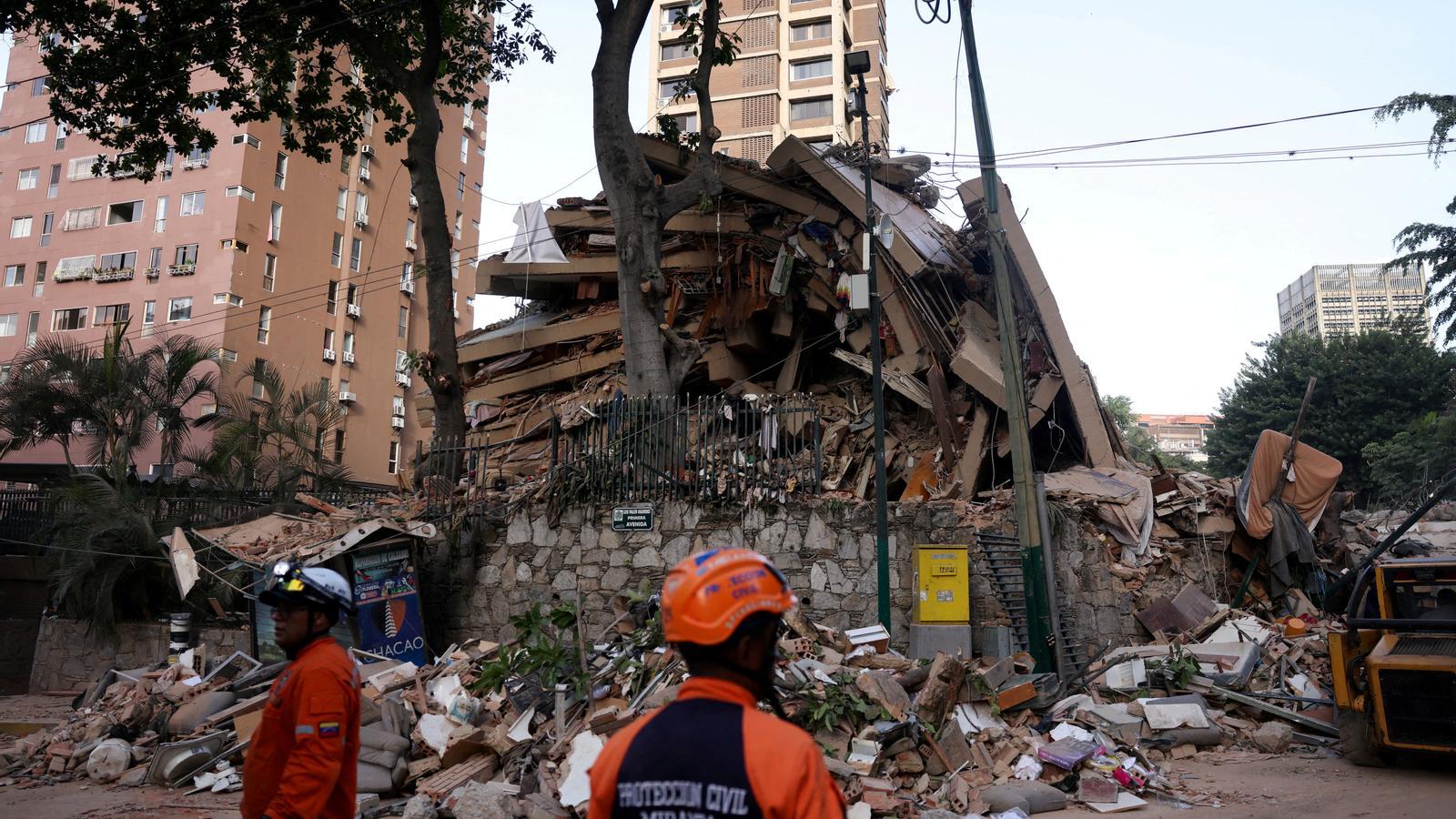

Venezuela has just suffered two devastating earthquakes that have exposed, if that were even possible, the inability of a bankrupt state to face the harsh reality. The earthquake has stripped bare organizational miseries and exponentially accentuated the torn seams of a country that was not working and that is now literally – physically and psychologically – in pieces.
Massive collapses are the product of a real estate park, of which it is estimated that only 25% of legal constructions complied with seismic regulations, in addition to having extensive self-built neighborhoods. Earthquakes like those Venezuela has suffered, of magnitude 7.2 and 7.5, in other latitudes, such as Japan, would have had a very limited impact and a minimum cost in human lives.
This dramatic situation is added to the political and economic confusion after, half a year ago, the United States forcibly took President Nicolás Maduro and his wife – since then imprisoned in New York – in an operation outside international legality. If then Venezuelan society was left in a state of shock, now infinitely more.
Shaken by earthquakes, Venezuela has almost no means to start searching for the missing, which the UN estimates could be around 50,000. Those not located in the coming hours will hardly survive. The drama is absolute. The confirmed death toll is approaching a thousand and the injured number over 3,000. And pay attention: about 6.7 million people have been affected by the tremors.
Less than a month ago, this newspaper – journalist Mònica Bernabé – travelled to the country to take a snapshot in situ of the living conditions. What he found was a broken society, formally still Chavista, but in practice it is not clear under which regime. With out-of-control inflation, with a lack of food, with a government under the weak interim presidency of a Delcy Rodríguez, who is tutored – not to say a puppet of Washington, even though she maintains a certain continuity rhetoric – and with continuous power and water cuts, the timid economic opening sponsored by the US has not been noticed for the moment.
The doubts that the situation now raises are many. Will the earthquakes accelerate political change? To what extent will the United States help Venezuela out of this new impasse? Many neighboring or distant countries, including Spain and Catalonia, despite ideological differences, have opted to make gestures of support for Caracas. But, of course, we will have to see how far international solidarity really goes and, above all, how long it lasts: it is usually concentrated in the first moments of media impact, which are also those of greatest humanitarian urgency. Afterwards, Venezuela will have no choice but to try to find a new direction amidst the rubble.
In any case, given the complicated previous situation from which it starts, it seems difficult for any substantial improvement to occur in the short term after the earthquakes. Venezuela could emerge very weakened. And the worst would be for the anomalous and uncertain post-Maduro normality to become entrenched.
