"Peace, roof, and wages": thousands demonstrate for May 1st
2,500 people according to the Guardia Urbana and between 10,000 and 15,000 according to the organizers, protest in the center of Barcelona

-
CAT -
CAST
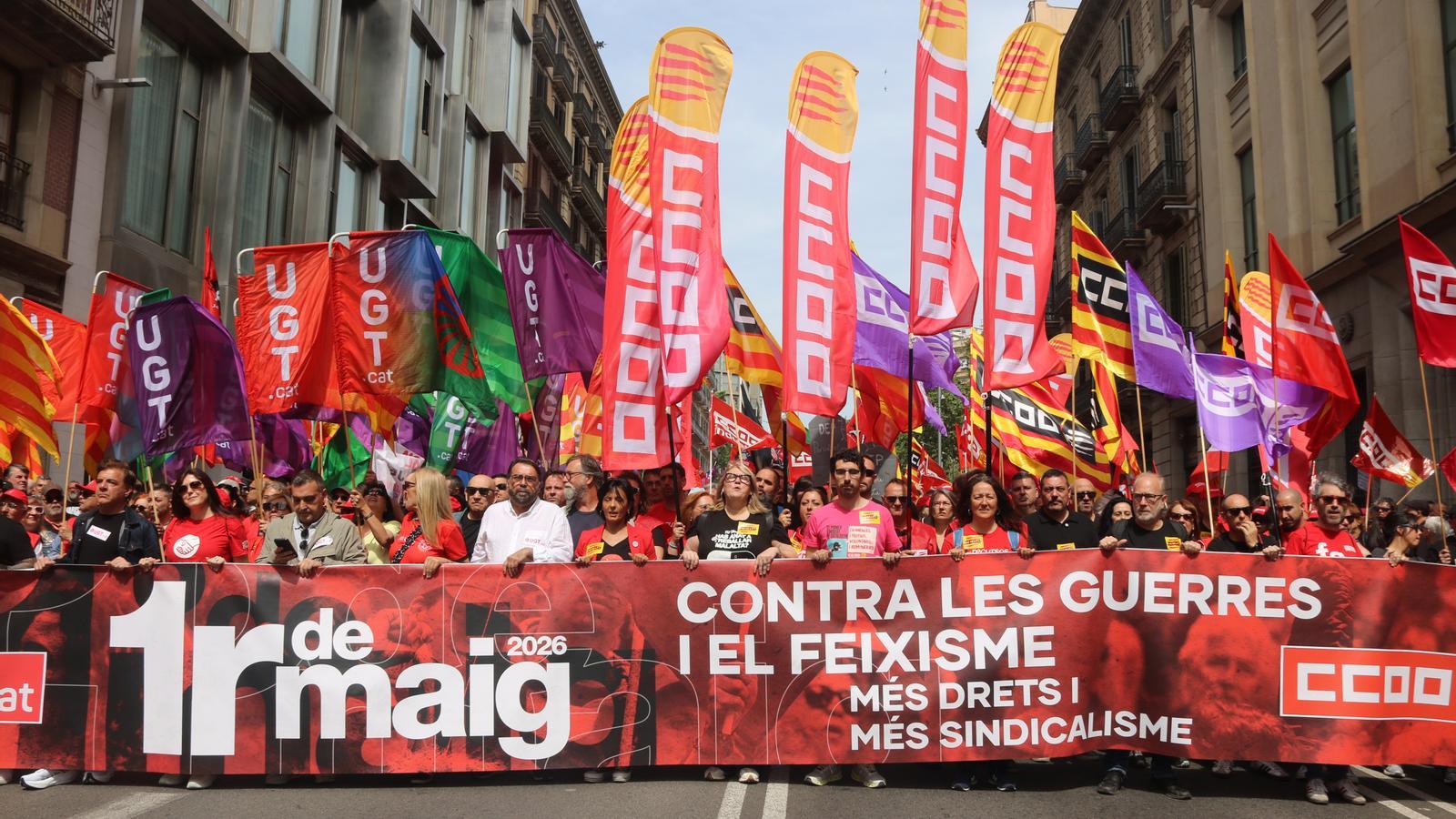
BarcelonaThousands of people participated this midday in the demonstration called by UGT and CCOO in Barcelona for Worker's Day, the central event of the day of protests in Catalonia. The Urban Guard put the participation in the protest at 2,500 people, while the organizers estimated there were between 10,000 and 15,000. Workers have mobilized spurred by international geopolitical instability and the electoral calendar in the State.
Alternative trade unionism has called for a protest at 5:30 p.m. together with the Mesa de Vivienda de Catalunya, in which the Sindicato de Inquilinos also participates.
"We are demonstrating to ask for decent work, but at the same time because we want to live better and in a world at peace," explained the general secretary of UGT de Catalunya, Camil Ros, in statements to journalists before the march began. Union leaders have condemned the "illegal wars" that "are having long-term humanitarian repercussions, but also an impact on the living conditions of the working class, especially the Catalan one," in the words of the general secretary of CCOO de Catalunya, Belén López.
The unions demand limiting fuel and energy prices, subsidizing basic products, and guaranteeing free transport in the face of the increase in energy and fuel costs caused by the war. Ros has argued that there is "a significant purchasing power crisis," a consequence of "wages gradually increasing while prices are soaring."
López has demanded "a reform of the dismissal law that guarantees it is the last resort," in the face of Employment Regulation Files (ERO) in "companies that have profits," among which she has pointed to Ficosa and Nestlé. Workers affected by this type of measure have increased by 53% compared to last year, a sharp increase that places the figure at 1,874 people, the highest point in a first quarter since 2021.
During the speeches that closed the protest, the general secretary of CCOO wanted to defend the agreement reached together with the UGT in the educational field, which sectoral unions reject. She recalled that they are "the two majority unions in the sector" and defended the proposal: "It is an agreement that improves the working conditions of all professionals in the sector and deploys inclusive schooling". Although she has opted for "continuing to deepen" the advances.
Against "extractivism"
After calling for an end to wars that, as López said, "only serve to prop up the usual power," he recalled that "peace is not just the absence of bombs, but also the existence of social justice." In this regard, he criticized the "historic record profits of many companies." "It's not economic growth, it's extractivism," he said.
According to the advanced CPI, prices rose by 3.2% in April compared to last year, although they moderated the increase from March. Despite this, thanks to the measures promoted by Pedro Sánchez's government, which included a reduction in VAT on electricity, gas, and fuels, the economy is in a very different position than at the time of the outbreak of the war in Ukraine, which sent the CPI growth soaring to 10.8% in July 2022.
López expressed confidence that the inflation situation "can be controlled" and opened the door to renegotiating the latest update of the minimum interprofessional wage: "When it was agreed, we did not have the inflationary situation we have now," he stated. At the end of January, the Spanish government and trade unions agreed to raise the minimum wage to 1,221 euros in 14 installments – 3.1% more than in 2025 – despite the employers' rejection.
Trump, Orriols, and Abascal
In political terms, Ros has asked citizens that "if they do not want what is happening in the United States to happen in Catalonia and in the State, do not vote the same", and has vehemently stated that "Trump, Orriols and Abascal are the same". However, he has also lashed out against "certain political left that lives only on criticism and chatter".
The main demonstration on a Spanish scale is taking place in Malaga, coinciding with the Andalusian elections campaign. Unions aspire to become a moral containment wall against right-wing and far-right forces, with the PP, Vox, and Alianza Catalana in their sights. They fear that the right-wing parties will occupy the San Telmo Palace for four more years, as has happened in Aragon, Extremadura, and Castilla y León.
Both Ros and López have applauded the regularization of immigrants (which could benefit up to 150,000 people in Catalonia and half a million in the State), and have reiterated that it is not a threat to Spanish workers or wages. "We want to welcome and, therefore, we want the regularization process to happen," Ros has defended. Furthermore, they have called for the release of all members of the flotilla to Gaza detained by Israel. The Israeli army is only holding two detainees.
Today's demonstration is also marked by the housing crisis, which López has described as "the great factor of inequality" currently present in Catalonia and Spain. He has called for a "decided public intervention in the real estate market", within which the housing decree rejected by Congress this week with the votes of Junts is reintroduced. rejected this week with the votes of Junts.

