"We want to be the engine of Europe again": Catalonia seals pact to relaunch industry
The agreement between the Government, employers, and unions foresees an initial investment of almost €4.5 billion, which could be extended up to €5 billion

-
CAT -
CAST
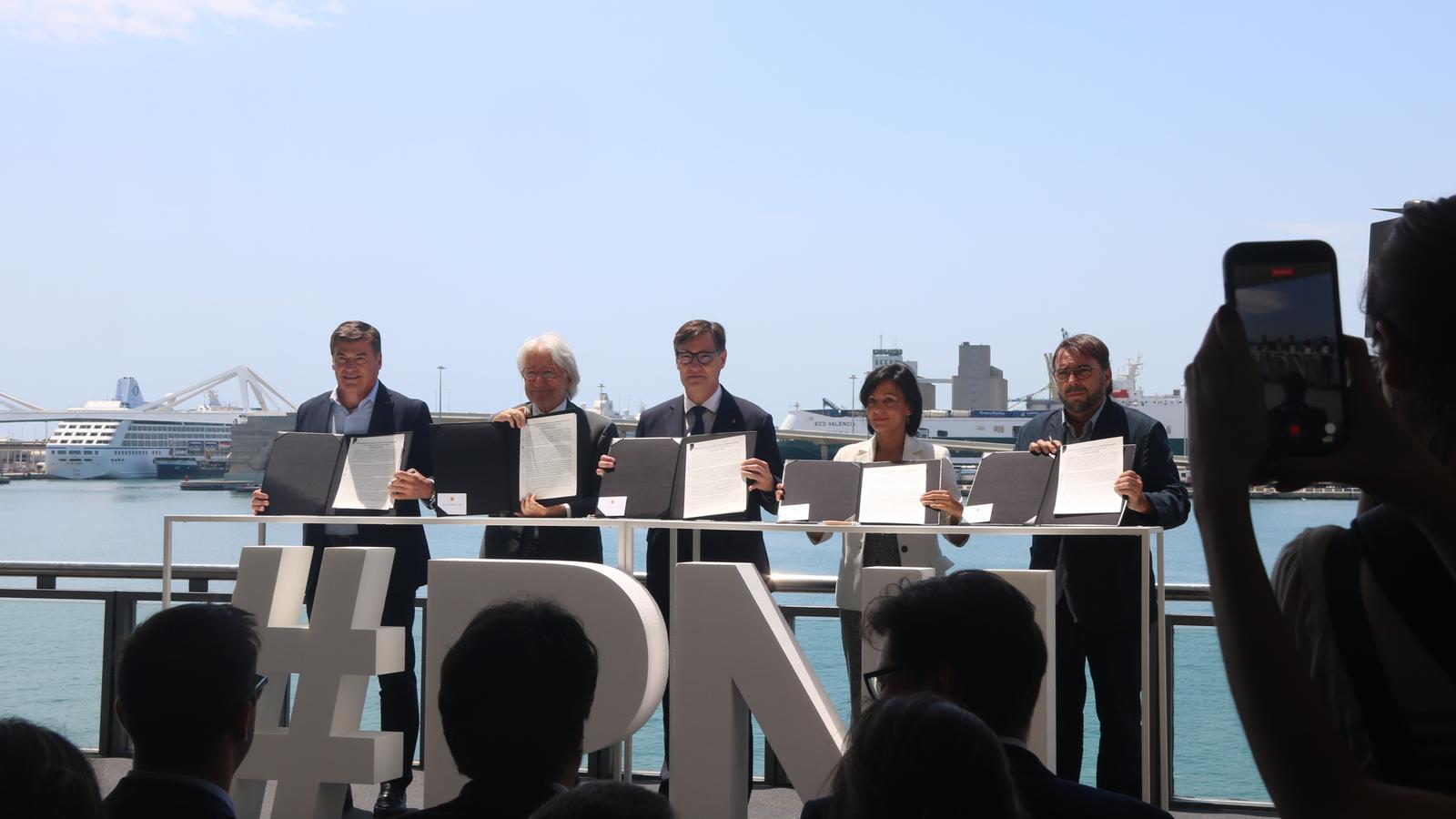
Barcelona“More industry, but, above all, of better quality”: Salvador Illa and the country's main economic agents have sealed this Monday the new National Pact for Industry. The roadmap until 2030 foresees an investment of almost 4,500 million euros in 190 actions comprised in five major areas, such as innovation or employment. During his speech, the President of the Generalitat emphasized that the agreement "is not a sectoral pact" but a "national and future pact". The text has been agreed with the two main employers' associations in the territory, Foment del Treball and Pimec, and the two majority trade unions, Comisiones Obreras (CCOO) and UGT. The objective: that by 2030 industry represents 25% of Catalonia's gross domestic product (GDP), the macroeconomic indicator that measures the monetary value of all final goods and services produced within a territory.
Specifically, the new National Pact for Industry is structured in two main sections: one that corresponds to a horizontal approach and another that is sectoral. The horizontal refers to those actions that are aimed at all industrial sectors, whether in innovation, infrastructure or training, while the sectoral foresees initiatives that focus on specific points considered to deserve "specific attention", such as the chip industry, dual technologies or artificial intelligence (AI). "The future of the world is played out in the new industry," Illa assured at an event held at the World Trade Center in Barcelona, where he added: "We want to be the locomotive of Spain and Europe again".
Furthermore, while the agreement signed this Monday establishes an investment of 4,463 million euros, the willingness of all agents to increase the plan's budget to, "at least", 5,000 million is also included. "The signing agents consider it necessary for the Generalitat's budgets in the coming years to progressively incorporate the necessary allocations to achieve all objectives," it is stated in the text. Salvador Illa celebrated that the industrial sector "is doing its job well" and assured that "we must think of Catalonia in big terms, with all the drive of which it is capable".
to his report for the European Union, former Italian Prime Minister Mario DraghiInfrastructure, at the center
The pact is structured through five main areas: sustainability and energy; quality employment; innovation and competitiveness; infrastructure and industrial land, and a fifth transversal area. However, of all of them, infrastructure is the one that accumulates the most investment, with 1,834 million planned until 2030. With this forecast, Illa has assured that the Government "has pressed the accelerator" in terms of infrastructure and, in addition to claiming that El Prat must become "an international hub and a benchmark for environmental sustainability", he has also spoken of improvements in the railway network. Furthermore, investments will also be concentrated in innovation (523.6 million); business dimension, investment and financing (475.1 million); industrial land (340.8 million), and training and skills accreditation (272.6 million).
By departments, Territory is the one with the most investment allocated in this pact, with 1,706 million until 2030, followed by Business and Labour, with 1,348 million, and the third place goes to Agriculture, Livestock, Fisheries and Food, with 706 million. Both the President of the Generalitat and Councillor Sàmper have indicated that the pact is structured around three objectives – productivity, sustainability and resilience – aligned with the proposal made in his report for the European Union by former Italian Prime Minister Mario Draghi.
A Catalan high-speed network?
In the act of the agreement, the trade unions CCOO and UGT and the employers' associations Foment del Treball and Pimec have also participated, who have celebrated the consensus between the parties in sealing the roadmap. Furthermore, the general secretary of CCOO in Catalonia, Belén López, has claimed that the pact takes into account the "concerns" of the male and female workers of the country, and has assured that the agreement foresees an eventual Catalan high-speed rail network "with a public service vocation". For their part, the general secretary of UGT of Catalonia, Camil Ros, has positively valued that the new edition of the pact also includes the food sector and has advocated for the role of industry as a tool for the integration of the immigrant population, as, according to him, it already was in the 1960s in Catalonia.
From the company's point of view, the president of Pimec, Antoni Cañete, has assured that thanks to the employers' association, the agreement has "a small business perspective", while also being "more executable, more manageable and more connected to the productivity reality" of the territory. He also indicated that the pact reserves 60% of its resources for small and medium-sized enterprises. Josep Sánchez Llibre, president of Foment del Treball, has advocated that the National Pact for Industry promotes "more economic activity, more added value, more innovation and more competitiveness".
