Economy ministers united by financing
The current holder, Alícia Romero, and three predecessors agree on some of the pending issues to improve growth

-
CAT -
CAST
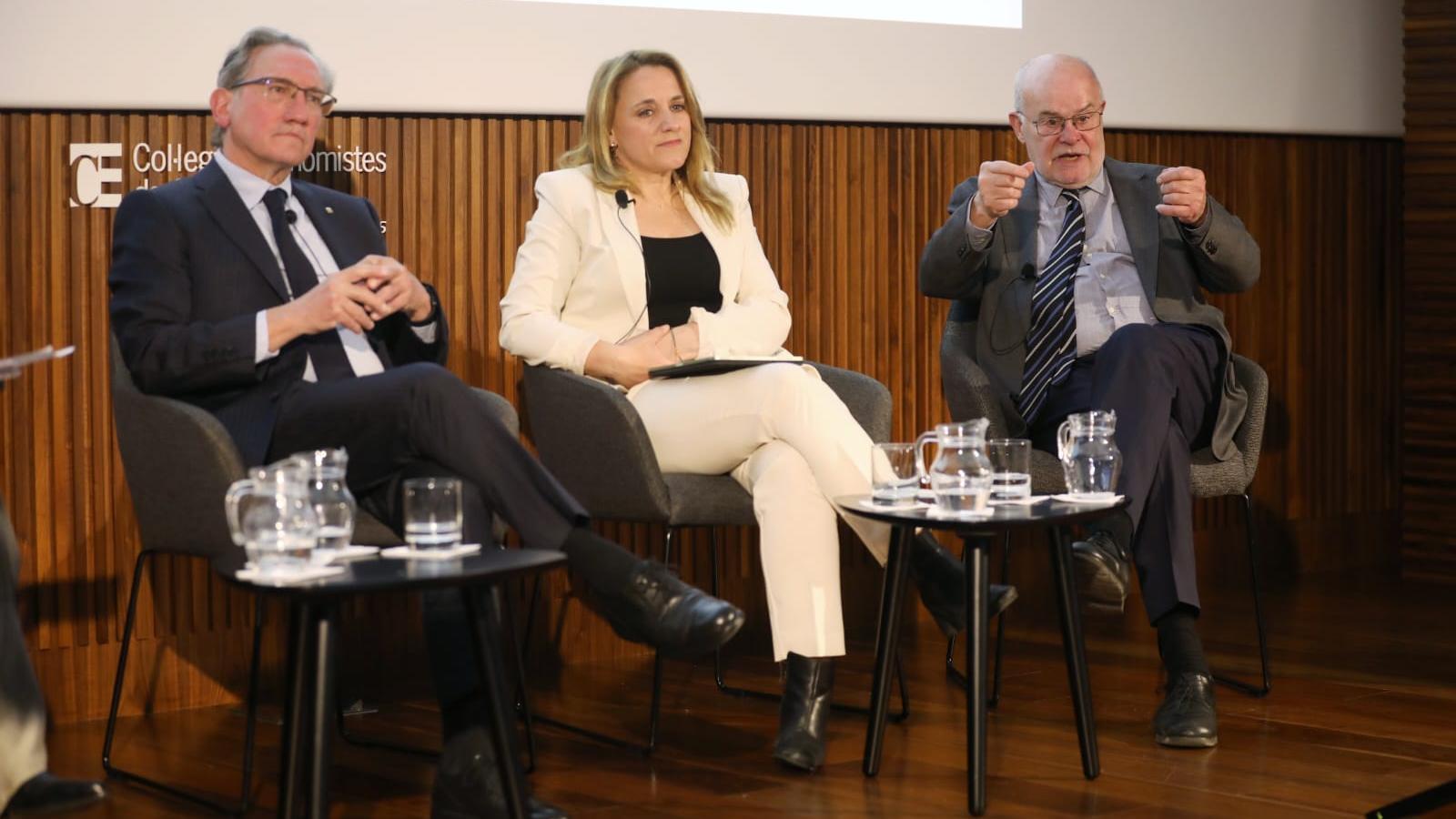
BarcelonaFor better growth, we must invest in batteries to store green energy or attract talent, but the key to the future is fairer financing. There is agreement between the Minister of Economy, Alícia Romero, and three of her predecessors from different political families, who are clear that there are aspects on which there can be broad consensus.
This was confirmed during the conference The Catalonia We Want, organized by the Economy and Business Foundation, at the College of Economists of Catalonia. In this way, they follow the line set in January of last year by three former presidents, Artur Mas (CiU), José Montilla (PSC), and Pere Aragonès (ERC), also at the College of Economists. The former Ministers of Economy Antoni Castells, who held the position for the PSC in the governments of Pasqual Maragall and José Montilla (2003-2010); Jaume Giró, proposed by Junts in the first executive of Pere Aragonès (ERC) (2021-2022), and Natàlia Mas, for ERC, in the second executive of Aragonès (2022-2024), believe that financing is one of the key pieces for progress. Once outside active politics, away from partisan tactics and strategies, it becomes easier to agree and speak clearly.
Along these lines, Giró states that financing "is the main problem" we face, which, moreover, "is chronic and endemic," especially currently "for demographic and sociological reasons." A proponent of maximum management autonomy, he is realistic regarding some of the objectives of the PSC and ERC investiture agreement: "Today the Catalan Tax Agency (ATC) is not prepared to collect all of the IRPF. It needs time." The same Republicans have erased this milestone as a red line.
Castells also admits it, but states that work must be done to achieve it in the future because "it is not impossible for the ATC to be ready". Natàlia Mas, who was in the government that designed the proposal for singular financing, warns that the problem of the fiscal deficit is not resolved only with the financing model, but also with the reduction of the debt of the autonomous liquidity fund (FLA) or specific financing for Catalonia's own competencies, such as the Mossos, prisons or language. Everyone applauds the step taken with the creation of the consortium for investments, which in any case will have to be approved, like financing, by Congress.
And, from the perspective that their experience as managers of Catalan finances gives them, they advocate for "moving from plans to concrete projects", according to Castells. For Giró, broad political majorities are needed to make this possible and to bet on the strategic sectors in which we already have an important weight, such as health, biotechnology or industry. And Natàlia Mas recalls that "Europe and Catalonia must continue to be what they are" and strengthen themselves where they are already strong.
Lines of country
The moderator of the debate between former ministers, Aurora Catà, reminded them of the importance of consensus because the three of them together represent political forces that add up to 70% of the votes in Catalonia. Romero, before the debate, also defended a Catalonia with hope and optimism, in which being constantly indignant does not prevail.
Likewise, Giró acknowledges that, just as when Barça loses it's not always the referee's fault, it's also not always others' responsibility that all investments are not executed. Castells, following the thesis, defends political leadership to move forward. "We have to say what needs to be said. That if we want to decarbonize we cannot close nuclear power plants or that the very high voltage line, the MAT, is indispensable. Leadership means courage," assured the former minister, who stressed the need to agree on issues such as Rodalies, renewables, or the MAT. "A country needs a leadership group that is clear about what country it wants, that shares basic ideas," he states.
What is evident, according to Mas, is that "there is no predetermined future but one conditioned by what we do today". That is why we must advance in financing and resolve deficits. Giró also believes that we must move away from victimhood. "The country needs strategic transformation projects, extensive time horizons, and broad political agreements. Without this, the changes the country needs cannot be faced. We have had many deficits, such as fiscal or investment ones, for more than 25 years. What is new is an attitude of complaint and inaction," he states. Also, again from a realistic perspective, he admits that the fiscal deficit may be reduced, but it will probably not disappear completely.
Mas adds that, in terms of infrastructure, "we need not only new construction but also maintenance to avoid depreciation of what we have". And this requires, he states, an amount equivalent to 1% to 1.5% of GDP. In addition to ensuring that the State executes a good part of the budgeted investments, renewable energies must be deployed, investment in networks, in interconnections with Europe, industrial self-consumption, and a commitment to batteries, which are and will be as important as oil or chips were and are.
