CaixaBank says that the conflict between great powers is "the biggest threat to global stability"
The entity also shows concern about the aging of the population and the lack of housing in the State
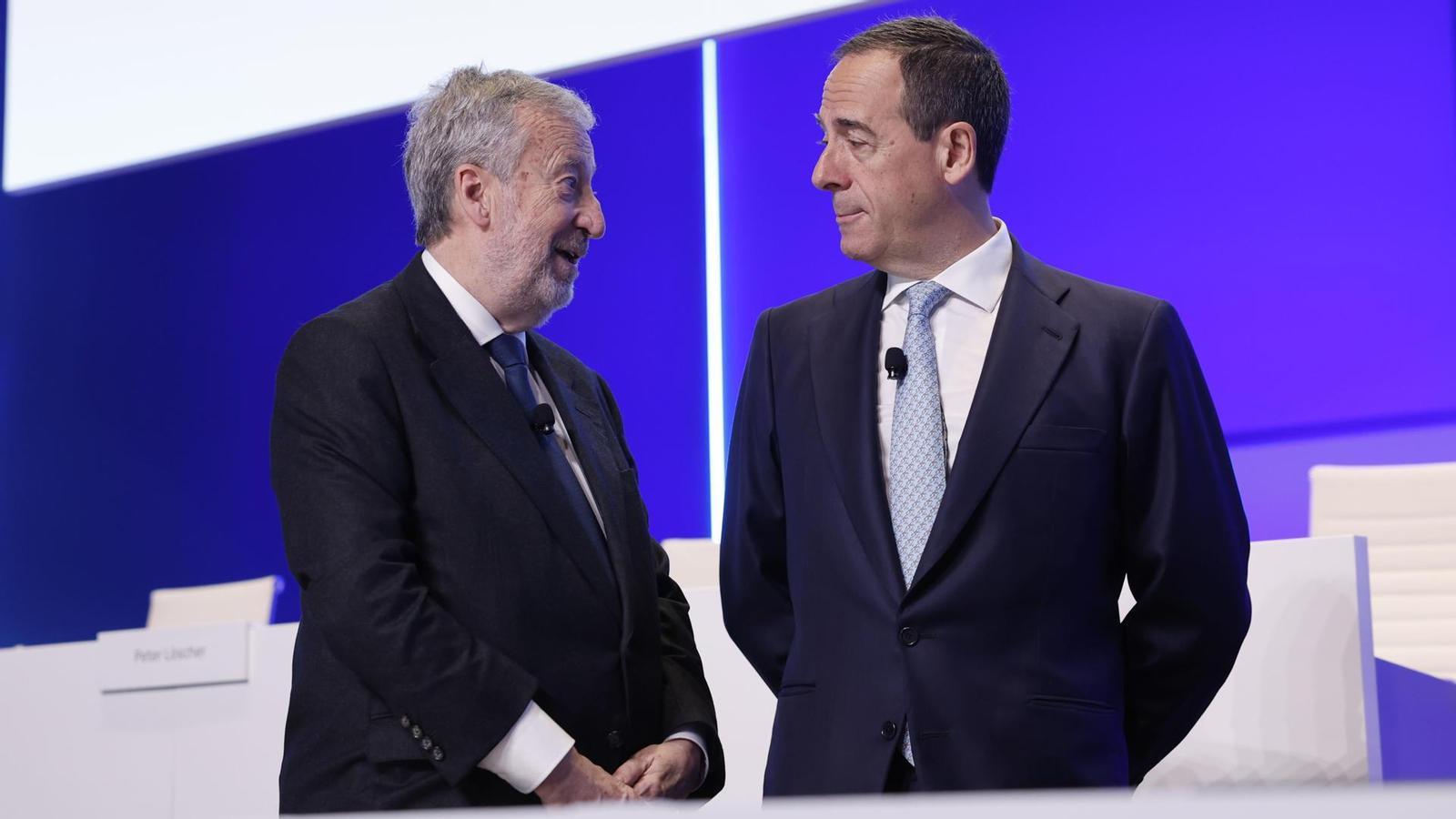
ValenciaThe confrontation between great powers is the "greatest threat to global stability". This was denounced this Friday by the president of CaixaBank, Tomàs Muniesa, during the company's general shareholders' meeting held in Valencia. The executive has held the foreign policy of the United States primarily responsible for this situation, which he has accused of "generating uncertainty". According to Muniesa, geopolitics has become the main threat to the global economy in the short term, while climate change is the main threat in the medium term.
The company fears that the dark clouds coming from the Middle East may increase inflation and financial market volatility, reduce trade, and affect supply chains. In summary, it weakens an economic moment from which the bank continues to benefit with the achievement in 2025 of a net profit of 5,891 million euros, 1.8% more than in 2024, but in which the unease of a staff that is on strike this Friday to denounce a "unbreathable" work climate due to "exaggerated demands" also increases.
Less threatening than global instability, but also worrying for Muniesa, are the weaknesses of a European economy which he has complained is "over-regulated" and excessively fragmented. Regarding the State's Achilles' heels, he has highlighted the aging population – which has the longest life expectancy in Europe – whose pensions will generate "debt of 181% of GDP by 2070". He has also pointed out "the lack of 700,000 homes", when "at most 150,000" are built per year. Regarding solutions, the president of CaixaBank has pointed to the arrival of foreign people to meet labor demand.
Increase in dividend
Much more stable than the global economy are the results of the Catalan root bank, which this Friday approved a distribution of a complementary dividend of 2,320 million euros, equivalent to 33.21 gross cents per share. This second payment raises the shareholder remuneration in cash for the 2025 financial year to 0.50 gross euros per share. This represents an increase in the dividend of 15%, compared to the 0.4352 gross euros per share of the previous financial year. In this way, the amount allocated to dividends from the 2025 results amounts to 3,499 million euros.
The entity maintains the objectives revised upwards this year for the 2025-2027 period, observing a "more favorable background sea" than anticipated, despite the "uncertainty" generated by the conflict in the Middle East. The bank has raised the average annual growth target from 4% to 6% during the strategic plan, while the non-performing loan ratio will be reduced to 1.75%, instead of the initial 2%, and the return on tangible equity will exceed 18%, compared to the 15% planned in the original plan.
The general shareholders' meeting of CaixaBank has also approved the re-election of the entity's chairman, Tomás Muniesa, as a proprietary director for a period of four years, as well as the appointment of Ana María García as an independent director and, by co-optation, of Pablo Arturo Forero as an independent director.
Workers' protests
One more year, the review of CaixaBank's green numbers has coincided with the workers' protest, which this year has escalated with two partial stoppages and a strike this Friday. Employees have gathered at the door of the Valencia Congress Palace –where the shareholders' meeting has been held– to denounce a "commercial pressure" that aims to increase business by 40 to 50% and generates "unaffordable" demands on staff and a "toxic" work situation.
From the CaixaBank Employees' Union, the majority with 42% representation, co-spokesperson Xavi Vidal has denounced to ARA that from the company they only receive "good words", but "zero commitments". Antoni Cano, general secretary of the Federació d'Estalvi de Catalunya, agrees, detailing that after the strike they expect "important movements" from the company. Eva Díaz, from the Independent Union of the Balearic Islands, also demands it from them, having announced that if the company does not make a move, the mobilization will continue. A negotiation that is not expected to be easy, given the words of Tomàs Muniesa, who has defended that "working at CaixaBank means facing a challenging, but manageable, work environment".
On the other hand, the Frob, CaixaBank's second largest shareholder, has voted against CaixaBank's new remuneration policy for the board of directors, which includes an increase in salaries, despite sources from the Ministry of Economy, Enterprise and Commerce explaining to Europa Press that the decision "has nothing to do" with the entity's management.
