Brussels only revises upwards the forecasts for Spain and places it as the locomotive of Europe
The European Commission estimates that the state's economy will grow by 2.4%, the highest percentage among the large EU countries

-
CAT -
CAST
BrusselsWhile the eurozone continues to register an anemic economic growth, Spain remains the major economy that is growing the most. Brussels has improved the State's economic forecasts and estimates that this year it will increase its gross domestic product (GDP, the indicator that measures the size of an economy) by a tenth more than it had predicted, 2.4%. A percentage that far exceeds the average of 0.9% for the countries of the single currency and 1.1% for the European Union as a whole.
The difference is even more substantial when compared to Germany's rate, which will remain at 0.6%, or with France and Italy, which will stand at 0.8% and 0.5%, respectively. The spring economic forecast report presented this Thursday by the European Commission points out that Spain maintains these good figures due to "internal demand" and an "increase in consumption and investment," which is benefiting from "job growth in a context of sustained immigration and record low household debt."
In fact, Brussels indicates that unemployment in the State will fall below 10% –a rate not seen since 2008– and will stand at 9.9% this year, and 9.6% in 2027. With these figures, Spain would cease to be the member state with the highest unemployment rate and would be surpassed by Finland, which will climb to 10.1% this year and will only fall to 9.9% next year, if forecasts are met. However, the Community executive warns that, although "this downward trend will be maintained", the pace of reduction in unemployment and job creation by Spain will be "lower" than in recent years due to the projection of a "gradual slowdown" in economic growth.
In this regard, the European Commission lowers its economic growth estimates for Spain in 2027 by one tenth, placing them at 1.9%. However, the State will remain well above the average for the euro area countries, which will rise to 1.2%, and for the global European Union, which will reach 1.4%. The major economies of the European bloc will continue to register low growth figures: Germany will stand at 0.9%, France will rise to 1.1%, and Italy will be limited to 0.6%.

Brussels also points out that Spain will again comply with the European Union's deficit rules and, as last year, in 2026 it will again register 2.4%, 6 tenths less than the maximum of 3% allowed by community regulation. And in 2027 the percentage will drop even further, to reach 2%. The European Commission explains that these percentages are due to the growth of the State's nominal GDP and, above all, to the fact that "income from direct taxes remain solid", as well as the entry into force of the global minimum tax on large multinational companies.
Once again, Spain's deficit situation continues to be better than that of France, Italy or even Germany, which is historically one of the great defenders of austerity and containment of public spending on the continent. Although the EU ceiling is 3%, the French deficit will climb this year to 5.1%. As for Italy, for the moment it would comply with the community rule and will remain at 2.9%. The euro area deficit average this year will be 3.3%.
The effects of the war in the Middle East
Spain is also one of the member states that will least notice and be affected by the war initiated by Donald Trump in the Middle East. Brussels estimates that this year's price increase rate in the State will be one point higher than it had predicted before the energy crisis and places it at 3%, the same as the eurozone average.
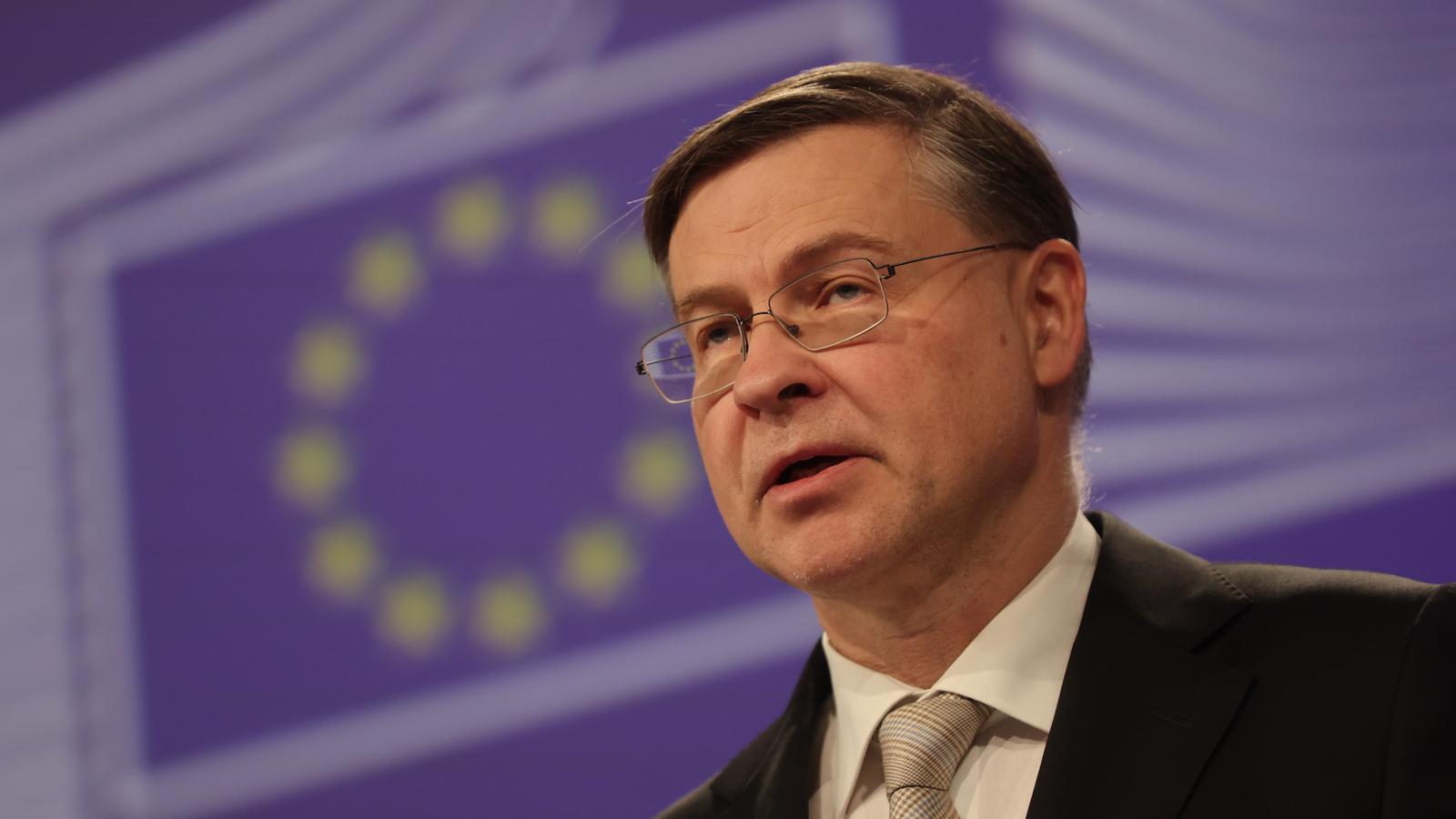
However, the European Commissioner for Economy, Valdis Dombrovskis, explained that "not all regions or countries in the EU" suffer the consequences of the conflict in the Middle East in the same way, and said that states that are "less dependent on fossil fuel imports" and have more renewables, such as Spain, are less affected. Regarding 2027, the European Commission projects an inflation in the State of 2.5%.
However, the report by the community executive's technicians warns that one of the "main risks" facing the eurozone, and especially the State, is a "potential weakening of tourist activity," especially "the arrival of tourists coming from long distances." "This may be due to the increasing costs of travel and other mobility-related disruptions," the report warns. In the same vein, Brussels warns that the international uncertainty caused by the war in the Middle East could lead to "a period of more prudent behavior from the private sector," which could lead to a reduction in investment and consumption.
All in all, Moncloa has congratulated itself in a statement on Brussels' economic projections and emphasizes that, in a context "marked by the war in Iran and the volatility of energy markets," the European Commission "confirms the uniqueness of the Spanish trajectory." "It is the only major economy in the eurozone that combines growth well above the average, intense job creation, reduction of unemployment, and fiscal consolidation," the Spanish government remarks.
