The more than 3,000 deaths at the Sant Boi psychiatric hospital receive a tribute that breaks decades of silence
After a long struggle, a plaque commemorates thousands of deaths during the Civil War in mental institutions
-
CAT -
CAST
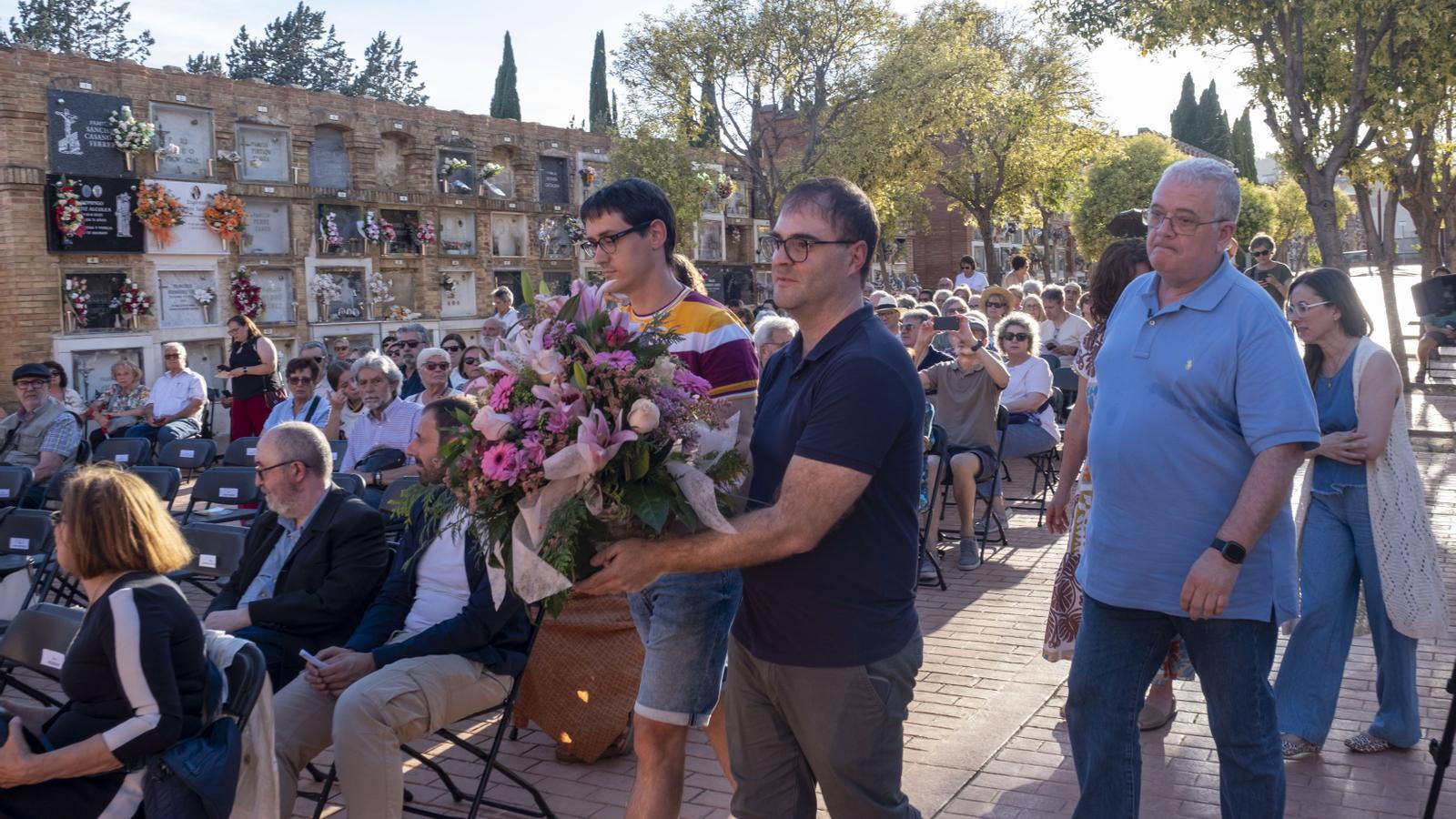
Sant Boi de LlobregatJanuary 2024, ARA revealed for the first time some staggering figures. During the Civil War (1936-1939), the cemetery of Sant Boi de Llobregat – a municipality that at the time barely exceeded 10,000 inhabitants – registered the death of more than 3,000 people admitted to the municipality's psychiatric hospital. This Saturday, finally, the memory of those men and women has been rescued from anonymity with an institutional tribute. A plaque from the Directorate General for Democratic Memory makes them visible and recalls their history. Their descendants not only have a place to bring flowers, but they also know something more about those who died a few meters from the cemetery. Just a week ago, after many demands, they received the medical records of some of their relatives.
more than 5,715 people died in psychiatric centers in just three years.The causes of death are indisputable:died in psychiatric centers more than 5,715 people in just three years.The causes of death are undeniable: extreme malnutrition, gastrointestinal infections, and severe physical deterioration.The scarcity caused by the war hit the corridors of centers where the most vulnerable and forgotten lived locked up with great cruelty. Despite their cries for help, outside those walls, the silence was absolute.
"Serret's reports with the death figures were in a drawer for a long time, and if today is possible it is thanks to the perseverance of many, like activist Edgar Vinyes", says Robles. "The investigation was activated after everything came to light with the ARA article", he adds. Robles did not expect to find all that he found, so many thousands of deaths. "The system failed and it's like a blind spot where we don't want to look; it's as if they hadn't existed", concluded the historian.
The names behind the figures
The effort of the families to find out who is behind the figures is titanic. "Because behind each name there was a life, a shared story, hands that loved and hearts that resisted, even when the world decided not to look," recalled the poem written by the members of Besnets per la Dignitat. "It has been difficult to accept the decisions our families made at a time when there was stigmatization and poverty. This must be a starting point and not an end, because we want to recover the individual history of each person and we still have many questions and many doubts. We want to encourage all those who have pending documentation to open it to give us access, because knowing is a right of families," exclaims Susanna Caselles, from the association.
Antoni Blanco, another family member, wanted to give a voice to those who died within the walls of the institution: "What did we do to deserve this, apart from being poor and vulnerable? We didn't hurt anyone, and after so many years of silence, we just want someone to explain what happened here." Francesc Martínez, who fought hard to find out what happened to his great-grandfather, recalled how they have been pulling the thread: "From a photograph that no one talked about, a letter, a whispered confidence... There has been a silence fueled by stigma.
Institutional representatives have taken up the challenge and have committed to continuing research. "When we talk about democratic memory, we reiterate the concepts of justice, truth, and reparation, to which we must add that of dignification, as an exercise of honesty with ourselves. We assume the challenge of continuing it: this is not the end of a stage, but a starting point. We are talking about people, about family members who were doubly forgotten. We have a lot of work to do, because the figures are staggering," assures the Minister of Justice, Ramon Espadaler.
The mayor of Sant Boi, Lluïsa Moret, has highlighted the transformation of a municipality also pursued by stigma: "We have gone from being the village of the madmen to becoming the city of mental health, and today we are a benchmark. It has been work done with humility, aimed at dignifying vulnerable people who, due to their situation or pathology, were invisible and had been deliberately made invisible by history. Today and here, hand in hand with all of you, we reaffirm our commitment to betting on research," she stated.
