Aena guarantees shareholders that airport management is "exclusively" theirs
Next week the airport coordination committee is scheduled to meet after years of being almost inactive

-
CAT -
CAST
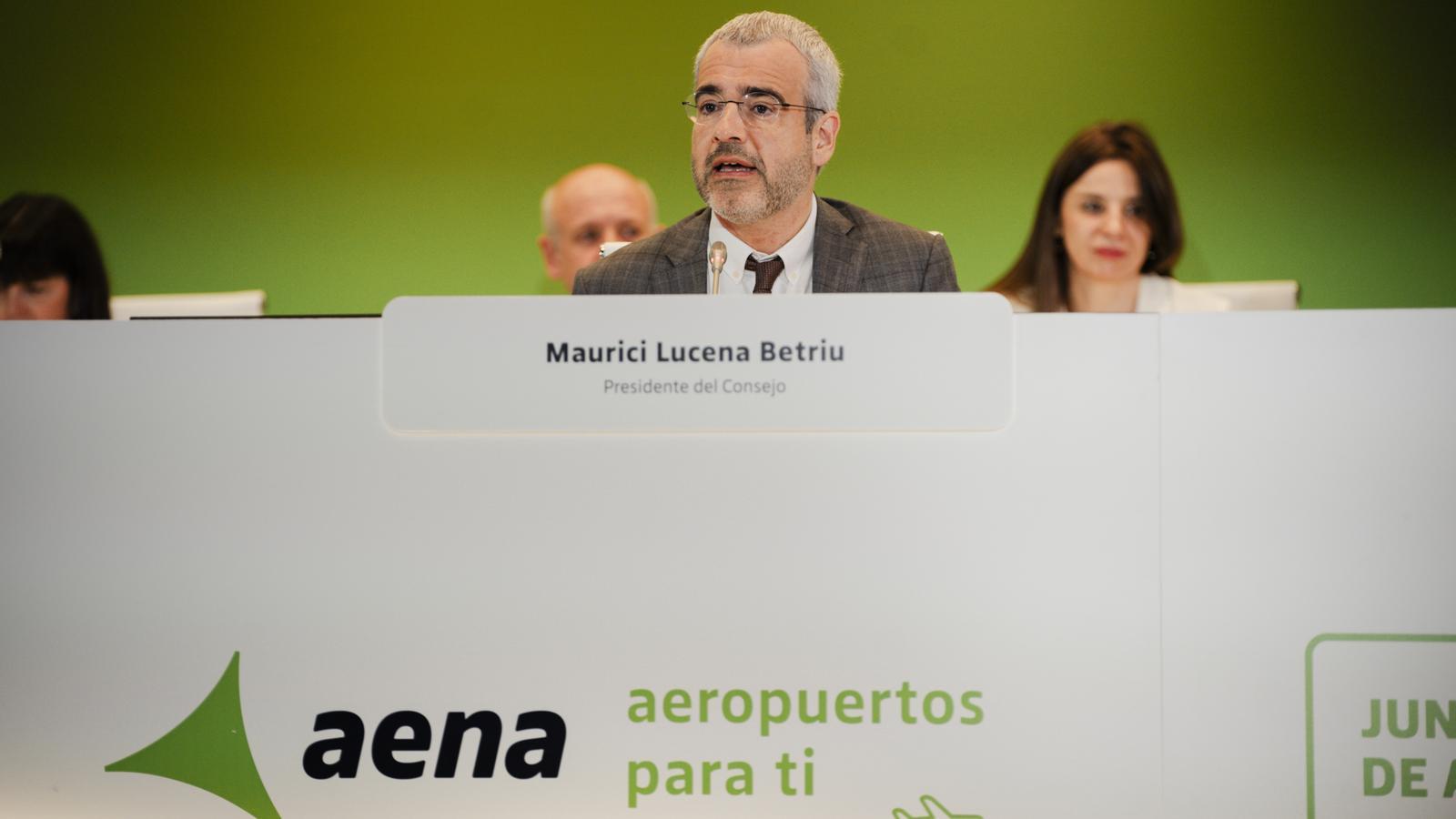
MadridTransfer, co-management or coordination. These are some of the words used when referring to the demand by some parties –ERC or PNB– and regional governments regarding the role of autonomous communities in the Spanish airport system. In particular, in those airports located in their territories. Aena, the airport operator in the State, is clear: no transfer, and "co-management", meaning participation in management, is an "impossible" demand. Aena, in which the State controls 51% of the share capital through Enaire, while the remaining 49% is in private hands, only opens up to deepening "coordination" with the territories. How? Through agreements like the one reached by the central and Basque governments on the airports in the Basque Country last March. All of this was recalled by Aena's own president, Maurici Lucena, this Thursday, taking advantage of the company's general shareholders' meeting, which re-elected him for another four years, extending his term until 2030 (he will have a total of 12 years as Aena's top executive).
"I have the bitter impression that in some cases a blatant reality is genuinely ignored, and in others feigned," Lucena stated. He was referring to the claims of those parties, but also regional governments, that want their community to play an important role in the management of the airports in their territories. "They are [claims] sterile," said the Catalan executive to the shareholders. Lucena dedicated a good part of his speech to this issue to conclude, as he has done on other occasions, that the management of airports of general interest in the State is "exclusively" Aena's.
What is the place for Catalonia?
Lucena's words come a day after the president of the Generalitat, Salvador Illa, assured that there will soon be an agreement with ERC for Catalonia to participate in "airport management". It should be recalled that within the framework of his investiture, Republicans and Socialists agreed on a change in the "governance" of El Prat airport so that the Generalitat has more say. The president of the ERC group in the Parlament, Josep Maria Jové, insisted that this is one of the "decisive points of this legislature". "The Generalitat must have weight and must lead", stated Jové.
But, is there a fit between this demand and Lucena's words? For now, Illa has taken steps forward to please the Republicans with the promotion of a Catalan Airport Authority. The intention is for it to be launched in 2027 and to have, among other things, its "own voice" in dialogue with Aena and the European Union. For example, it will be able to intervene in planning documents such as the Airport Regulation Document (DORA), to speak "one-on-one" with Aena or Enaire, as explained by the Govern. The key, however, will be the scope of this intervention and whether it will have executive powers or if what it says will be binding, or if it will be a merely consultative body.
For Aena, progress can be made in the creation of such bodies, but without them having executive functions or their decisions being binding. In fact, Lucena defended this Thursday that this is what the Basque government of Imanol Pradales and the executive of Pedro Sánchez have done. Pradales assured that an understanding was reached for the Basque Country to begin to "participate in decision-making" affecting the airports of Euskadi, but the Ministry of Transport pointed out in a press release hours later that the agreement was limited to the creation of a bilateral airport body between the Basque and Spanish governments to "collaborate and cooperate" on the strategy of the airports in the Basque Country. This body, however, "does not question or alter the autonomy of Aena's management", the ministry emphasized.
Resurrect coordination committees?
Spaces like this are reminiscent of the airport coordination committees that autonomous communities have had since 2013 and which, according to the law, must meet at least twice a year, which has not happened. In fact, it is planned that the Catalonia committee will meet next week, after a long period of inactivity, according to different sources consulted by ARA. Although the meeting planned for next week comes just as Illa has promised progress, it was necessary to hold it as a mandatory procedure before Aena's new investment plan, the so-called DORA III, which will have to be approved shortly by the council of ministers.
The committee is made up of the Spanish government (Ministry of Transport and the central government's delegation in Catalonia); the Generalitat, through the Department of Territory; local entities (Barcelona, El Prat, and Vilobí), the Chambers of Commerce, and representatives of economic organizations (currently Fomento and RACC), explain Aena. Aena acts as the committee's secretary. Furthermore, in the case of Catalonia, a specific "coordination commission" could be created for El Prat airport due to its passenger volume, as the regulations indicate.
For years, neither the Spanish government nor the Catalan government has promoted these meetings, even though they were the forum where, as established by law, the Generalitat could have its say regarding investments or even "collaborate" on the strategic lines of Catalan airports. ARA has requested the meeting schedule from the Ministry of Transport but has received no response. In parallel, the CDRA (Air Routes Committee) operates, a body established in 2005 to promote new intercontinental routes at El Prat airport, with which business sources acknowledge that dialogue is more fluid.

Aena's reasons
However, Lucena clings to the "impossibility" of co-managing the airports due to Aena's shareholding structure – the Catalan executive recalled that 49% of airport infrastructure, regardless of its location, is privately owned – but also due to the constitutional framework, which "makes impossible any operation that alters Aena's management autonomy," he said.
