What happens when women go out into the street?
An exhibition at Muhba traces female activism from the 19th century to current housing demands
-
CAT -
CAST
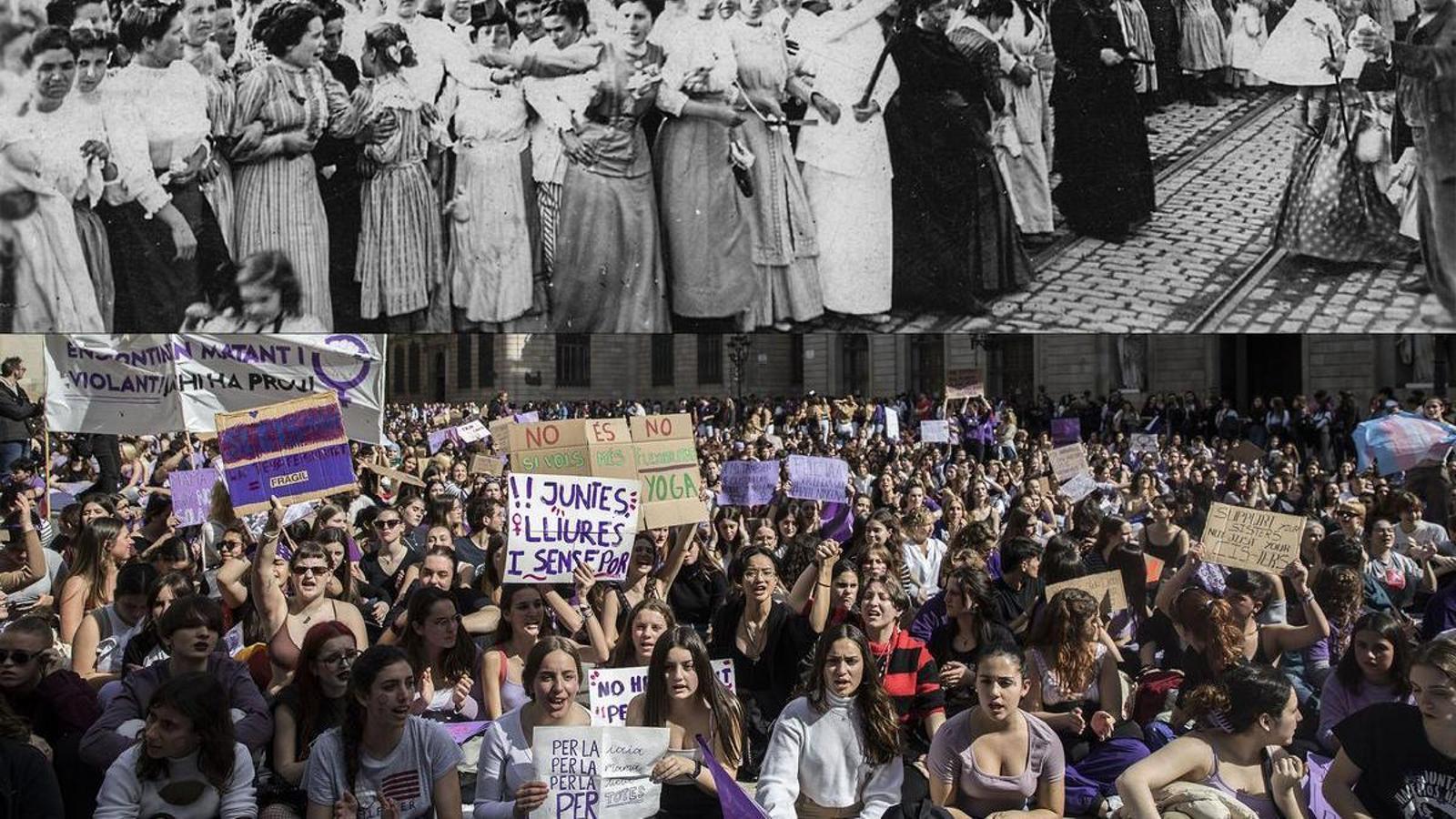
BarcelonaWhat happens when women take to the streets? This is what the exhibition Vindran les dones. 150 anys de lluites als carrers de Barcelona, which can be seen at the Barcelona History Museum (Muhba) in Plaça del Rei until September 13, attempts to answer. The exhibition recovers the invisible thread that unites 19th-century anarchists with 21st-century young women who claim the right to decent housing, all through the eyes of some eighty writers, artists, and activists who have lived in the Catalan capital.
The origin of the project dates back to Barcelona's participation in the Guadalajara International Book Fair in 2025. As Ingrid Guardiola, who curated the exhibition with Mita Casacuberta and Anna Maria Iglesia, recalls, the fair was the catalyst for "recovering women writers in general." "From there, we wanted to analyze how the public space of Barcelona and of large capitals is expropriated from collective life when it falls into the hands of vulture funds," says Guardiola, who warns of the drama of losing historic venues or the impossibility of affording a place to live, and how women have always taken to the streets when it comes to defending collective rights. According to Guardiola, the richness and idiosyncrasy of each neighborhood run the risk of disappearing. “In the last fifteen years, many voices have warned that the city is polarizing between shacks or low-cost apartments and luxury penthouses. Historically, women writers have wonderfully captured the personality of the neighborhoods, which, unfortunately, is being lost,” she adds.
The exhibition is divided into four historical periods that contrast two views of the metropolis. On the one hand, there is the "ideal Barcelona" built by the bourgeoisie for the most conservative sectors. This idealized image was created through poetry and the founding of the Jocs Florals in 1859, under the slogan "Homeland, faith, love", with women like Dolors Monserdà, Carme Karr or Francesca Bonnemaison, founder of the first library for women in Europe. On the other hand, other voices arose that described the conflicts, abuses, and problems of the popular classes. It is a more demanding and revolutionary Barcelona, with female writers, educators, and activists who organized themselves into fraternities and lodges to discuss literature, politics, or spiritualism, and to defend working women. Names like Clotilde Cerdà, promoter of the Academy for the Enlightenment of Women, or Ángeles López de Ayala, Amalia Domingo and Teresa Claramunt,, expressed their demands in the press of the time. The levels of sexual, intellectual, and labor freedom achieved during the Second Republic are glimpsed in the texts of Mercè Rodoreda, Anna Murià, Teresa Pàmies, Aurora Bertrana, Irene Polo, Clementina Arderiu, and Maria Aurèlia Capmany, many of whom suffered the pain of exile in 1939. After the long Francoist repression, the Transition would bring Montserrat Roig's cry for a "moral unveiling".
Rent and class struggle in the 21st century
Despite spanning a century and a half of history, the exhibition shows that certain structural problems remain alive. The 1929 Universal Exhibition already led Rosa Maria Arquimbau to propose reforms to the Barcelona City Council to protect vulnerable sectors and single women. In the 21st century, Anna Pacheco gives a voice to exploited hotel maids in tourist areas, while Stefanie Kremser explains how she was expelled from the Born and was forced to leave the city for a while with her partner, the also writer Toni Puntí. Najat El Hachmi reflects on the women who arrive in Barcelona from Morocco and their daughters, and Llucia Ramis shares the anxiety about constantly rising rental prices. Irene Pujadas makes her protagonist's body a metropolitan city, Marina Garcés recalls the Barcelona of social activism in the late nineties, and Blanca Llum Vidal connects with the popular memory of October 1st and the sovereignty of peoples.
Throughout the exhibition, the authors ask themselves what it means to have a dignified life and what are the means to achieve it. As Guardiola recalls, the historical struggles led by women have "a unique nature very tied to daily survival and the sustenance of the community." They mobilized the entire city during the bread riots in 1789 because they were responsible for feeding the family; they took to the streets around 1900 to demand freedom of conscience and to defend that their children should not go to war; and they organized to demand a secular school.
For the curator, the home should not be understood as a passive refuge but as an authentic political center, the place where children grow up and become citizens, directly connecting the personal and the collective spheres. One of the reflections that Guardiola reaches after curating the exhibition and collecting dozens of testimonies is a generational shift: younger authors have overcome the gender issue and focus on social class, talking about classism and access to basic dignities, while older authors focus on gender. "However, they all share that feminism essentially seeks rights and equality for everyone," says Guardiola.
