Karim Kattan: "What do you do when you see your country disappearing?"
Palestinian writer. Author of 'The Palace of Two Hills' and 'Eden at Dawn'
-
CAT -
CAST
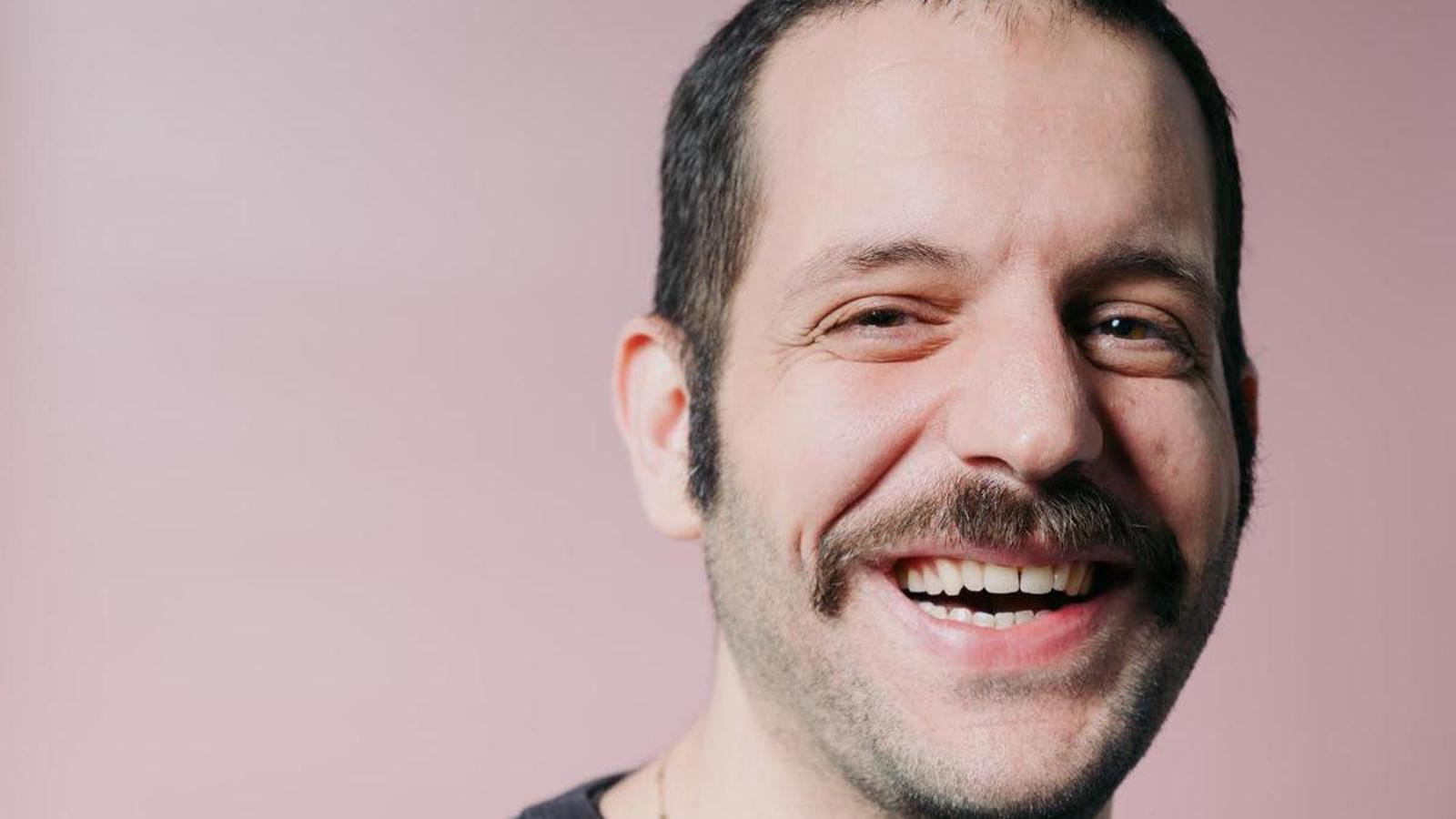
BarcelonaKarim Kattan (Jerusalem, 1989) is a Palestinian writer, doctor in comparative literature from Paris University, who explores through poetic fiction exile, memory, and violence, but also love and eroticism. He has lived in France since he was 18, but his family remains in Palestine. In his acclaimed debut novel, Le palais de deux collines (2021; The Palace of Two Hills in the Spanish edition published by Deleste),there is the return of an exile to his village and to the family palace full of ghosts and stories of a past that seems unreal. In L'Éden à l'aube (2024; Eden at Dawn in the Txalaparta edition) he narrates a story of love and desire between two men traveling under a hurricane wind that buries Palestine under the sand. His third novel, to be published in France in September, is even more apocalyptic.
In Le palais de deux collines, he describes a house inhabited by ghosts and refers to Palestine as a kind of "theater of shadows".
— This image is born from the mind of the narrator, Faisal, and his confrontation with his grandmother, Nawal; two characters who represent very different ways of understanding the Palestinian condition. Faisal, who is younger, tries to reject this condition, considering it an illusion. When you live under the yoke of colonialism, occupation, and constant grief, you end up feeling like you're moving in a house of ghosts. The book was originally published in French in 2021. The current situation has changed so much and so profoundly that I am sure that today the debate between these two characters would be completely different.
The book raises a great reflection on memory: how is the identity of a nation preserved when there is a colonial power that systematically tries to erase its past? How does one resist this disappearance?
— In the novel, we talk about characters who belong to a very well-off, almost aristocratic social class, so their relationship with the land and belonging has particular nuances. But the fundamental question of the book is: what do you do when you see your country disappearing? How do you contemplate your destiny when you are part of a people facing this situation? I wanted to explore all of this from the perspective of the novel and not from an essay. As a novelist, I prefer to avoid pamphlets or categorical statements; literature serves precisely to reflect on contradictions.
The book states that the colonists "are born with weapons in their hands". It presents violence not as an isolated fact, but almost as an inherent trait of their nature.
— It is a provocation that I take responsibility for; sometimes one needs to provoke. I wrote this novel between 2018 and 2019, before the pandemic. At that time, what I was describing was intended to be an exaggerated version of reality. What I find profoundly depressing is that, over the years, many of these exaggerations have become real facts. In the West Bank, a settler is exactly that: a person with a weapon who can do whatever they want with you, protected and supported by the army. No one defends you. They have, by definition, the right over the life and death of the Palestinian population.
The narrator describes the history of Palestine as a family trauma that is passed down in silence, like an inherited curse. How is this wound transformed into literature?
— I am very interested in exploring how the trauma of the Nakba and ethnic cleansing continues to beat through generations like a black hole. However, I do not use writing as therapy or as a strategy to manage this pain; I write literature and poetry because that is what I am passionate about. Ideas such as the disappearance of territory or generational trauma are not premises from which I start, but rather elements that emerge during the writing process itself.
This landscape that crumbles and disappears under occupation is also the backdrop for L'Éden à l'aube. How do you write about a territory that changes and is destroyed every day?
— It is a question I ask myself daily and for which I do not have a fixed answer. What I think today will surely be different from what I will think tomorrow, because we are facing a constant emergency: the genocide in Gaza, the violence in the West Bank... When I started L'Éden à l'aube, I did not want to talk about the occupation, I wanted to focus on a love story. But it is impossible to talk about two men in Palestine ignoring the reality that surrounds them. In September I am publishing my third novel in French, and it is an even more radical response to this question: it is an openly apocalyptic book where two characters have to cross a nameless country by car before the night ends, because the next day the country will disappear. I am writing at a historical moment when every five years the reality is worse than the previous one, and literature reflects it.
In this hostile and violent environment of his novels, are desire and love also a form of resistance?
— More than resistance or survival, I prefer to think it is simply a way of living. The characters do not theorize about resistance; they simply try to live and be free. Le palais de deux collines was a gothic novel, dark and nocturnal. L'Éden à l'aube, despite the violence surrounding it and its outcome, I consider it a much brighter work. It is a statement of intent: whatever happens, the life drive and freedom always find a way.
Filmmakers like Kamal Aljafari explain the difficulty of reconstructing memory when most historical archives have been destroyed. Do you consider their literature to be a form of archive against the erasure of history and collective memory?
— Yes and no. I don't want to overestimate the power of art; after all, a book is just a book. What can literature do against a multi-million dollar industry dedicated to employment and death? Practically nothing. But, at the same time, it is evident that when you create fiction, cinema, or poetry, you are generating counter-narratives and new archives where institutions have made them disappear. The work itself becomes the archive. I think, for example, of the documentary "Bye Bye Tiberias,by Lina Soualem; through the history of the women in her family, she ends up building a historical archive of Palestinian women over the last century.
You moved to France at 18, although you maintain a constant connection with your family in Palestine. How does this physical distance affect your writing?
— Distance changes everything. When I am in Palestine, I experience the reality of the occupation firsthand, directly. When I am in Paris, I inevitably adopt a position closer to that of a spectator. Furthermore, from a distance, one's home country risks becoming a space of imagination, while there it is the rawness of real life. In France, I am a European citizen with rights, protection, and freedom of movement; I am privileged. Writing from this duality inevitably changes one's perspective.
For a long time he rejected the label of "Palestinian writer", but now he openly claims it. Why this change?
— It continues to be a label that limits and boxes in, and my ideal wish would be for my books to be read exclusively for their literary value. But historical context dictates. Faced with the current genocide in Gaza, institutional censorship, and the systematic attempt to silence and marginalize Palestinian voices in places like France, embracing this identity has become a political and moral obligation. I am fortunate to have a platform, to be translated, and to receive public interest. This gives me a great responsibility.
How do you see, residing in the heart of Europe, the stance of European institutions regarding the conflict?
— It enrages me. The most painful thing is the hypocrisy of seeing how Europe boasts of calling itself the cradle of human rights. We cannot speak of a passive Europe; many governments are actively supporting the situation. Despite UN reports, Gaza remains closed to foreign journalists and not even the slightest economic or political sanction is applied. But I want to make an important distinction: there is an enormous rift between the complicity of European governments and the solidarity of the good people I meet in the streets and at my events.
He writes his novels in French, a language he has adopted as his own. What does this linguistic distance bring him creatively?
— I speak fluent Arabic, but I don't know how to write it at the literary level I want. French is my language of expression. When you write in a language that is not strictly your mother tongue, you have a small margin, a distance that allows you to play with syntax and vocabulary in a different, freer way.
