Antoni Vives: "I told the prince of Saudi Arabia: 'When I tell you my idea, you might throw me out'"
Writer, economist and politician

-
CAT -
CAST
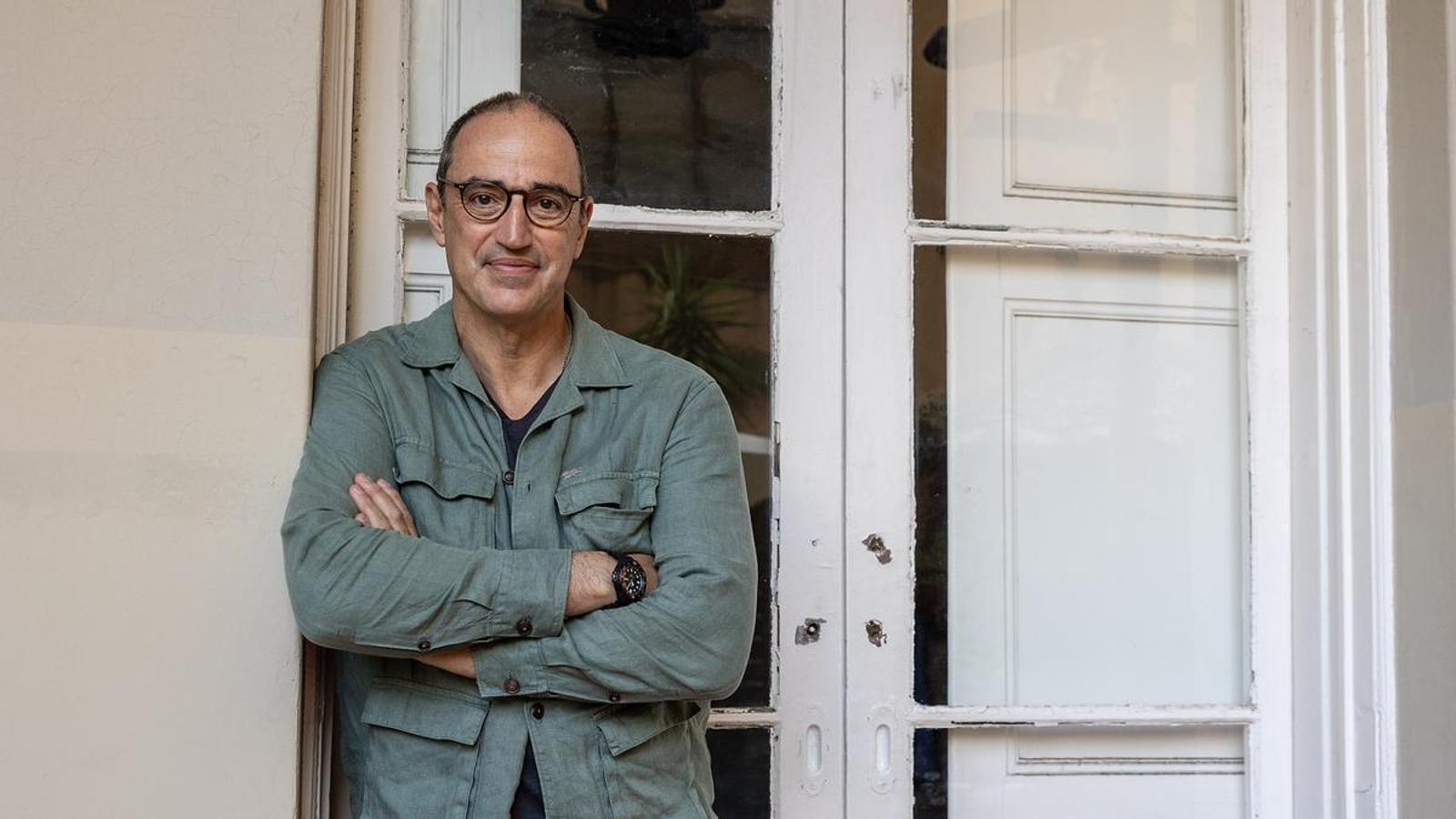
BarcelonaThe life of the economist, politician, and writer Antoni Vives (Barcelona, 1965) took a radical turn when, in 2018, he landed in Saudi Arabia to meet with the country's prince, Mohammed bin Salman, and the team with which he was preparing Vision 2030, which was to translate into the urbanization of a region in the middle of the desert "the size of Belgium" called Neom – which integrates the words new and future– to build "a city designed for nine million inhabitants" in the middle of the desert. He has now decided to explain the seven years he spent leading that mammoth project in a memoir literary and very interesting, In the secret country (Pòrtic, 2026), which does not hide the contradictions of an absolute monarchy guided by Sharia, capable of having a journalist critical of the regime murdered and dismembered as Jamal Khashoggi and which, at the same time, has the aspiration to modernize itself. Vives's own trajectory will surprise more than one reader. In addition to winning the Crexells prize with Farringdon Road's Dream (La Magrana, 2011) and the Bookseller with And tomorrow, paradise (RBA, 2014), has been deputy mayor for Urbanism between 2011 and 2015 at Barcelona City Council —during Xavier Trias's last term— and in 2022 was sentenced to two years in prison, settled with a compensation of 155,000 euros, for irregular contracting of the then mayor of Santa Coloma de Cervelló, Jesús Arévalo, by the entity Barcelona Regional, which Vives had chaired.
He arrived in Saudi Arabia after a few years working in India, an experience that inspired the novel "Shilpi's life (Univers, 2024).
— I settled in India to lead the transformation project of the city of Pune starting in 2016. I had been there for work before, when I was still at the Barcelona City Council, just as I had traveled to Russia, Colombia... When they called me from somewhere, they would arrange meetings with businessmen, mayors, and ministers, and I always told them the same thing: "First, you have to let me have a few days on my own. I want to see schools, hospitals, and markets. I need to get in touch with the neighborhoods."
In 2016, I worked for the consultancy McKinsey & Co. Was the work I did in Pune and, later, in Amaravati, India, good preparation for the trip to Saudi Arabia?
— At that time I couldn't know it, because I arrived there by chance, to do a favor for one of McKinsey's great partners, who asked me to. In Pune I had the good fortune to meet a municipal manager who was far ahead of his time. He understood that to improve life in the city we had to sit down and look. I'll give you just one example: in Indian cities there is terrible traffic, and Pune was no exception, until we realized that to decongest the center we could clean up and urbanize the nales – an open-air sewer system–, so that pedestrians and cyclists could use an alternative route.
What did he/she think of Saudi Arabia in 2018, when he/she arrived there?
— My first contact had been a little earlier, to do a gig there for the Ministry of Transport. It seemed to me that it was dreadfully hot there, and obviously alcohol could not be drunk... In 2018, at McKinsey they explained to me that in Saudi Arabia they were developing a project that was going to be big and that they were not yet entirely clear about. I was only supposed to go for a few weeks, but those conversations, which were supposed to last a short time, kept getting longer and more pleasant each time. Until they made me an offer to stay there.
Why did he/she/it accept it?
— In a meeting with the Minister of Economy, I understood that the project they were explaining to me was the corollary of many things I had intuited. On the one hand, I could delve deeply into Arab culture and Islam, which had always attracted me. In addition to intellectual compensation, there was the remuneration, which would be different from anything I had known before.
Was it a way, perhaps, to solve their life economically?
— This was more of a consequence. I wasn't thinking so much about that as about the possibility of entering a professional league that I knew existed but had never been a part of.
How would you describe this professional league?
— It allows you to enter a dimension in which fundamental aspects for all of us are decided. They go over our heads a lot, but they are not that far away either, because if I have been able to reach it, it means that many people have also achieved it. There are a few Catalans who are there, right now, in this league. When you find yourself there, you can see how reality is broadly shaped in the world. My objective was also to try to influence it positively.
His previous experiences were not bad at all: he had worked in India and as deputy mayor in Barcelona City Council.
— Saudi Arabia vaccinated me against the need to say that Barcelona is the center of the world and that the world is watching us. This is not true. The world does not watch us continuously, only from time to time. And yes, we have very good things, but we cannot remain in the usual complacency.
One of the virtues of Al país secret is that it reveals to us, from within, a reality we know little about. Besides trips to Petra and Leuke Kome and excursions to the Gulf of Aqaba, it explains coexistence with Saudi power through the long waits in the palaces of Riyadh and Jeddah.
— There were people who had a very bad time during these long waits. I settled in right away, perhaps because of this admiration for the oriental world that I had since I was little. Saudi Arabia has been the country that has welcomed me best, and I don't just say that because I had a very good job there, but above all because of its people. It is a place where you can walk through the middle of the desert and, from very far away, a family that only has a truck and a tent calls you to invite you for lunch.
The book narrates how his society is transforming. He says that Prince Mohammed bin Salman has to decide between acting fast like Napoleon or going at a slower pace like Deng Xiaoping. Why?
— Napoleon, who was of Corsican origin, needed to prove that he was more French than anyone, and he used absolute power to reform his country and alter the world order. Deng's strategy was different: even if he was as nationalistic as Napoleon, he knew how to understand that Chinese culture had deep rhythms that had to be respected in order to be more effective in advancing the human mass towards where he wanted them to go. Deng was an absolute visionary and I have had great admiration for him, although as a supporter of an autocratic regime he has things with which I cannot agree.
The fear of settling in a country where equality between men and women does not exist and where the regime could have a journalist like Jamal Khashoggi assassinated?
— I didn't feel fear, but I did feel a certain dissonance. A few months after I started working in Saudi Arabia, there was the assassination of Khashoggi. It was brutal... It helped me to process it by thinking, firstly, about the conversation I had had with the Minister of Economy. He asked me to think carefully before accepting the job, because I would see things I wouldn't like. He wasn't talking about things like this. The reaction within the country was, in many cases, one of desolation. I remember a dinner with the head of the most important business group in the country, and I emphasize the head, because she is a woman and not a man, as one might think. She was dismayed, but at the same time she didn't want to resign herself to thinking that evolution was not possible. I would say that the assassination of Khashoggi accelerated the changes in the country.
What role do women play in this change?
— Saudi Arabia's change looks like a young woman educated at Berkeley or Bartlett. If this change makes a dent in the country, it will drag the entire Arab world with it.
He ended up dedicating seven years to the Neom project, whose cherry on top is the creation of a large city, The Line.
— Prince Mohammed bin Salman always demanded that we go beyond expectations. He said not to bring him projects that might not work out entirely. It was then that we reconsidered an idea that had been thrown in the trash, that of the linear city that was to be 170 kilometers long, 200 meters wide, and 500 meters high at sea level, which emits no polluting gases and is designed to house nine million people. In one of the many meetings we had, I told the prince: "When I explain my idea to you, you might throw me out on the street."
But it didn't go like that.
— Either he kicked me out or we would end up working together for a long time, as eventually happened.
Why did he disassociate?
— In authoritarian regimes, politics does not function through parties, but through subterranean currents. When the prince could no longer pay as much attention to the Neom project, some ideas began to change: I always argued that the return on investment should not be based on the criteria of a fund but by considering its impact on GDP with a dual character, that is, as a return for the economy and society, but also in terms of national pride that Saudi Arabia wants to build as a complement to what Mecca and Medina represent. The other reason I left was to close a cycle of the project itself: during my tenure, we went from being 30 employees to over 125,000. There have been very tough and high-pressure moments.
A good part of these seven years has been spent in a provisional cabin, in the middle of the desert, working on site.
— We have lived for this, it has obsessed us and many of us have paid a personal price. Living in the middle of the desert allows you to understand monotheism. We Mediterranean people live surrounded by light, trees, and nature. The desert is different. When you are there, you understand Moses' dialogue with the burning bush that is not consumed. Also the miracle of seeing water gushing from under a rock. Furthermore, even if you think you are absolutely alone, there is always someone in the desert. And when that someone sees you, they will approach you with a smile and say "salamaleikum", which does not mean hello, but "may peace be with you".
